
Thursday, July 23, 2026
Home Blog Page 83

Myanmar military coup leader takes presidency to tighten grip on power

0
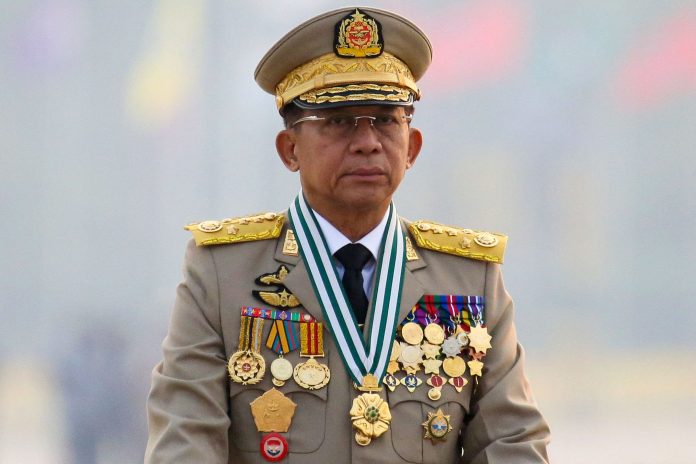
Myanmar military leader Min Aung Hlaing, who ousted the elected government in a 2021 coup, presides an army parade on Armed Forces Day in Naypyidaw on March 27, 2021. (Credit: Reuters)

Min Aung Hlaing, who as Myanmar ’s military commander had led the Southeast Asian nation with an iron fist since seizing power from Aung San Suu Kyi’s civilian government in 2021, was sworn in as an elected president on Friday.

His inauguration came after a general election judged by U.N. experts and rights groups to be neither free nor fair, with the National League for Democracy (NLD) party among many not taking part. He faces the major challenge of ending the civil war that began when he ousted the NLD and jailed its leader Aung San Suu Kyi.

The transition back to a nominally democratic government is widely seen as an effort to keep the army in power behind a facade of civilian rule.

Min Aung Hlaing’s ascent to the presidency follows a tradition of military strongmen installing themselves as the nation’s top leader and seeking to legitimize their rule through unfair elections.

He will be serving a five-year term after his April 3 election by parliament.

Most cabinet members also have military links

Twenty-eight of the 30 new cabinet members, also sworn in on Friday, are current or former generals, lawmakers from the military-backed Union Solidarity and Development Party (USDP), or members of the previous military government.

The pro-military bloc holds nearly 90 per cent of the seats in the Pyidaungsu Hluttaw, Myanmar’s bicameral legislature.

“Myanmar is back on the path to democracy and moving toward a better future,” Min Aung Hlaing, 69, said in a speech after being sworn in.

He also pledged to strive for peace with warring ethnic rebels and restore normal relations with the Association of Southeast Asian Nations (ASEAN), which has pressured Myanmar because of concern over its political instability.

Min Aung Hlaing took the oath of office alongside First Vice President Nyo Saw, a former general and close adviser to him, and Second Vice President Nan Ni Ni Aye, an ethnic Karen politician from the USDP, in the newly renovated parliament building in the capital Naypyitaw. It was damaged in last year’s earthquake.

Civil war prevented voting in some areas

The general election in December and January was widely criticized, in part because the polls were not held in large parts of the country due to the ongoing civil war.

“The junta’s elections were held in only 42 per cent of Myanmar’s territory, under a restrictive legal framework that barred legitimate political competition to the advantage and benefit of the military-aligned Union Solidarity and Development Party,” the Bangkok-based Asian Network for Free Elections (ANFREL) said in a report issued Friday.

“Every aspect of the staged elections, from its election management body to the design of the electoral system and the selection of political parties, was carefully engineered to ensure a predetermined outcome,” it said.

Min Aung Hlaing, who had attained the rank of senior general, last week relinquished his post of commander-in-chief because the constitution prohibits the president from simultaneously holding the top military position. A close aide, Ye Win Oo, took over the powerful job.

Major role in Rohingya crisis

In 2017, under the NLD government, Min Aung Hlaing oversaw a harsh counterinsurgency campaign against the Rohingya Muslim minority that drove hundreds of thousands into Bangladesh. The campaign was condemned internationally and some accused the army of being complicit in genocide.

Since the 2021 army takeover, nearly 8,000 civilians have been killed and some 22,208 political detainees remain jailed, according to the Assistance Association for Political Prisoners (AAPP), a rights monitoring group. Total deaths in the ongoing conflict are estimated to be much higher.

Aung San Suu Kyi, Myanmar’s 80-year-old former leader, is serving a 27-year prison term on charges widely viewed as spurious and politically motivated. Her NLD party won back-to-back landslide election victories in 2015 and 2020 against the USDP, but was forced to dissolve in 2023 after refusing to register under new military rules post 2021-coup.

AP
Only 12 percent of conscripts return home after two-year military service ends

0
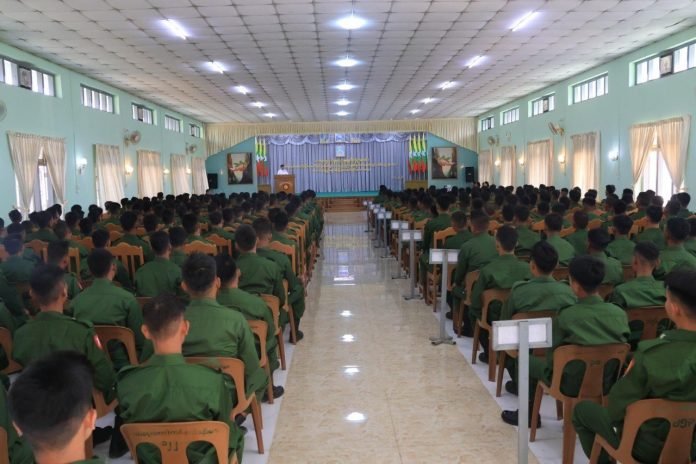
Conscripts from the first batch drafted into military service in 2024 during a ceremony marking the completion of their two-year service in Loikaw, Karenni State, on April 3. (Credit: Regime media)

An estimated 631 male conscripts from the first batch of 5,155 new recruits, who began training on April 8, 2024, have reportedly been allowed to return home after completing their mandated two years of military service under the regime’s conscription law, according to sources close to the regime.

Naung Yoe, a military defector who joined the Civil Disobedience Movement (CDM) after the 2021 military coup, told DVB that the number of those discharged is limited and as part of a “propaganda effort” by the regime in Naypyidaw.

“The low percentage of conscripts allowed to be discharged suggests that many were either forced to remain in the service or were killed in combat across the country,” said Naung Yoe, who is also a researcher from the Myanmar Defense & Security Institute (MDSI).

MDSI is a group of military defectors who track the regime’s human rights abuses on behalf of the CDM, which is the non-violent resistance movement opposed to a return to military rule in Myanmar.

“We believe that some of the survivors have been permitted to withdraw in order to be used for recruitment propaganda,” he added.

Those discharged after completing their two-years of military service included 385 conscripts in the Karenni State capital of Loikaw on April 3.

Another 246 were reportedly recalled from the “frontline” and sent back to their families on April 6, although pro-regime media did not disclose the locations or provide further details.

The conscription law, enforced on Feb. 10, 2024, requires a minimum of two years of service for males aged 18 to 35 and females aged 18 to 27. The first batch completed its term on April 8, according to MDSI.

A source close to a family with a son who was conscripted told DVB that the number discharged after completing their two-years of military service appears “incomplete,” leaving many families uncertain of the fate of their conscripted sons and brothers.

“Families don’t know whether their sons are dead or alive. They hear nothing back,” the source told DVB on the condition of anonymity. “The silence makes them believe the worst like their sons were killed.”

The regime said those who have completed training are now serving in military units nationwide, fulfilling what it described as their “responsibilities for national defence and security.” 

But it refuses to disclose how many conscripted males are serving in the military.

Nationwide conscription has now reached its 23rd round with the 21st round of conscripts reported to have completed training earlier this month, according to the regime.

MDSI estimates that the number of conscripts has reached nearly 100,000.

The regime stated in 2024 that around 5,000 conscripts would be drafted into the military per round, but the total number of conscripts in each intake has not been publicly disclosed.

Officially known as the “People’s Military Service Law,” conscription was enacted in 2010 under former military ruler Than Shwe.

Min Aung Hlaing Inaugurated Myanmar President [AUDIO]

0
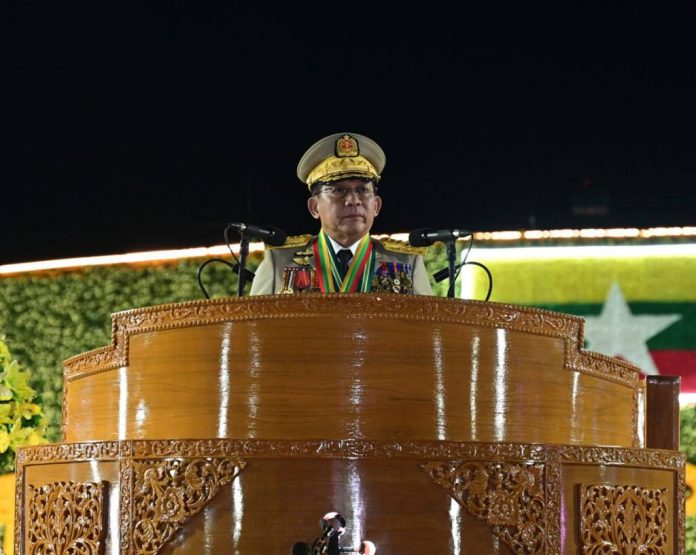
Min Aung Hlaing delivers a speech at the 81st Armed Forces Day in Naypyidaw on March 27. (Credit: Regime)

Myanmar’s junta leader Min Aung Hlaing was inaugurated as president on April 10 after shedding his military uniform and handing control of the military to a hand-picked successor following a highly criticized 2025-26 election.

In this video we explain the strategy behind Min Aung Hlaing’s transition from military leader to “civilian” president five years after leading the coup that ousted the National League for Democracy (NLD) government led by State Counsellor Aung San Suu Kyi and President Win Myint, who have been held in detention by the junta since Feb. 1, 2021.

Min Aung Hlaing Inaugurated Myanmar President [VIDEO]

0
Min Aung Hlaing delivers a speech at the 81st Armed Forces Day in Naypyidaw on March 27. (Credit: Regime)

Myanmar’s junta leader Min Aung Hlaing was inaugurated as president on April 10 after shedding his military uniform and handing control of the military to a hand-picked successor following a highly criticized 2025-26 election.

In this video we explain the strategy behind Min Aung Hlaing’s transition from military leader to “civilian” president five years after leading the coup that ousted the National League for Democracy (NLD) government led by State Counsellor Aung San Suu Kyi and President Win Myint, who have been held in detention by the junta since Feb. 1, 2021.

Myanmar president says challenges ahead, seeks to enhance relations 

0
Min Aung Hlaing delivers a speech at the 81st Armed Forces Day in Naypyidaw on March 27. (Credit: Regime)

Min Aung Hlaing, inaugurated as president on Friday after being appointed by a pro-military parliament on April 3, said that his new government has many challenges to overcome and ​would seek to enhance international relations and normalise ties ‌with the Association of Southeast Asian Nations (ASEAN).

In his inauguration address to parliament, Min Aung Hlaing said peace and democracy was his priority, and his ​government would spur foreign investment, develop agriculture and form ​effective, long-term strategic plans.

Min Aung Hlaing was voted president by ⁠a pro-military parliament a week ago following highly controversial elections held from Dec. 28, 2025 to Jan. 28. He’s formalising his grip on political power ​in Myanmar five years after he led a coup that ​sent the nation spiraling into chaos.

His carefully choreographed journey from top military general to “civilian” president follows a landslide victory by the military-backed ​Union Solidarity and Development Party (USDP) in the military’s polls, called a “sham” designed to perpetuate ​military rule behind a veneer of democracy.

The coup and ensuing crackdown under Min Aung Hlaing’s command led to an intervention by ASEAN, which later barred him and his military leadership from attending its summits.

“Myanmar is now well on ​its way toward ​democracy but ⁠the new government has a lot of challenges to overcome,” Min Aung Hlaing said in the ​speech in the capital Naypyidaw on April 10, which lasted less ​than 20 ⁠minutes and was attended by more than 50 foreign guests.

“The new government will implement a roadmap based on democracy and federalism … our ⁠priorities ​are democracy and peace.”

“We we will ​enhance international relations and strive to restore normal relations with ASEAN,” he later said.

REUTERS

Power cuts disrupt water supply in Yangon Region; Thailand urged to assist Myanmar Rohingya refugees

0
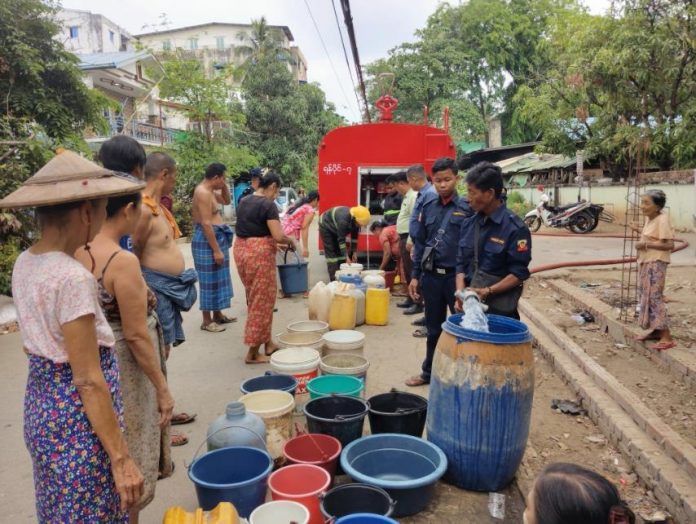
The Fire Services Department distributed water to residents in Thingangyun Township, Yangon Region, on April 7. (Credit: Fire Services Department)

Power cuts disrupt water supply in Yangon Region

Residents of Yangon Region told DVB that they’ve been struggling with water shortages due to “frequent” power outages, which started on March 18 and are expected to continue until the end of June. The regime’s Ministry of Electric Power reported that electricity will be distributed in two groups on a rotating four-hour schedule between 9 a.m. and 9 p.m. every day in Yangon Region.

“They say the power should come back at 5 p.m. but it doesn’t,” a resident in Mingalar Taungnyunt Township told DVB on the condition of anonymity, adding that residents must have power to pump water into their homes. Factory owners in Yangon told DVB that the ministry’s regular electricity supply, priced at 150–500 MMK ($0.03–0.11) per unit, is plagued by “frequent” power outages

A “24-hour” power supply at a rate of 900 MMK ($0.21 USD) per unit was introduced on Feb. 1. Burma consumes 4,664 megawatts of electricity per day but can generate only 3,600 MW—about 77 per cent of demand—according to the regime. The Fire Services Department stated that it has donated water to residents of Mayangone, North Dagon, Pazuntaung, Kungyangone, East Dagon, Kyimyindaing, Thingangyun and Sanchaung townships. 

Thailand urged to assist Rohingya refugees

Fortify Rights called on Bangkok to grant legal status and support third-country resettlement for Rohingya refugees who arrived in Thailand in February after being “forcibly” returned to Burma by Indian authorities in May 2025. It warned that they now face detention, extortion, and the risk of further displacement, describing their ordeal as “chain refoulement,” or repeated forced returns across countries.

“Rohingya refugees are being pushed from one danger to another,” stated Puttanee Kangkun, the director at Fortify Rights, in a press release on April 8. She wants Thailand to ensure lawful pathways to protection that respect refugee rights. Puttanee also demanded that India investigate and hold its officials accountable for the forced deportation and reported abuse of an unknown number of Rohingya refugees.

Over one million Rohingya, many of whom fled Burma military operations in 2017, live in refugee camps in Bangladesh’s Cox’s Bazar District, as well as in Malaysia, Thailand and Indonesia. An estimated 519,647 Rohingya remain in Arakan State, according to the U.N. In Burma, Rohingya face ongoing security risks and restrictions on basic rights, including freedom of movement and access to citizenship.

Min Aung Hlaing hands the ceremonial saber to Ye Win Oo, his replacement as the ninth commander-in-chief of the Myanmar military, at a ceremony in Naypyidaw on March 30. (Credit: Regime)

Who is Myanmar’s Commander-in-Chief Ye Win Oo?

The Myanmar Defense & Security Institute (MDSI) told DVB that the elevation of Ye Win Oo, from intelligence chief to become Burma’s new commander-in-chief, marks the first time in the country’s history that a “spymaster” and graduate of the Officers Training School (OTS) – instead of an alumni of the Defense Services Academy (DSA) – has risen to the top post in the military. 

“We saw him use various methods to dismantle opposition groups in order to consolidate and strengthen the political power of the regime. For example, he carried out suppressions against urban [underground] groups, tortured [members of] resistance groups, and violated human rights [at military interrogation centers],” Naung Yoe, the MDSI research officer, told DVB. 

Ye Win Oo oversaw the arrests of State Counsellor Aung San Suu Kyi and President Win Myint during the military coup on Feb. 1, 2021. He’s the chief of the Military Security Affairs Corps and the chief executive officer of the regime’s National Defence and Security Council (NDSC). He was appointed Chief of the Burma Army on March 2 and has held various military posts prior to the 2021 coup. Read more

News by Region

NAYPYIDAW—At least 50 regime staff have been “ordered” to participate on a rotating basis in the annual Thingyan Water Festival April 13-16, a source told DVB. A “Walking Thingyan” pavilion has been constructed in front of Naypyidaw City Hall, located along the Pyinmana-Taungnyo road.

The source told DVB on the condition of anonymity that each department of a regime ministry must arrange its own dancing troupe to perform during the festival. They were told to cancel their plans to visit their families due to this order to remain in the capital and participate in Thingyan.

SAGAING—A Buddhist monk and two women were killed in Shwebo Township’s Sinin village during airstrikes carried out by the Burma Air Force April 3-8. Eight civilians, including two girls, were injured at the monastery. Shwebo is located 57 miles (91 km) northeast of the region’s capital Monywa. 

Residents told DVB that two pagodas, 10 homes, a school, and an unknown number of shelters inside the monastery were destroyed. “Innocent civilians, monasteries, clinics, hospitals and schools are not military targets,” a People’s Defense Force (PDF) member told DVB. Read more

SHAN—Sources close to the Kachin Independence Organization (KIO) told DVB that Deputy Chairperson Gunmaw Sumlut met with leaders of the Myanmar National Democratic Alliance Army (MNDAA), the Ta’ang National Liberation Army (TNLA), and the Shan State Progressive Party (SSPP) last week.

Naw Bu, the KIO spokesperson, confirmed to DVB the meetings took place. The KIO ceased taxation at its checkpoints in Kutkai Township’s Namhpatkar village, which it seized in 2024, last month. The MNDAA seized Kutkai, 47 miles (75 km) north of the regional capital Lashio, from the TNLA on March 15

(Exchange rate: $1 USD = 4,150 MMK) 

Stay up-to-date with the latest on #WhatsHappeninginMyanmar by subscribing for free to the DVB English News Daily Briefing newsletter.

Contact