Thursday, July 23, 2026
Home Blog Page 87

Fourth Chiang Mai Ethnic Market celebrates New Year

0
The fourth edition of the Chiang Mai Ethnic Market was held at Lan Din Cafe in Chiang Mai, Thailand, April 4-5. (Credit: DVB)

The fourth Chiang Mai Ethnic Market was held under the theme “Traditional New Year and Water Festival: Foods and Cultures in Thailand and Myanmar” at Lan Din Cafe in Chiang Mai, Thailand, April 4-5.

The event highlighted the shared heritage of the annual water festival such as Thailand’s Songkran and Myanmar’s Thingyan, featuring cultural performances and intercultural dialogue before the traditional new year begins.

“Thingyan, or Songkran, or the water festival, is like the common theme that will bring about the new year, the new start, and also the family and friendship time. And this is a way of bringing more happiness to the communities,” Pi Ae, the organizer of the Chiang Mai Ethnic Market, told DVB.

Myanmar university students performed traditional Thingyan dance, and a Lanna New Year ceremony, such as pouring fragrant water into the palms of elders, asking for blessings, to offer blessings, emphasizing themes of respect, renewal, and community unity.

China welcomes Min Aung Hlaing as Myanmar president as genocide case is filed against him in Indonesia

0
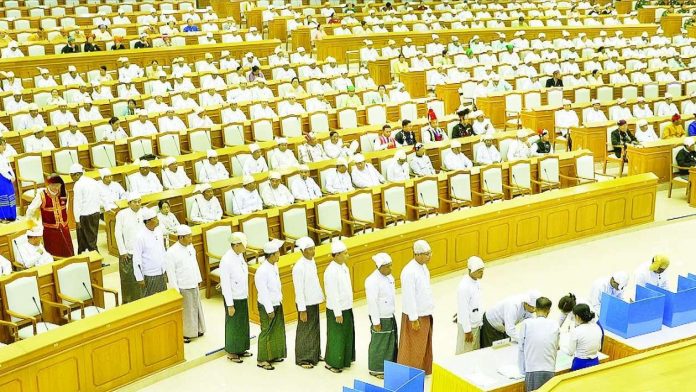
Pro-military lawmakers vote in the Pyidaungsu Hluttaw, or Union Parliament, to elect Burma's 11th president in the capital Naypyidaw on April 3. (Credit: Regime)

China welcomes Min Aung Hlaing as Myanmar president

Min Aung Hlaing was congratulated by China, Russia, Belarus and Nicaragua after his ascension to Burma’s presidency following a vote in the Pyidaungsu Hluttaw, Burma’s bicameral legislature, on Friday. Min Aung Hlaing led a military coup on Feb. 1, 2021 that ousted the democratically elected National League for Democracy (NLD) government and jailed State Counsellor Aung San Suu Kyi and President Win Myint.

China’s President Xi Jinping sent a congratulatory message to Min Aung Hlaing on April 3, stating that he is “willing” to work with Burma’s new president for the “benefits of the people of both countries and regional peace.” Deng Xijun, China’s Foreign Ministry Special Envoy for Asian Affairs, told a press briefing in Naypyidaw on Dec. 29 that Burma’s 2025-26 elections were an agreement between Min Aung Hlaing and Xi Jinping.

China’s Vice-President Han Zheng congratulated regime Prime Minister Nyo Saw and Union Solidarity and Development Party (USDP) lawmaker Nan Ni Ni Aye after being named vice-presidents on April 3. Amnesty International and Burma Campaign UK warned that Min Aung Hlaing becoming president won’t stop the International Criminal Court (ICC) issuing an arrest warrant requested by its Chief Prosecutor Karim Khan in November 2024. Read more

Stay tuned to DVB English News on YouTube for our feature video podcast explainer this Friday on how Min Aung Hlaing became president

Myanmar sailors await passage through the Strait of Hormuz

A Myanmar sailor whose ship has been anchored in the United Arab Emirates (UAE) told DVB that they have been instructed by the Emiratis to follow strict security guidelines while awaiting to cross the Strait of Hormuz from the Persian Gulf into the Gulf of Oman. Around 150 ships are anchored in the UAE awaiting passage, according to the sailor. 

“The [person who organizes the freight on the ship] has ordered our ship to wait,” a Myanmar sailor in the UAE told DVB on the condition of anonymity. Sailors are concerned about their ships being hit during the U.S. and Israeli airstrikes on Iran. Tehran blocked ships from entering the Strait of Hormuz on March 3 – three days after attacks began on Feb. 28.

The Strait of Hormuz is a critical maritime checkpoint, serving as a vital trade route for approximately 20 per cent of the world’s oil. It has been listed as a danger zone by the Joint War Committee (JWC) on March 11 due to the war in the region, which has led to higher security risks for maritime navigation. Read more

Yasmin Ullah, the co-founder of the Rohingya Maiyafuinor Collaborative Network, at a protest in Vancouver, Canada in 2019. (Credit: Al Ameen Post)

Genocide case filed against Min Aung Hlaing in Indonesia

The Myanmar Accountability Project (MAP), led by its executive director Chris Gunness, and Rohingya genocide survivor Yasmin Ullah will launch a criminal complaint under the legal principle of universal jurisdiction against Min Aung Hlaing on charges of genocide at the Prosecutor’s Office in Jakarta, Indonesia, today.

“I urge the Indonesian authorities to uphold the rule of law and hold the Myanmar dictatorship to account. The junta has become a regional embarrassment and this genocide case sends send a powerful signal that impunity for the crime of crimes must end,” Ullah, the co-founder of the Rohingya Maiyafuinor Collaborative Network, said on April 3. 

The criminal complaint was filed under the legal principle of universal jurisdiction, which allows national courts to prosecute individuals for the most serious international crimes, such as genocide, war crimes, and crimes against humanity, regardless of where the crime was committed or the nationality of the perpetrator and the victims. Read more

News by Region

CHIN—The Chin Human Rights Organization (CHRO) has documented that at least 19 civilians have been killed by 137 airstrikes carried out by the Burma Air Force across the state from Jan. 1 to March 31. A total of 42 others have been injured and 88 homes have been destroyed so far this year.

“Airstrikes have become the Myanmar military’s weapon of choice against civilians. Every bomb dropped on villages is enabled by the international supply chains that keep military aircraft in the air. Those supply chains must be shut down,” said Salai Za Uk Ling, the CHRO executive director.

KAREN—A Buddhist monastery was destroyed by airstrikes carried out by the Burma Air Force in Wawlay village, located in southern Myawaddy Township, on Friday, residents told DVB. Myawaddy is located along the Burma-Thailand border 81 miles (130 km) east of the state capital Hpa-An.

Myawaddy residents reported that there were no casualties. Everyone living in Wawlay had already fled their homes when the Karen National Liberation Army (KNLA) attempted to seize the regime’s Wawlay outpost on March 31. The battle for the control of the Wawlay outpost began in July 2025

MAGWAY—The People’s Defence Force (PDF) told DVB that at least six of its members were killed and 10 others were injured by airstrikes on an oilfield between Myaing and Pauk townships on Saturday. Myaing and Pauk, located 130-136 miles (209-218 km) north of the region’s capital Magway, are partially controlled by the PDF under the National Unity Government (NUG).

A PDF member in Myaing told DVB that members of the NUG and the interim Magway Federal Unit were meeting to discuss management over oilfields on April 4. The Magway Federal Unit is a local government formed by anti-regime forces and NLD lawmakers, ousted in the 2021 coup, in December. 

(Exchange rate: $1 USD = 4,160 MMK) 

Watch our latest Newsroom interview with Aung Ko Ko on DVB English News YouTube or Spotify. Listen wherever you get podcasts.

The day my university degree lost its meaning

0
Medical students from universities in Yangon, who joined the Civil Disobedience Movement, protest against the military coup in Yankin Township on Feb. 22, 2021. (Credit: MPA)

Guest contributor

Dr. Chin

When a university honors a general who destroyed its students’ future, it dishonors education itself

The day I heard that Min Aung Hlaing had been awarded an honorary doctorate by Yangon University, something inside me collapsed.

I did not cry. I did not speak. I simply stared at the news, unable to reconcile what I was seeing with the institution I once loved.

Yangon University was not just where I studied. It was where I became who I am.

I earned my doctorate there through years of sacrifice. I remember the exhaustion, the long nights surrounded by books, the quiet belief that education could shape not only my life, but the future of our country. 

I believed knowledge was sacred. I believed universities were sanctuaries of truth.

I believed education could protect us from darkness. I was wrong.

When the military seized power in February 2021, everything I had built—and everything I believed in—was shattered overnight.

At the time, I was serving as a civil servant in Myanmar’s education system. I had dedicated my life to teaching. 

My students were not just names on a list. They were young people full of intelligence, curiosity, and hope. They trusted us to prepare them for a future that was theirs to claim.

When the coup happened, I faced a choice.

To continue teaching under a regime built on violence and lies—or to refuse.

I joined the Civil Disobedience Movement, knowing full well what it would cost me. I lost my job. I lost my stability. I lost the life I had spent decades building.

But I could not lose my conscience.

Since then, I have lived in hiding inside Myanmar. I exist in the shadows of the country I once served openly. I move carefully. I speak cautiously. Fear has become part of daily life.

Not because I committed a crime—but because I refused to accept injustice.

Yet what haunts me most is not what I lost.

It is what my students lost.

They were young. Brilliant. Full of promise. They came to my classroom with dreams of becoming teachers, doctors, writers—builders of a better Myanmar.

Many of them joined the resistance after the coup.

Some were killed.

Some were forced into exile.

Some disappeared into prisons.

Some are still fighting.

And some will never return.

At night, their faces come back to me.

I see them as they were—alive, hopeful, smiling. Then I remember what was taken from them. I remember that the future they deserved was stolen before it could begin.

There is no greater pain for a teacher than to see her students’ lives cut short.

And now, the man responsible for their suffering stands in academic robes, receiving honors from the very institution that once stood for truth.

He presents himself as a patron of education.

But his army has bombed schools. His orders have turned campuses into places of fear.

His power has driven teachers into hiding and students into graves.

He did not build education. He destroyed it.

When I saw him receive that honorary degree, I felt something I never expected to feel toward Yangon University.

Shame. Not shame for myself—but shame for what the institution had become.

I looked at my own doctorate certificate, something I once treasured, and felt its meaning dissolve in my hands.

What does a degree represent when it can also honor a destroyer of lives?

What does academic recognition mean when it is given to legitimize oppression?

For the first time, I wondered whether my degree still held the dignity I believed it did.

Many of my colleagues feel the same.

We speak quietly, remembering the lives we once had. The classrooms we once filled. The future we once believed was within reach.

It feels like remembering another country.

The military wants us to accept this reality. They want us to believe that resistance is futile. That their authority is permanent.

But I refuse to accept that. Because education is stronger than fear.

Because truth is stronger than propaganda. Because the sacrifices of our students must mean something.

I continue to believe that one day, I will return to teaching—not in hiding, but in freedom.

I will stand in a classroom again, not under the shadow of violence, but under the protection of justice.

I will teach students who no longer have to choose between education and survival.

That day has not yet come.

The struggle continues. The cost is immense. Many of us carry grief that cannot be measured.

But we endure.

Because surrender would mean accepting the destruction of our nation’s future.

Min Aung Hlaing may hold an honorary degree.

But he will never hold legitimacy.

He may control universities.

But he cannot control the truth.

And one day, when Myanmar is free again, we will return—not in fear, but in dignity.

We will rebuild our classrooms.

We will honor those we lost.

And we will restore the meaning of education.


Dr. Chin is a pseudonym of an academic in Myanmar

DVB publishes a diversity of opinions that does not reflect DVB editorial policy. We’d like to hear what you think about this or any of our stories: [email protected]

Jue Jue’s Safe Space hosts fifth mental health conference

0
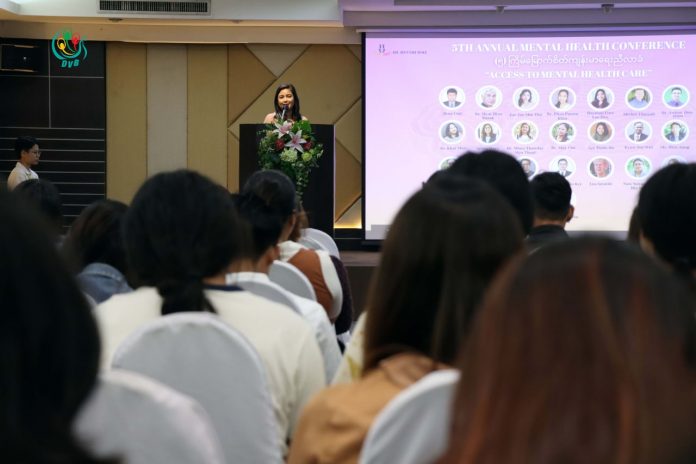
Jue Jue Min Thu, the founder of Jue Jue’s Safe Space Organization speaks at the fifth annual mental health conference in Chiang Mai, Thailand on April 3. (Credit: DVB)

Mental health professionals, activists, and educators convened at the 5th Annual Mental Health Conference in Chiang Mai, Thailand, April 2-3.

The event organized by Jue Jue’s Safe Space in partnership with the Foundation for Education and Development (FED) was called “Access to Mental Health Care.” 

Experts from the U.S., U.K., Norway, Germany, and Thailand joined the conference to bridge the gap between clinical practice and community-based healing.

“We need to connect these dots to work together for the common goal. Because, you know, together we’re stronger. So, therefore, we wanted to provide this mental health conference as a platform to share resources, to share ideas, programs, and services,” said Jue Jue Min Thu, the founder of Jue Jue’s Safe Space Organization, which provides mental health services to people from Myanmar.

Organizers told DVB that the conference focused on strengthening one-on-one mental health care, or “individual access,” ensuring support is available at the grassroots level, or “community access,” and addressing mental health at a systemic and policy level, or “national access.”

The funds raised from the event will be reinvested into Jue Jue’s Safe Space’s annual initiatives, which provide direct assistance to those in Myanmar most in need of mental health support.

Myanmar sailors await passage through the Strait of Hormuz

0
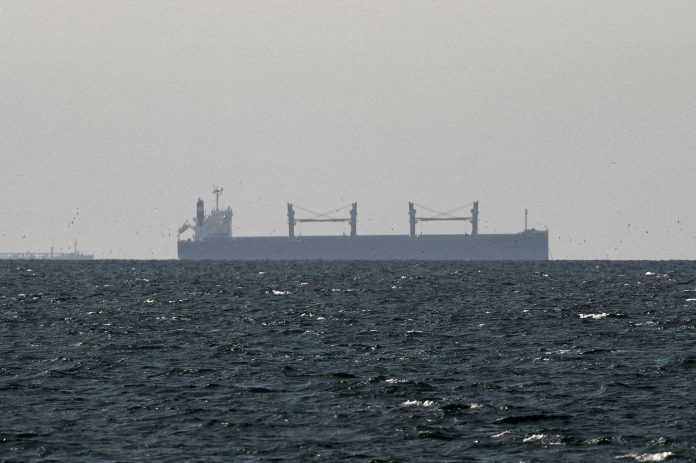
A cargo ship in the Gulf, near the Strait of Hormuz, in the United Arab Emirates, on March 11. (Credit: Reuters)

A Myanmar sailor whose ship has been anchored in the United Arab Emirates (UAE) told DVB on the condition of anonymity that they have been instructed by the Emiratis to follow strict security guidelines while awaiting to cross the Strait of Hormuz from the Persian Gulf into the Gulf of Oman. Around 150 ships are anchored in the UAE, according to the sailor. 

“The [person who organizes the freight on the ship] has ordered our ship to wait,” a Myanmar sailor in the UAE, told DVB on the condition of anonymity. 

Sailors are concerned about their ships being hit during the U.S. and Israeli airstrikes on Iran. Tehran blocked ships from entering the Strait of Hormuz on March 3 – three days after attacks began on Feb. 28, 2026. 

The Strait of Hormuz is a critical maritime checkpoint, serving as a vital trade route for approximately 20 per cent of the world’s oil. It has been listed as a danger zone by the Joint War Committee (JWC) on March 11 due to the war in the region, which has led to higher security risks for maritime navigation. 

There are an estimated 500 sailors from Myanmar working on ships awaiting passage through the Strait of Hormuz. 

The regime in Naypyidaw introduced fuel rationing on March 7, blaming disruptions to the global energy supply chain caused by escalating hostilities in the Middle East.

Examining India’s support for the Myanmar military

0
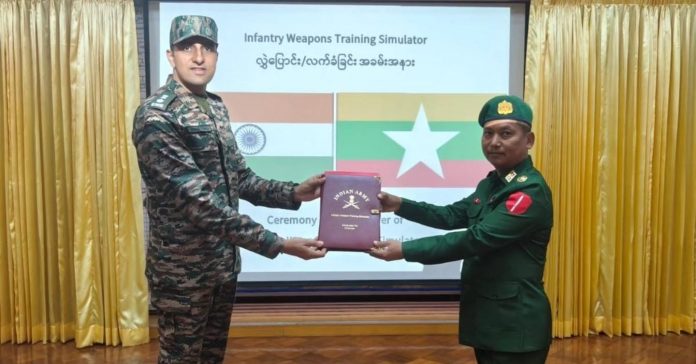
The Official Indian Army Facebook page shared this photo of an Indian Army Mobile Training Team from the Simulator Development Division installing a 12-Lane Infantry Weapon Training Simulator at the Myanmar Army Combat Forces School in Bahtoo, Shan State, on Feb. 9. (Credit: ADGPI - Indian Army)

Guest contributor

Shalini Perumal

On February 9, a shocking social media post by the Indian Army highlighted the successful installation and operationalization of a 12-Lane Infantry Weapon Training Simulator at the Myanmar Army Combat Forces School in Bahtoo, located in southern Shan State. 

The project, executed by the Indian Army Mobile Training Team from the Simulator Development Division, involved imparting comprehensive training to Myanmar Army personnel on system handling, simulated scenario execution, and technical maintenance. 

Promoted under the hashtags #DefenceCooperation and #IndiaMyanmarFriendship, the update showcased the ongoing military-to-military engagement between New Delhi and Naypyidaw.

However, against the backdrop of the 2021 military coup in Myanmar and the subsequent horrifying nationwide crackdown on civilians by the military junta, this continued defense cooperation has become a subject of intense international scrutiny. 

Leading human rights monitors, including Justice for Myanmar and Fortify Rights, alongside various United Nations mandate holders, have published highly critical assessments of these ties. 

They argue that by supplying military hardware, dual-use technology, and professional training to a regime accused of widespread atrocities, India is effectively undermining international humanitarian law and is complicit in war crimes.

Since seizing power from the democratically-elected government in 2021, the Myanmar military has engaged in a brutal campaign against ethnic resistance organisations and civilian populations. 

The U.N. and numerous independent watchdogs have extensively documented these actions, classifying them as crimes against humanity and war crimes.

International humanitarian law, primarily codified in the Geneva Conventions, establishes the rules of armed conflict. 

A cornerstone of this law is the Principle of Distinction, which mandates that armed forces must strictly distinguish between combatants and civilians, and between military objectives and civilian infrastructure. 

Furthermore, the Principle of Proportionality prohibits attacks where the incidental loss of civilian life would be excessive in relation to the concrete military advantage anticipated.

The Myanmar military has systematically violated these core tenets. Fortify Rights, for example, has documented repeated and deliberate airstrikes on civilian targets in Kachin, Chin and Karenni states, hitting schools, displacement camps, and hospitals. 

They argue these attacks often follow battlefield defeats, indicating collective punishment—a grave breach of international law. 

Because the military relies heavily on its air superiority and artillery to terrorise civilian populations, the international supply of arms, ammunition, and technical support is viewed by rights groups as directly enabling these atrocities.

Despite international calls for a comprehensive arms embargo, investigations by human rights groups reveal a steady flow of military equipment and support from India to the Myanmar military. 

Critics highlight that many of these transfers involve Indian Public Sector Undertakings (PSUs)—state-owned enterprises under the Ministry of Defence.

There are numerous instances of support documented by rights groups. 

An investigation by Justice for Myanmar has documented that BEL (an Indian state-owned aerospace and defense company) transferred over $5.1 million USD in military end-use equipment to the Myanmar military between November 2022 and April 2023. 

These shipments included metallic sonar domes, radar equipment, directing gear systems, and battlefield radio communications, often routed through known Myanmar arms brokers like Mega Hill General Trading.

Additionally, Justice for Myanmar reported that in January 2024, the Indian Air Force’s 31 Movement Control Unit shipped over 50 items—including sensors and thermometers categorized as “defense goods”—to the Myanmar Air Force in Yangon. 

This followed a December 2023 deployment of 15 Indian Air Force personnel to Myanmar to install meteorological instruments. 

Rights groups argue that automated weather stations provide critical data that improves the accuracy and operational effectiveness of the military’s indiscriminate airstrikes.

In October 2022, export records seen by Justice for Myanmar showed that the Indian state-owned arms company Yantra India Ltd shipped multiple 122-mm howitzer barrels to the Myanmar military. 

Similarly, Indian private firms like Sandeep Metalcraft have been identified as supplying fuses for munitions to the military.

The core critique leveled by human rights defenders is that India cannot claim ignorance regarding how its exported military goods and training are being utilised.

“The Indian government and its state-owned arms companies are continuing business as usual in Myanmar, equipping and profiting from the junta as it commits acts of terror against the people,” stated Yadanar Maung, a spokesperson for Justice for Myanmar, in a June 2023 press release. 

Under international legal frameworks, providing material support—whether it be howitzer barrels, radar technology, or infantry training simulators—with the knowledge that the recipient is engaged in systemic human rights violations can constitute “aiding and abetting” atrocity crimes.

Fortify Rights has also been highly critical of India’s active enablement of the military. 

In January 2023, following an airstrike on the headquarters of the Chin National Front that reportedly saw bombs drop near or within Indian territory, Fortify Rights publicly urged the Indian government to close its airspace to Myanmar fighter jets. 

They argued that tolerating these incursions and continuing to supply the military directly conflicts with India’s responsibility to protect civilians under international law.

From a diplomatic and strategic standpoint, foreign policy analysts often contextualize India’s continued engagement with the Myanmar military as a product of Realpolitik

New Delhi shares a porous 1,600-km-long border with Myanmar and relies on Naypyidaw’s cooperation to manage insurgent groups operating in India’s restive Northeast. 

Furthermore, India views maintaining a foothold in Myanmar as a vital strategic counterbalance to China’s deep economic and military influence in the region.

However, organizations like Justice for Myanmar and Fortify Rights wholly reject this geopolitical justification. They maintain that regional security concerns cannot override the absolute prohibitions of international humanitarian law. 

By hosting Myanmar military officials, conducting joint military exercises, and supplying them with both lethal and non-lethal military infrastructure, critics argue that India is bestowing unwarranted political legitimacy on an illegal regime.

The installation of an infantry training simulator at Bahtoo in the name of “Defence Cooperation” is a microcosm of a much larger, highly controversial relationship. 

While New Delhi may view its military exports and training programs as necessary instruments of regional statecraft and border security, human rights monitors see a different reality. Through the persistent documentation of arms transfers—from howitzer barrels and radar components to air force logistics and infantry training—human rights organisations make a forceful case that India’s policies are directly underwriting the military’s campaign of terror. 

As the conflict in Myanmar continues to devastate civilian lives, the calls for India to align its foreign policy with international human rights standards and enforce a comprehensive arms embargo remain as urgent as ever. 


Shalini Perumal is a creative international development professional who has worked previously in Mae Sot, Thailand at Mae Tao Clinic, consulted for Finnish Refugee Council Myanmar, and served as a Writer/Researcher at Insight Myanmar Podcast. She is currently a freelance journalist working on a novel.

DVB publishes a diversity of opinions that does not reflect DVB editorial policy. We’d like to hear what you think about this or any of our stories: [email protected]

Contact