
Thursday, July 23, 2026
Home Blog Page 88

Examining India’s support for the Myanmar military

0
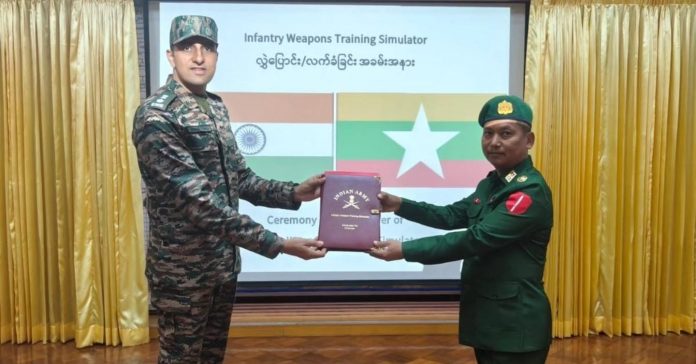
The Official Indian Army Facebook page shared this photo of an Indian Army Mobile Training Team from the Simulator Development Division installing a 12-Lane Infantry Weapon Training Simulator at the Myanmar Army Combat Forces School in Bahtoo, Shan State, on Feb. 9. (Credit: ADGPI - Indian Army)

Guest contributor

Shalini Perumal

On February 9, a shocking social media post by the Indian Army highlighted the successful installation and operationalization of a 12-Lane Infantry Weapon Training Simulator at the Myanmar Army Combat Forces School in Bahtoo, located in southern Shan State. 

The project, executed by the Indian Army Mobile Training Team from the Simulator Development Division, involved imparting comprehensive training to Myanmar Army personnel on system handling, simulated scenario execution, and technical maintenance. 

Promoted under the hashtags #DefenceCooperation and #IndiaMyanmarFriendship, the update showcased the ongoing military-to-military engagement between New Delhi and Naypyidaw.

However, against the backdrop of the 2021 military coup in Myanmar and the subsequent horrifying nationwide crackdown on civilians by the military junta, this continued defense cooperation has become a subject of intense international scrutiny. 

Leading human rights monitors, including Justice for Myanmar and Fortify Rights, alongside various United Nations mandate holders, have published highly critical assessments of these ties. 

They argue that by supplying military hardware, dual-use technology, and professional training to a regime accused of widespread atrocities, India is effectively undermining international humanitarian law and is complicit in war crimes.

Since seizing power from the democratically-elected government in 2021, the Myanmar military has engaged in a brutal campaign against ethnic resistance organisations and civilian populations. 

The U.N. and numerous independent watchdogs have extensively documented these actions, classifying them as crimes against humanity and war crimes.

International humanitarian law, primarily codified in the Geneva Conventions, establishes the rules of armed conflict. 

A cornerstone of this law is the Principle of Distinction, which mandates that armed forces must strictly distinguish between combatants and civilians, and between military objectives and civilian infrastructure. 

Furthermore, the Principle of Proportionality prohibits attacks where the incidental loss of civilian life would be excessive in relation to the concrete military advantage anticipated.

The Myanmar military has systematically violated these core tenets. Fortify Rights, for example, has documented repeated and deliberate airstrikes on civilian targets in Kachin, Chin and Karenni states, hitting schools, displacement camps, and hospitals. 

They argue these attacks often follow battlefield defeats, indicating collective punishment—a grave breach of international law. 

Because the military relies heavily on its air superiority and artillery to terrorise civilian populations, the international supply of arms, ammunition, and technical support is viewed by rights groups as directly enabling these atrocities.

Despite international calls for a comprehensive arms embargo, investigations by human rights groups reveal a steady flow of military equipment and support from India to the Myanmar military. 

Critics highlight that many of these transfers involve Indian Public Sector Undertakings (PSUs)—state-owned enterprises under the Ministry of Defence.

There are numerous instances of support documented by rights groups. 

An investigation by Justice for Myanmar has documented that BEL (an Indian state-owned aerospace and defense company) transferred over $5.1 million USD in military end-use equipment to the Myanmar military between November 2022 and April 2023. 

These shipments included metallic sonar domes, radar equipment, directing gear systems, and battlefield radio communications, often routed through known Myanmar arms brokers like Mega Hill General Trading.

Additionally, Justice for Myanmar reported that in January 2024, the Indian Air Force’s 31 Movement Control Unit shipped over 50 items—including sensors and thermometers categorized as “defense goods”—to the Myanmar Air Force in Yangon. 

This followed a December 2023 deployment of 15 Indian Air Force personnel to Myanmar to install meteorological instruments. 

Rights groups argue that automated weather stations provide critical data that improves the accuracy and operational effectiveness of the military’s indiscriminate airstrikes.

In October 2022, export records seen by Justice for Myanmar showed that the Indian state-owned arms company Yantra India Ltd shipped multiple 122-mm howitzer barrels to the Myanmar military. 

Similarly, Indian private firms like Sandeep Metalcraft have been identified as supplying fuses for munitions to the military.

The core critique leveled by human rights defenders is that India cannot claim ignorance regarding how its exported military goods and training are being utilised.

“The Indian government and its state-owned arms companies are continuing business as usual in Myanmar, equipping and profiting from the junta as it commits acts of terror against the people,” stated Yadanar Maung, a spokesperson for Justice for Myanmar, in a June 2023 press release. 

Under international legal frameworks, providing material support—whether it be howitzer barrels, radar technology, or infantry training simulators—with the knowledge that the recipient is engaged in systemic human rights violations can constitute “aiding and abetting” atrocity crimes.

Fortify Rights has also been highly critical of India’s active enablement of the military. 

In January 2023, following an airstrike on the headquarters of the Chin National Front that reportedly saw bombs drop near or within Indian territory, Fortify Rights publicly urged the Indian government to close its airspace to Myanmar fighter jets. 

They argued that tolerating these incursions and continuing to supply the military directly conflicts with India’s responsibility to protect civilians under international law.

From a diplomatic and strategic standpoint, foreign policy analysts often contextualize India’s continued engagement with the Myanmar military as a product of Realpolitik

New Delhi shares a porous 1,600-km-long border with Myanmar and relies on Naypyidaw’s cooperation to manage insurgent groups operating in India’s restive Northeast. 

Furthermore, India views maintaining a foothold in Myanmar as a vital strategic counterbalance to China’s deep economic and military influence in the region.

However, organizations like Justice for Myanmar and Fortify Rights wholly reject this geopolitical justification. They maintain that regional security concerns cannot override the absolute prohibitions of international humanitarian law. 

By hosting Myanmar military officials, conducting joint military exercises, and supplying them with both lethal and non-lethal military infrastructure, critics argue that India is bestowing unwarranted political legitimacy on an illegal regime.

The installation of an infantry training simulator at Bahtoo in the name of “Defence Cooperation” is a microcosm of a much larger, highly controversial relationship. 

While New Delhi may view its military exports and training programs as necessary instruments of regional statecraft and border security, human rights monitors see a different reality. Through the persistent documentation of arms transfers—from howitzer barrels and radar components to air force logistics and infantry training—human rights organisations make a forceful case that India’s policies are directly underwriting the military’s campaign of terror. 

As the conflict in Myanmar continues to devastate civilian lives, the calls for India to align its foreign policy with international human rights standards and enforce a comprehensive arms embargo remain as urgent as ever. 


Shalini Perumal is a creative international development professional who has worked previously in Mae Sot, Thailand at Mae Tao Clinic, consulted for Finnish Refugee Council Myanmar, and served as a Writer/Researcher at Insight Myanmar Podcast. She is currently a freelance journalist working on a novel.

DVB publishes a diversity of opinions that does not reflect DVB editorial policy. We’d like to hear what you think about this or any of our stories: [email protected]
International response to Min Aung Hlaing ascending to presidency in Myanmar

0
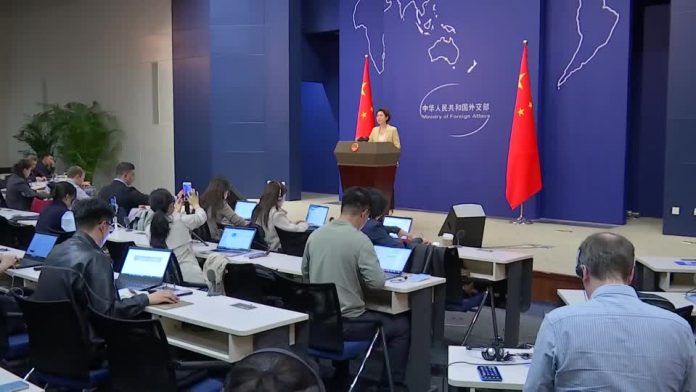
China's foreign ministry congratulated Myanmar’s Min Aung Hlaing on his election as the country's president on April 3. (Credit: Reuters)

China expressed its support to the new “government of Myanmar” in “maintaining national peace and stability,” and “achieving development and prosperity,” said Mao Ning, a Ministry of Foreign Affairs spokesperson, at a press briefing in Beijing on Friday.

Min Aung Hlaing, 69, won ‌a parliamentary vote on April 3 to become the president, formalising his grip on power in Myanmar five years after he ousted the country’s democratically-elected government led by Aung San Suu Kyi and sparked a nationwide uprising against a return to military rule. 

Aung San Suu Kyi, 80, and President Win Myint, 74, have been held in detention by Min Aung Hlaing since the military coup on Feb. 1, 2021

The journey from senior general to civilian president follows polls in December and January that were won in a landslide by the military-proxy Union Solidarity and Development Party (USDP), which was derided by critics and Western governments as a sham to perpetuate military rule behind a veneer of democracy.

“Min Aung Hlaing is a wanted criminal evading an arrest warrant in Argentina for his role in genocide against the Rohingya,” said Tun Khin, President of the Burmese Rohingya Organisation UK (BROUK), who filed a case in 2019 under the legal principle of universal jurisdiction in a court in Buenos Aires that led to arrest warrants for 25 senior Myanmar military and government officials, including Min Aung Hlaing.

“Just months ago, his military was forced to defend itself at the International Court of Justice. Any government that believes he can bring reform or change to Burma is deluding itself,” Tun Khin added.

The Myanmar military denied allegations of genocide during legal hearings in January at the International Court of Justice (ICJ). The ICJ case, brought by Gambia in 2019, accuses Myanmar of carrying out genocide against the Rohingya in Rakhine State during a military “security clearance” operation in 2017.

“If Min Aung Hlaing thinks that an official civilian title will shield him from prosecution… that is not how international justice works,” Joe Freeman, an Amnesty International researcher on Myanmar, said in a statement on April 3. 

Amnesty International and fellow advocacy group Burma Campaign UK warned that the appointment of Min Aung Hlaing as Myanmar’s president will not shield him from ongoing efforts to seek his arrest from the International Criminal Court (ICC). 

The ICC Chief Prosecutor Karim Khan requested a warrant on Nov. 27, 2024 for Min Aung Hlaing on crimes against humanity committed against the Rohingya in Rakhine State in 2016-17

“Those cases in the ICC and the ICJ are very slow, but they are actually moving in the right direction,” said Chris Gunness, the director of the Myanmar Accountability Project (MAP). “[We have ongoing] cases in the Philippines, in Timor-Leste, in Indonesia, and Turkey.”

The universal jurisdiction cases allow MAP and Myanmar civil society organisations to pursue justice for the people of Myanmar in national courts for serious international crimes such as genocide, war crimes, and crimes against humanity, regardless of where the crime was committed or the nationality of the perpetrator and the victims. 

Amnesty International called on the U.N. Security Council to refer Myanmar to the ICC, warning that failure to prosecute Min Aung Hlaing and other senior military officials would prolong the “cycle of impunity” that has lasted since the military first took power in 1962.

Min Aung Hlaing was replaced by Ye Win Oo as commander-in-chief on March 30. This allowed him to ascend to the presidency since the 2008 constitution stipulates that a military leader cannot legally hold the position of president of Myanmar at the same time.

All of these efforts at international justice aim to hold Min Aung Hlaing accountable for alleged genocide and other war crimes committed by the military under his command from 2011-26.

Rohingya genocide survivor files case against Min Aung Hlaing in Indonesia

0
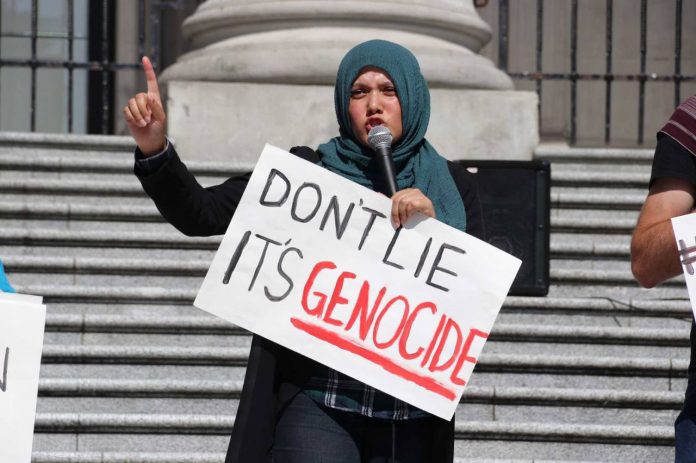
Yasmin Ullah, the co-founder of the Rohingya Maiyafuinor Collaborative Network, at a protest in Vancouver, Canada in 2019. (Credit: Al Ameen Post)

The Myanmar Accountability Project (MAP), led by Chris Gunness, and Rohingya genocide survivor Yasmin Ullah will launch a criminal complaint under the legal principle of universal jurisdiction against Myanmar regime leader and recently-elected President Min Aung Hlaing in Jakarta, Indonesia, on Monday.

“I urge the Indonesian authorities to uphold the rule of law and hold the Myanmar dictatorship to account. The junta has become a regional embarrassment and this genocide case sends send a powerful signal that impunity for the crime of crimes must end,” Ullah, the co-founder of the Rohingya Maiyafuinor Collaborative Network, said in a statement on Friday. 

The criminal complaint was filed under the legal principle of universal jurisdiction, which allows national courts to prosecute individuals for the most serious international crimes, such as genocide, war crimes, and crimes against humanity, regardless of where the crime was committed or the nationality of the perpetrator and the victims. 

“What brazen disdain for the wishes of the Burmese people and for the rule of law, that this mickey mouse dictator commits genocide against his own people while simultaneously claiming to be their president,” Gunness, the MAP director, said in the same statement on April 3.

Ullah, along with Indonesia’s former Attorney General Marzuki Darusman and nine Indonesian legal experts and civil society leaders, will file a criminal complaint alleging that Min Aung Hlaing bears responsibility for genocidal acts committed against Myanmar’s ethnic Rohingya nationality at the Prosecutor’s Office in Jakarta on April 6. 

Indonesia updated its penal code in January, which allows courts to exercise universal jurisdiction over serious international crimes such as genocide, regardless of where they were committed.  

Over one million Rohingya live in refugee camps in Bangladesh, according to the U.N. Over 700,000 arrived following a military “security clearance” operation in 2017, which was labelled a genocide by the U.S. government in 2022. 

The Myanmar military defended itself against allegations of genocide during legal proceedings in January at the International Court of Justice (ICJ). The ICJ case, brought by Gambia in 2019, accuses Myanmar of carrying out genocide against the Rohingya in Rakhine State during a military “security clearance” operation in 2017.

The International Criminal Court (ICC) Chief Prosecutor Karim Khan requested an arrest warrant be filed against Min Aung Hlaing for crimes against humanity committed against the Rohingya in Rakhine State in 2016-17 with the ICC Pre-Trial Chamber 1 on Nov. 27, 2024. 

An arrest warrant was issued by a court in Argentina for Min Aung Hlaing, along with 24 other senior Myanmar military and government officials, on Feb. 28, 2025. The case was filed by the Burmese Rohingya Organisation UK (BROUK) on Nov. 13, 2019 for genocide against the Rohingya under universal jurisdiction.

Timor-Leste’s judiciary opened legal proceedings on Feb. 2 against Min Aung Hlaing, and senior military officials, under universal jurisdiction for war crimes and crimes against humanity committed in Chin State since the 2021 military coup. 

This follows a previous attempt at filing charges against the 10 Myanmar military officials, including Min Aung Hlaing, under universal jurisdiction in the Philippines on Oct. 25, 2023.

The universal jurisdiction case in Indonesia – filed on April 6 – will be the fifth attempt by MAP and Myanmar civil society organizations to hold Min Aung Hlaing and senior military leaders accountable for crimes committed since the 2021 coup, whereas the ICJ and ICC cases are investigating crimes committed by the military prior to the coup.

Myanmar’s parliament elects ruling general as president, keeping the army in charge

0
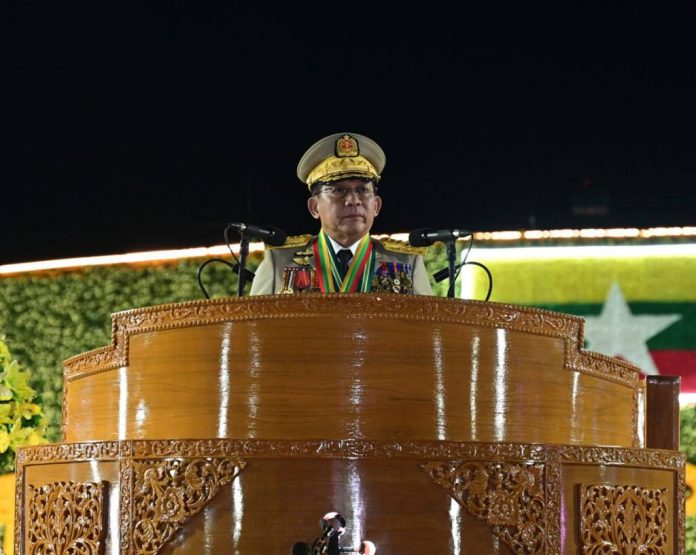
Min Aung Hlaing delivers a speech at the 81st Armed Forces Day in Naypyidaw on March 27. (Credit: Regime)

Myanmar’s parliament on Friday elected Min Aung Hlaing, a general who ousted Aung San Suu Kyi’s civilian government in 2021 and kept an iron grip on power for the past five years, as the country’s new president.

The move marks a nominal return to an elected government but is widely considered to be an effort to keep the army in power after an election organized by the military that opponents and independent observers deemed neither free nor fair.

Min Aung Hlaing was one of three nominees for the president’s post, but was virtually guaranteed the job as lawmakers from military-backed parties and appointed members from the army hold a commanding majority in parliament.

AP

Min Aung Hlaing elected president by Myanmar pro-military parliament

0
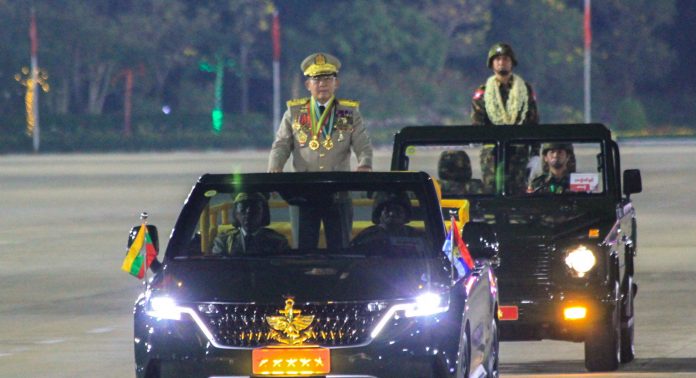
Myanmar's military regime leader Min Aung Hlaing participates in a parade commemorating the 81st Armed Forces Day in Naypyidaw on March 27. (Credit: Reuters)

Myanmar regime leader Min Aung Hlaing won ‌a parliamentary vote on Friday to become the country’s president, formalising his grip on political power in the war-torn nation five years after he ousted an elected government.

The 69-year-old general orchestrated a 2021 coup against the administration of Nobel Peace Prize winner Aung San Suu Kyi and placed her under arrest, sparking widespread ​protests that morphed into nationwide armed resistance against the military.

The transition from top general to civilian president follows a lopsided ​election in December and January that was won in a landslide by an army-backed party and derided ⁠by critics and Western governments as a sham to perpetuate military rule behind a veneer of democracy.

In a live broadcast of the ​vote count in a parliament dominated by the election-winning Union Solidarity and Development Party (USDP) and the military’s quota of appointed armed forces legislators, ​former commander-in-chief Min Aung Hlaing comfortably passed the threshold required to win the presidential vote.

‘Dreams becoming reality’

Min Aung Hlaing’s ascent to the presidency – a position that analysts say he has long sought – followed a major reshuffle in the leadership of Myanmar’s armed forces, which he had led since 2011.

On Monday, as ​he was nominated in parliament as a presidential candidate, Min Aung Hlaing anointed Ye Win Oo, a former intelligence chief seen as fiercely ​loyal to the general, as his successor to lead the military.

The military handover and Min Aung Hlaing’s rise to the presidency are seen by analysts ‌as ⁠a strategic pivot to consolidate his power as head of a nominally civilian government and earn international legitimacy, while protecting the interests of an armed forces that has run the country directly for five of the past six decades.

“He has long harboured the ambition to trade his title of commander-in-chief for president and it appears his dreams are now becoming a reality,” said Aung Kyaw Soe, an ​independent Myanmar analyst.

Civil war persists

Still, the ​civil war that has wrecked ⁠Myanmar for much of the last five years is raging, with some anti-military groups – including those comprising remnants of Suu Kyi’s party and longstanding ethnic minority armies – forming a new combined front this week ​to take on the military.

“Our vision and strategic objectives are to completely dismantle all forms of ​dictatorship, including the ⁠military dictatorship, and to collectively initiate a new political landscape,” the Steering Council for the Emergence of a Federal Democratic Union said in a statement on Monday.

Resistance groups could face intensified military pressure as well as increased scrutiny from neighbouring countries that may seek to bolster ⁠their relationship ​with Min Aung Hlaing’s new administration, analysts say.

“Amidst global oil and fuel shortages ​and economic crises, maintaining organisational stability could become difficult,” analyst Sai Kyi Zin Soe said of the opposition.

“As these hardships grow, it may become even harder to build ​mutual understanding and trust between groups, reach firmer agreements, and sustain cooperation.”

REUTERS

Can peace ever be achieved in Myanmar [AUDIO]

0
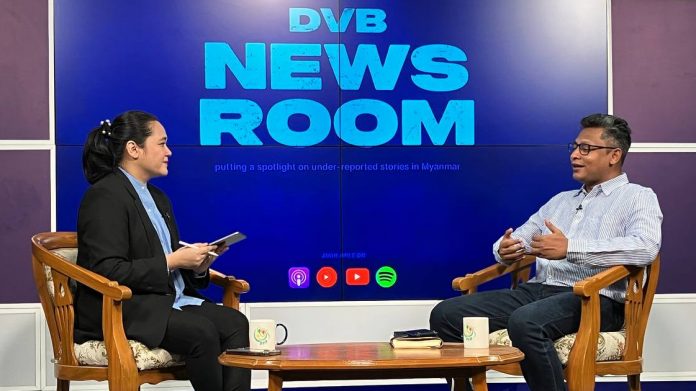
Aung Ko Ko, the executive director of Mosaic Myanmar, joined us in the DVB Newsroom on March 26. (Credit: DVB)

Aung Ko Ko, a peace building scholar-practitioner and the executive director of Mosaic Myanmar, joins us in the DVB Newsroom to discuss minority rights, inclusion, and social cohesion in the context of conflict and political transition.

Watch Newsroom on DVB English News YouTube or Spotify. Listen on Apple Podcasts, YouTube Music, Audible, Amazon Music, or wherever you get podcasts.

Contact