Thursday, July 23, 2026
Home Blog Page 89

Min Aung Hlaing elected president by Myanmar pro-military parliament

0
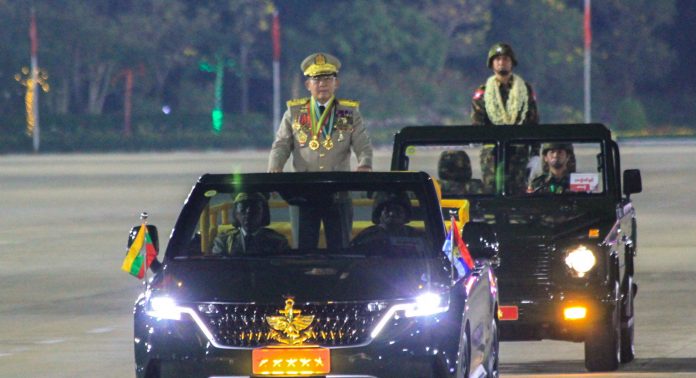
Myanmar's military regime leader Min Aung Hlaing participates in a parade commemorating the 81st Armed Forces Day in Naypyidaw on March 27. (Credit: Reuters)

Myanmar regime leader Min Aung Hlaing won ‌a parliamentary vote on Friday to become the country’s president, formalising his grip on political power in the war-torn nation five years after he ousted an elected government.

The 69-year-old general orchestrated a 2021 coup against the administration of Nobel Peace Prize winner Aung San Suu Kyi and placed her under arrest, sparking widespread ​protests that morphed into nationwide armed resistance against the military.

The transition from top general to civilian president follows a lopsided ​election in December and January that was won in a landslide by an army-backed party and derided ⁠by critics and Western governments as a sham to perpetuate military rule behind a veneer of democracy.

In a live broadcast of the ​vote count in a parliament dominated by the election-winning Union Solidarity and Development Party (USDP) and the military’s quota of appointed armed forces legislators, ​former commander-in-chief Min Aung Hlaing comfortably passed the threshold required to win the presidential vote.

‘Dreams becoming reality’

Min Aung Hlaing’s ascent to the presidency – a position that analysts say he has long sought – followed a major reshuffle in the leadership of Myanmar’s armed forces, which he had led since 2011.

On Monday, as ​he was nominated in parliament as a presidential candidate, Min Aung Hlaing anointed Ye Win Oo, a former intelligence chief seen as fiercely ​loyal to the general, as his successor to lead the military.

The military handover and Min Aung Hlaing’s rise to the presidency are seen by analysts ‌as ⁠a strategic pivot to consolidate his power as head of a nominally civilian government and earn international legitimacy, while protecting the interests of an armed forces that has run the country directly for five of the past six decades.

“He has long harboured the ambition to trade his title of commander-in-chief for president and it appears his dreams are now becoming a reality,” said Aung Kyaw Soe, an ​independent Myanmar analyst.

Civil war persists

Still, the ​civil war that has wrecked ⁠Myanmar for much of the last five years is raging, with some anti-military groups – including those comprising remnants of Suu Kyi’s party and longstanding ethnic minority armies – forming a new combined front this week ​to take on the military.

“Our vision and strategic objectives are to completely dismantle all forms of ​dictatorship, including the ⁠military dictatorship, and to collectively initiate a new political landscape,” the Steering Council for the Emergence of a Federal Democratic Union said in a statement on Monday.

Resistance groups could face intensified military pressure as well as increased scrutiny from neighbouring countries that may seek to bolster ⁠their relationship ​with Min Aung Hlaing’s new administration, analysts say.

“Amidst global oil and fuel shortages ​and economic crises, maintaining organisational stability could become difficult,” analyst Sai Kyi Zin Soe said of the opposition.

“As these hardships grow, it may become even harder to build ​mutual understanding and trust between groups, reach firmer agreements, and sustain cooperation.”

REUTERS

Can peace ever be achieved in Myanmar [AUDIO]

0
Aung Ko Ko, the executive director of Mosaic Myanmar, joined us in the DVB Newsroom on March 26. (Credit: DVB)

Aung Ko Ko, a peace building scholar-practitioner and the executive director of Mosaic Myanmar, joins us in the DVB Newsroom to discuss minority rights, inclusion, and social cohesion in the context of conflict and political transition.

Watch Newsroom on DVB English News YouTube or Spotify. Listen on Apple Podcasts, YouTube Music, Audible, Amazon Music, or wherever you get podcasts.

Can peace ever be achieved in Myanmar? [VIDEO]

0
Aung Ko Ko, the executive director of Mosaic Myanmar, joined us in the DVB Newsroom on March 26. (Credit: DVB)

Aung Ko Ko, a peace building scholar-practitioner and the executive director of Mosaic Myanmar, joins us in the DVB Newsroom to discuss minority rights, inclusion, and social cohesion in the context of conflict and political transition.

Watch Newsroom on DVB English News YouTube or Spotify. Listen on Apple Podcasts, YouTube Music, Audible, Amazon Music, or wherever you get podcasts.

Easter under fire: Religious freedom under assault in Myanmar

0
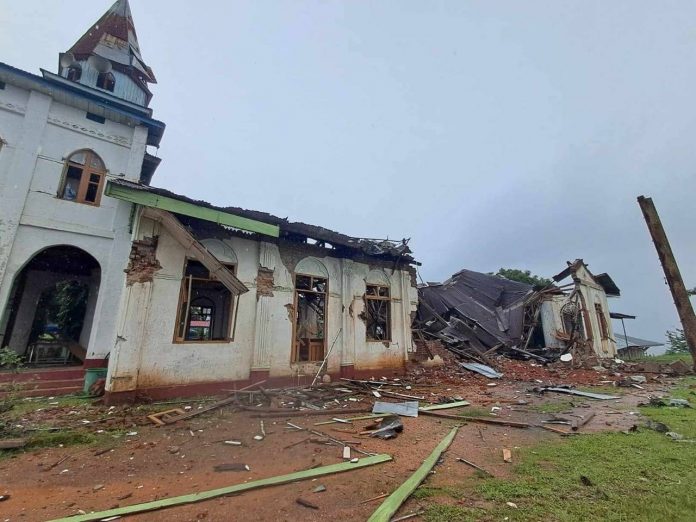
A church in Matupi Township, southern Chin State, destroyed by an airstrike on June 29, 2024. (Credit: CHRO)

Guest contributor

Salai Za Uk Ling

As Christians around the world prepare to celebrate Easter, many Christian communities in Myanmar are bracing for airstrikes.

On March 29, Myanmar’s military carried out airstrikes using two jet fighters on civilian homes in Kyaung Chaung village in Paletwa Township, killing seven Khumi Chin civilians and injuring four others. 

The targets were not military positions but residential homes. This attack was not an isolated incident.

In the first three months of 2026, the Chin Human Rights Organization (CHRO) has documented 137 airstrikes across Chin State, killing at least 19 civilians, injuring 42 and destroying 88 homes.

For many believers in Chin State, Easter no longer arrives only with prayer and reflection. It arrives with the sound of fighter jets overhead.

What is unfolding in Myanmar is not simply the tragedy of war. It is also a systematic assault on freedom of religion or belief, a fundamental right protected under Article 18 of the Universal Declaration of Human Rights.

Chin State is one of Myanmar’s most heavily Christian regions, where churches have long served as the center of community life. 

When churches are bombed or pastors arrested, the impact goes far beyond physical destruction. It strikes at the heart of communities and their ability to practice their faith freely.

Since the 2021 military coup, CHRO has documented more than 140 attacks on churches and religious infrastructure in Chin State alone. 

Churches have been burned, shelled or occupied by military forces. Pastors have been arrested, tortured or killed. Entire Christian communities have been forced to flee their homes.

Across Myanmar’s ethnic regions, similar patterns have emerged. Churches and religious buildings have been destroyed in Chin, Karenni, Karen and Kachin states. 

Religious sites have been damaged or repurposed for military use. Christian villages have been burned, forcing thousands of believers into forests and displacement camps.

Holy Week itself has not been spared.

In recent years, airstrikes have struck Christian communities during Easter week, killing civilians including a pastor and an infant as believers gathered for worship.

For persecuted Christians in Myanmar, Easter arrives not only with prayer, but with fear.

Yet the story of Myanmar’s Christians today is not only one of suffering. It is also one of courage.

Documenting violations of religious freedom

Across Myanmar’s ethnic regions, communities continue to document atrocities committed against them.

They do so because truth matters.

Local human rights defenders have transformed documentation into a powerful form of resistance. 

Evidence gathered on the ground exposes violations of religious freedom that might otherwise remain hidden from the world.

These efforts are also laying the groundwork for justice.

CHRO has worked with international partners to pursue accountability through universal jurisdiction cases against Myanmar military officials in the Philippines and Timor-Leste.

Justice, after all, should not stop at national borders.

Earlier this year, I traveled to Dili to engage civil society leaders and government officials about these legal efforts. 

I was honored to be received by President José Ramos-Horta, whose country’s own struggle for justice and freedom resonates deeply with the people of Myanmar.

Such solidarity matters profoundly to victims.

It reminds persecuted communities that they are not forgotten. It also sends a powerful message that impunity cannot last forever.

In Manila, we have also engaged church leaders and civil society groups to raise awareness about the persecution of Christians in Myanmar. 

During earlier visits, I had the privilege of meeting Catholic leaders including Pablo Virgilio S. David to discuss how faith communities can stand with those who suffer.

Faith communities have historically played an important role in defending freedom of belief and the dignity of the oppressed. Today that role remains as urgent as ever.

ASEAN and the protection of religious freedom

This year carries particular significance because the Philippines holds the chairmanship of the Association of Southeast Asian Nations (ASEAN). 

As chair, the Philippines helps shape the regional agenda and diplomatic response to Myanmar’s crisis.

For decades ASEAN has struggled to respond effectively to Myanmar’s crises. But the region now faces a defining moment.

Myanmar’s military is attempting to manufacture legitimacy through deeply flawed elections while continuing to bomb civilian communities across the country, including churches and other places of worship.

Violence must not be laundered through ballots.

Regional governments should speak clearly about the systematic violations of freedom of religion or belief taking place in Myanmar.

ASEAN member states should reject any attempt by the military to legitimize its rule while it continues to wage war against civilians and target religious communities.

They should also support accountability efforts, including universal jurisdiction cases brought by victims and civil society organizations.

Practical measures are urgently needed to restrict the flow of aviation fuel and weapons that enable airstrikes against civilian communities and religious sites.

Finally, ASEAN must strengthen engagement with Myanmar civil society organizations so that regional diplomacy reflects the voices of the people most affected by this crisis.

Hope amid persecution

Earlier this month I raised these concerns at the United Nations Human Rights Council in Geneva. 

During the session, the importance of accountability pathways including universal jurisdiction was recognized as an emerging avenue for justice for Myanmar’s victims.

This recognition offers hope.

But justice will require more than legal mechanisms. It will require sustained international attention to the systematic violations of religious freedom taking place in Myanmar.

For me, this appeal is deeply personal.

My grandfather was among the earliest converts to Christianity among the Chin people more than a century ago. 

Since then the church has stood at the heart of our communities, shaping our identity, our values and our hope.

Today those churches are under attack. Yet our faith remains unbroken.

Myanmar’s persecuted Christians are not passive victims. Communities continue to document atrocities committed against them. 

Civil society organizations pursue justice through international law. And believers across the country continue to worship despite the risks they face.

Easter reminds Christians that light can emerge even from the darkest moments.

“The light shines in the darkness, and the darkness has not overcome it.”

For the people of Myanmar, that hope now depends not only on faith, but also on the solidarity of the world.


Salai Za Uk Ling is executive director of the Chin Human Rights Organization, a nongovernmental organization established in 1995 to protect civilians, document atrocity crimes, and advance justice for the Chin people and other ethnic communities in Myanmar. He has a pending war crimes complaint against top officials of the Myanmar junta before the Philippine Department of Justice under the international humanitarian law.

DVB publishes a diversity of opinions that does not reflect DVB editorial policy. We’d like to hear what you think about this or any of our stories: [email protected]

Military retakes key town in Sagaing Region from PDF; UN draft resolution on human rights situation in Myanmar

0
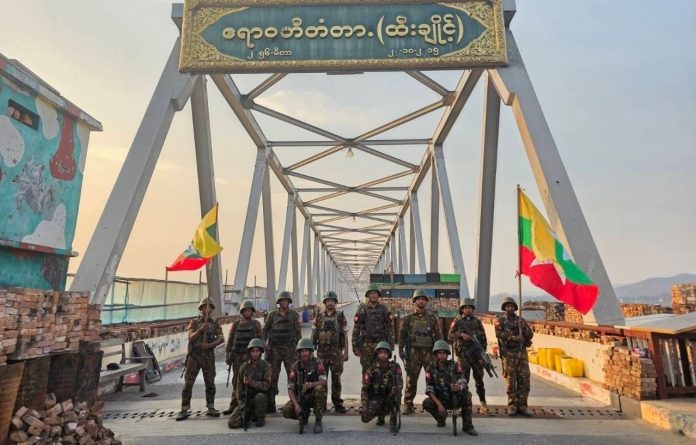
Regime forces on the Mandalay Region side of Tigyaing Bridge, which crosses the Irrawaddy River into neighbouring Sagaing Region, as its counteroffensive recaptures Tigyaing Township from resistance forces on March 26. (Credit: Pro-regime social media)

Military retakes key town in Sagaing Region from PDF

The People’s Defence Force (PDF) told DVB that fighting is still ongoing in the outskirts of Sagaing Region’s Tigyaing Township on Wednesday, despite the loss of the town to regime forces on March 26. Tigyaing, located 182 miles (292 km) northeast of the Sagaing Region capital Monywa, has been partially administered by the National Unity Government (NUG) since it was seized by the PDF in 2024. 

A PDF member said that they were “overwhelmed” by airstrikes carried out by the Burma Air Force and drone strikes carried out by the regime’s Unmanned Aerial Vehicles (UAV). Zin Yaw, a military defector, told DVB that if the regime regains control of the 58-mile (93 km) long Tigyaing-Katha road, it’ll be able to recapture Indaw town, 42 miles (67 km) north of Tigyaing. Indaw was seized by the PDF on April 7, 2025

Tigyaing, Katha and Indaw are located along the road connecting Mandalay to Kachin State’s Bhamo Township, where fighting between the Kachin Independence Army (KIA) and regime forces has been ongoing since 2024. Katha, 58 miles (93 km) north of Tigyaing, has been contested between the KIA and regime forces since December. Katha and Bhamo are 223-304 miles (359-489 km) north of Monywa and 214-278 miles (344-447 km) north of Mandalay. 

UN draft resolution on human rights situation in Myanmar

The U.K. issued a joint statement with the E.U. welcoming the draft resolution submitted to the U.N. Human Rights Council (HRC), on the “situation of human rights in Myanmar,” on Tuesday. The draft resolution, which was introduced during the 58th session of the HRC, states that Burma still constitutes one of “the worst-and most active-human rights crises” following the military coup on Feb. 1, 2021.

“The human rights crisis in Myanmar remains one of the most severe and urgent situations on our agenda, and the international community cannot look away,” said Eleanor Sanders, the U.K. human rights ambassador to the U.N., in a statement on March 31. “Recent military airstrikes, including in Rakhine, Magway and Sagaing, continue to destroy homes, religious sites and shelters for displaced communities.” 

The draft resolution highlights the fact that Min Aung Hlaing’s regime continues to attack civilians in communities nationwide by carrying out airstrikes. It outlined “effective and targeted action” to stop the military from being able to access weapons to be able to carry out these attacks and referenced the conscription law enforced on Feb. 10, 2024, which stipulates that all male citizens aged 18 to 35, and women aged 18 to 27, must serve at least two years in the military. Read more

Read our latest story on the new UN Special Rapporteur on the situation of human rights in Myanmar Kelley Anne Eckels-Currie

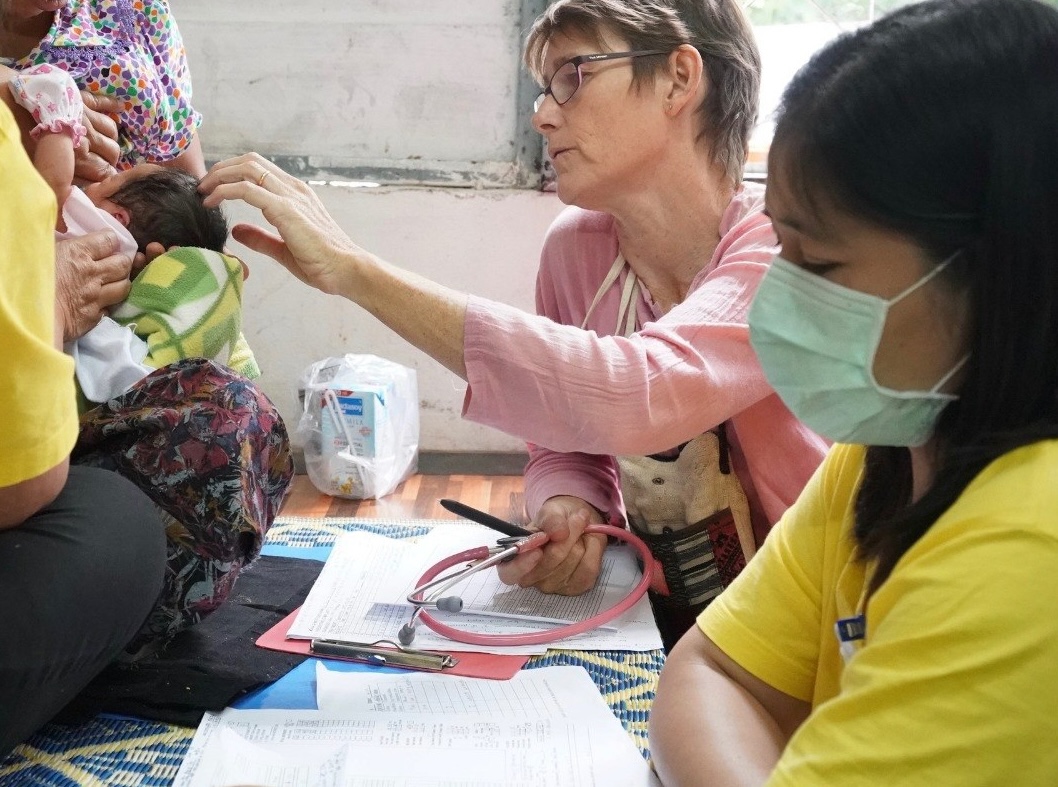
Dr. Rose McGready checks a mother with her newborn baby at Wang Pha clinic located along the Thailand-Myanmar border on an unknown date. (Credit: Dr Rose McGready Foundation)

Australian doctor serving Myanmar refugees wins national award

The Australian Embassy in Yangon announced on Monday that Dr. Rose McGready, who has provided healthcare to refugee communities along the Thailand-Burma border for over 30 years, was named Australian of the Year for 2026 by the National Australia Day Council (NADC), a not-for-profit social enterprise owned by the Australian Government.

The Australian Embassy in Yangon said in a social media post on March 30 that McGready, 61, has spent “more than 30 years training local staff to support women from Myanmar through childbirth in difficult conditions and to reduce malaria.” It added that McGready’s “commitment, compassion and clinical expertise provide life-saving aid to some of the most vulnerable communities in the world.”

McGready was born and raised in Canberra, Australia. In an award video released by the NADC, she said she only intended to volunteer as a doctor along the Thai-Burma border for six months. “I got spellbound by the local Karen and Burmese staff in the camps, thinking that I had something to offer,” she said. Read more

News by Region

ARAKAN—The Arakan Army (AA) announced that four members of a family, including two children, were killed and three others were injured in Thandwe Township during airstrikes carried out by four Burma Air Force jets on Wednesday. Thandwe, located 534 miles (939 km) south of capital Sittwe, was seized by the AA on July 16, 2024.

A resident of Thandwe told DVB on the condition of anonymity that a Burma Navy ship docked in the sea near the township also fired rounds into civilian areas. The AA claimed that regime forces continue to intentionally target civilians. It added that urgent medical treatment is being provided to those injured during the attacks. 

KAREN—The regime’s administration reopened the 27-mile (43 km) stretch of the Myawaddy-Kawkareik road along the Asia Highway, which connects the state capital Hpa-An to Myawaddy Township, along the Myanmar-Thailand border, with a ceremony on Thursday. 

Thamein Tun, an executive member of the Karen National Union (KNU), told DVB that regime forces might have made an agreement with the pro-military Karen Border Guard Force (BGF) to provide security along the Myawaddy-Kawkareik road. Read more

NAYPYIDAW—Regime media reported that five Burma nationals and five Chinese nationals were sentenced 10-15 years in prison on March 24 under the Anti-Trafficking in Persons Law. All 10 were arrested in March at their homes in Yangon’s Mingaladon Township and the Shan State capital Taunggyi. 

A legislative drafting committee was formed in Naypyidaw on March 14 to “prevent and suppress organized human smuggling and trafficking activities and networks,” according to the regime. Police are searching for three women from Yangon and Ayeyarwady regions in connection with this case. 

SAGAING—The PDF in Salingyi told DVB that one liter of gasoline costs between 11,000-20,000 MMK ($2.6-4.7 USD). These prices are more than double or triple the regime’s reference rates. Salingyi, located 27 miles (43 km) south of the region’s capital Monywa, is partially administered by the NUG. 

One litre of 92-octane gasoline increased 3,610-4,450 MMK ($0.80-1.05 USD) with 95-octane gasoline up 3,850-4,975 MMK ($0.90-1.10 USD). Diesel rose 4,390-5,450 MMK ($1-1.20 USD) with premium diesel 4,820-6,085 MMK ($1.10-1.40 USD) March 25 to April 2, according to the regime-controlled Petroleum Products Regulatory Department.

(Exchange rate: $1 USD = 4,310 MMK) 

Stay up-to-date with the latest on #WhatsHappeninginMyanmar by subscribing for free to the DVB English News Daily Briefing newsletter.

Myanmar’s middle class fuels Chiang Mai’s economy

0
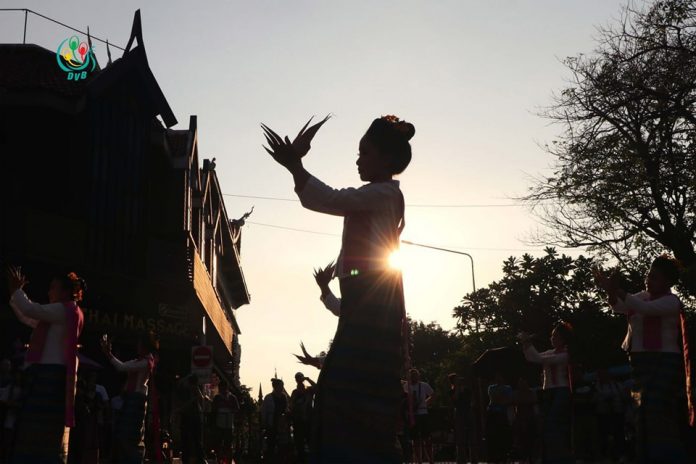
Dancers in Chiang Mai, Thailand, set a Guinness World Record for the largest traditional Thai dance to celebrate the city’s 729th anniversary at the Three Kings Monument on April 19, 2025. (Credit: DVB)

A new wave of middle-class migrants from Myanmar has boosted Chiang Mai’s economy, injecting capital into various service sectors, according to a research report by the Surin Pitsuwan Foundation.

The study by the Surin Pitsuwan Foundation finds that at least 6,000 Myanmar middle-class migrants have settled in Chiang Mai as of mid-2025, a sharp increase driven largely by political instability following Myanmar’s 2021 military coup and the enforcement of conscription laws in 2024.

Unlike earlier migration patterns dominated by low-skilled laborers, the new arrivals include educated professionals, entrepreneurs, students, and digital workers. Many hold university degrees and bring both financial resources and international experience.

“This is not traditional labor migration,” the report notes. “It is a form of semi-survival migration, where individuals seek stability and predictability rather than higher wages.”

Nearly half of those surveyed arrived between 2024 and 2025, coinciding with Myanmar’s enforcement of mandatory military service targeting young adults.

Chiang Mai, long a hub for cross-border migration due to its geographic proximity and cultural ties to Myanmar, has emerged as a preferred destination.

Its established infrastructure, international schools, private healthcare system, and diaspora networks have made it a sanctuary for those fleeing uncertainty.

Myanmar migrants are contributing significantly to Chiang Mai’s service-driven economy, which accounts for more than 70 per cent of the province’s gross product.

The city’s economy, valued at about 285 billion Thai baht ($8 billion USD), relies heavily on tourism, healthcare, and education — sectors where the new arrivals are increasingly active.

Researchers identified more than 110 new businesses with Myanmar partners established since 2021, mostly in food and hospitality. Openings peaked in 2024, aligning with increased outflows from Myanmar.

These enterprises largely reinvest locally, with more than 95 per cent of operational spending — including rent, utilities, and supplies — flowing back into the Thai economy.

Myanmar migrants are also emerging as a major consumer base. Private hospitals report that Myanmar nationals now account for up to one-third of international patients, while international schools are seeing rising enrollment from Myanmar families paying annual tuition fees of up to 500,000 Thai baht.

The report highlights widespread “brain waste,” with former doctors, engineers, and academics taking jobs in restaurants, small businesses, or freelance work due to licensing restrictions.

At the same time, legal uncertainty has fueled an informal economy. Some migrants report paying unofficial “protection fees” to avoid inspections, while others rely on costly brokers to navigate visa processes.

“Capital is leaking into informal channels rather than contributing to public revenue,” the study notes, adding that many migrants would be willing to pay higher formal taxes in exchange for legal security.

Thai stakeholders, including local businesses and officials, largely view the Myanmar middle class as an economic stabilizer. Their higher purchasing power and limited remittances mean much of their income remains within Thailand.

In sectors such as hospitality and co-working spaces, Myanmar entrepreneurs are seen as well integrated and beneficial to local supply chains.

The report argues that Thailand has an opportunity to harness this trend as part of a broader economic transition toward a knowledge-based economy, particularly as the country faces long-term labor shortages.

The World Bank projects Thailand could face as many as 14.4 million job openings by 2060, increasing reliance on migrant labor.

To maximize benefits, researchers recommend policy reforms including flexible visa pathways, recognition of foreign qualifications, streamlined business regulations, and stronger anti-corruption measures.

They also suggest positioning Chiang Mai as a regional hub for cross-border services and education, leveraging migrants’ transnational networks.

“If effectively integrated,” the report concludes, “this displaced population could become a strategic asset for Thailand’s long-term development.”

For now, Chiang Mai continues to serve as both a refuge and an economic engine — where political upheaval across the border is quietly reshaping the future of a Thai city.

ThaiPBS World

Contact