
Thursday, July 23, 2026
Home Blog Page 90

Myanmar’s middle class fuels Chiang Mai’s economy

0
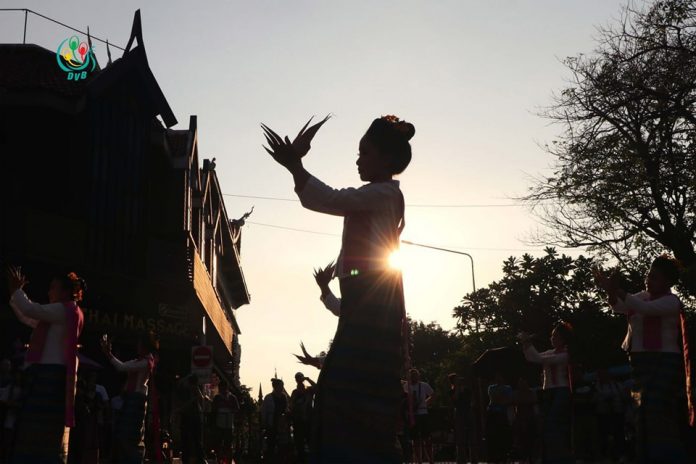
Dancers in Chiang Mai, Thailand, set a Guinness World Record for the largest traditional Thai dance to celebrate the city’s 729th anniversary at the Three Kings Monument on April 19, 2025. (Credit: DVB)

A new wave of middle-class migrants from Myanmar has boosted Chiang Mai’s economy, injecting capital into various service sectors, according to a research report by the Surin Pitsuwan Foundation.

The study by the Surin Pitsuwan Foundation finds that at least 6,000 Myanmar middle-class migrants have settled in Chiang Mai as of mid-2025, a sharp increase driven largely by political instability following Myanmar’s 2021 military coup and the enforcement of conscription laws in 2024.

Unlike earlier migration patterns dominated by low-skilled laborers, the new arrivals include educated professionals, entrepreneurs, students, and digital workers. Many hold university degrees and bring both financial resources and international experience.

“This is not traditional labor migration,” the report notes. “It is a form of semi-survival migration, where individuals seek stability and predictability rather than higher wages.”

Nearly half of those surveyed arrived between 2024 and 2025, coinciding with Myanmar’s enforcement of mandatory military service targeting young adults.

Chiang Mai, long a hub for cross-border migration due to its geographic proximity and cultural ties to Myanmar, has emerged as a preferred destination.

Its established infrastructure, international schools, private healthcare system, and diaspora networks have made it a sanctuary for those fleeing uncertainty.

Myanmar migrants are contributing significantly to Chiang Mai’s service-driven economy, which accounts for more than 70 per cent of the province’s gross product.

The city’s economy, valued at about 285 billion Thai baht ($8 billion USD), relies heavily on tourism, healthcare, and education — sectors where the new arrivals are increasingly active.

Researchers identified more than 110 new businesses with Myanmar partners established since 2021, mostly in food and hospitality. Openings peaked in 2024, aligning with increased outflows from Myanmar.

These enterprises largely reinvest locally, with more than 95 per cent of operational spending — including rent, utilities, and supplies — flowing back into the Thai economy.

Myanmar migrants are also emerging as a major consumer base. Private hospitals report that Myanmar nationals now account for up to one-third of international patients, while international schools are seeing rising enrollment from Myanmar families paying annual tuition fees of up to 500,000 Thai baht.

The report highlights widespread “brain waste,” with former doctors, engineers, and academics taking jobs in restaurants, small businesses, or freelance work due to licensing restrictions.

At the same time, legal uncertainty has fueled an informal economy. Some migrants report paying unofficial “protection fees” to avoid inspections, while others rely on costly brokers to navigate visa processes.

“Capital is leaking into informal channels rather than contributing to public revenue,” the study notes, adding that many migrants would be willing to pay higher formal taxes in exchange for legal security.

Thai stakeholders, including local businesses and officials, largely view the Myanmar middle class as an economic stabilizer. Their higher purchasing power and limited remittances mean much of their income remains within Thailand.

In sectors such as hospitality and co-working spaces, Myanmar entrepreneurs are seen as well integrated and beneficial to local supply chains.

The report argues that Thailand has an opportunity to harness this trend as part of a broader economic transition toward a knowledge-based economy, particularly as the country faces long-term labor shortages.

The World Bank projects Thailand could face as many as 14.4 million job openings by 2060, increasing reliance on migrant labor.

To maximize benefits, researchers recommend policy reforms including flexible visa pathways, recognition of foreign qualifications, streamlined business regulations, and stronger anti-corruption measures.

They also suggest positioning Chiang Mai as a regional hub for cross-border services and education, leveraging migrants’ transnational networks.

“If effectively integrated,” the report concludes, “this displaced population could become a strategic asset for Thailand’s long-term development.”

For now, Chiang Mai continues to serve as both a refuge and an economic engine — where political upheaval across the border is quietly reshaping the future of a Thai city.

ThaiPBS World
Chiang Mai tops global pollution rankings for fourth day

0
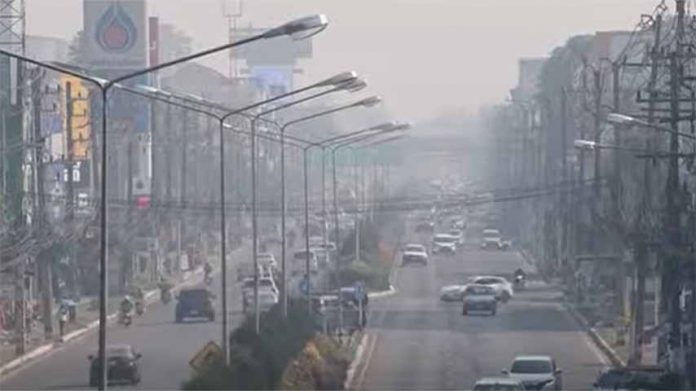
Air quality monitoring website IQAir reported that Chiang Mai, Thailand's second-largest city, reached a US AQI of 239, ranking it as the number one most polluted city in the world out of 120 major cities, on March 31. (Credit: DVB)

Thailand’s northern tourist destination, Chiang Mai, has remained the world’s most polluted city, with an AQI score of 227 for the fourth consecutive day on Wednesday, followed by cities in Pakistan and Myanmar.

A total of 324 villages and 27 communities in six districts of Chiang Mai province have been declared public disaster zones by the provincial administration due to the worsening PM2.5 pollution, which has reached 286 µg/m³ in Chiang Dao.

Chiang Mai Governor Ratthaphol Naradisorn said that not the entirety of the six districts — Hot, Samoeng, Chiang Dao, Doi Saket, Mae Taeng and Mae Wang — has been declared disaster zones, but only the areas affected by forest fires where efforts are being concentrated to address the problem.

He disclosed that 1,020 hotspots were detected in the province on Sunday, dropping to 355 the following day. He added that most hotspots were found at night and in the early morning.

Armed with this information, the governor said officials have adjusted fire containment plans by increasing forest patrols in the evenings, when hotspots begin to rise.

He also said local officials have been instructed to reach out to villagers, warning them not to start forest fires while hunting wild animals.

ThaiPBS World

Myawaddy–Kawkareik road on Asia Highway reopened in Karen State

0
The regime's Karen State administration reopened the Asia Highway connecting Myawaddy Township, located along the Myanmar-Thailand border, to the Karen State capital Hpa-An with a ceremony in Lunnya village on April 2. (Credit: CJ)

The regime’s Karen State administration reopened the 27-mile (43 km) stretch of the Myawaddy-Kawkareik road along the Asia Highway, which connects the Karen State capital Hpa-An to Myawaddy Township, along the Myanmar-Thailand border, with a ceremony on Thursday. 

Thamein Tun, an executive member of the Karen National Union (KNU), told DVB that regime forces might have made an agreement with the pro-military Karen Border Guard Force (BGF) to provide security along the Myawaddy-Kawkareik road.

He added that fighting between pro-regime and Karen National Liberation Army (KNLA)-led resistance forces is still ongoing in southern Myawaddy’s Wawlay town, as well as in the vicinity of Kawkareik and Kyondoe townships, 27-41 miles (43-66 km) west of Myawaddy.

Regime forces regained control of the Myawaddy-Kawkareik road from the KNLA in September. The road had been closed due to a military counteroffensive launched against the KNLA in December 2023. 

Kyondoe, Kawkareik, and Myawaddy are located 41-81 miles (65-130 km) southeast and east of the Karen State capital Hpa-An.

A truck driver in Karen State told DVB on the condition of anonymity that he still won’t travel along the road despite its reopening by the regime in fear of getting caught in a firefight between the KNLA and the military.

Sources close to the Karen State administration told DVB on April 2 that at least 600 cars and motorcycles had travelled along the road earlier in the day, but that no cargo trucks had yet driven along the reopened road.  

Cargo trucks had to use a secondary route, via mountain roads, to travel between Hpa-An and Myawaddy from 2023, according to drivers.

Myawaddy residents told DVB that the Myanmar-Thailand Friendship Bridge 2 has not yet been reopened. It was closed on Aug. 18 due to a regime crackdown on “illegal trade.”

Regime leader Min Aung Hlaing reportedly met with Ukris Boontanondha, the Chief of Defence Forces in the Royal Thai Army, in Naypyidaw on March 18. They reportedly discussed combatting illegal trade via the Myanmar-Thailand border.

Myanmar parliament to hold vote to elect president on Friday, house speaker says

0
Myanmar's regime leader Senior General Min Aung Hlaing participates in a parade commemorating the 81st Armed Forces Day in Naypyidaw on March 27. (Credit: Reuters)

Myanmar’s parliament will hold a bicameral vote to elect a president ​on Friday, house speaker Aung Lin Dwe said ‌on Thursday, with the country’s military regime leader Min Aung Hlaing in the running for the position.

The 69-year-old ​general, who led a 2021 coup that ​ousted the democratically elected government of Nobel laureate ⁠Aung San Suu Kyi and triggered a civil war, stepped ​down as Myanmar’s top military commander on Monday, after ​15 years in the position.

On the same day, a member of Myanmar’s lower house of parliament nominated him as a vice ​presidential candidate, alongside two other contenders put forward by ​the upper house and a block of military representatives in parliament.

A ‌joint ⁠meeting of both houses, including the military-appointed lawmakers, will be held at 10.00 a.m. local time (0330 GMT) on Friday to elect a president from among those ​three vice presidential ​candidates.

“The three ⁠candidates selected by their respective groups meet the necessary qualifications,” Aung Lin Dwe ​said, according to parliamentary proceedings broadcast on ​regime-controlled ⁠media.

The move follows a controversial election held in December and January that was won by a military-backed Union Solidarity and ⁠Development ​Party (USDP) but widely derided as ​a sham by the United Nations and many Western countries.

REUTERS

UN appoints new Special Rapporteur on the situation of human rights in Myanmar

0
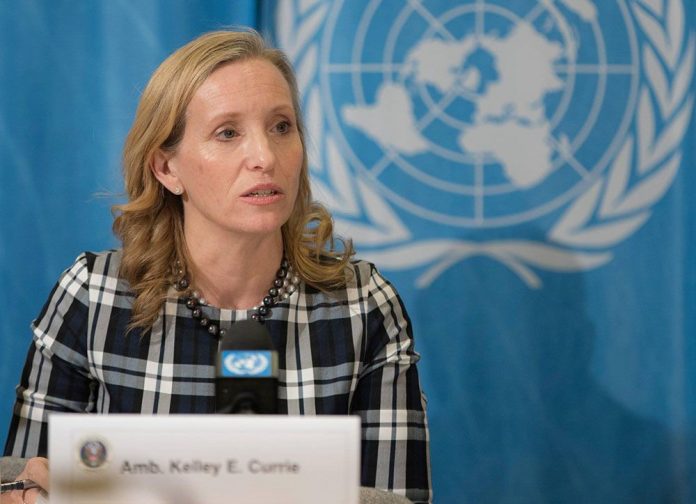
U.S. diplomat Kelley Currie condemned China's mass detention of Muslims in Xinjiang on March 14, 2019. (Credit: UN)

The U.N. Human Rights Council (HRC) appointed Kelley Anne Eckels-Currie as the new Special Rapporteur on the situation of human rights in Myanmar to replace Tom Andrews, who served in the role from 2020-26, during its 61st regular session in Geneva, Switzerland, on Tuesday.

“Big congrats to Kelley Currie… She is uniquely positioned to fulfill this role,” Matthew Smith, the founder and CEO of Fortify Rights, shared on social media. Smith added that Currie would bring a “longstanding commitment to truth and justice” to the role.

The HRC extended the mandate of the U.N. Special Rapporteur on Myanmar for one year, meaning Currie will likely only serve in the role until April 2027, but this is subject to the standard annual renewal process for country-specific mandates.

“The Council decides to extend the mandate of the Special Rapporteur on the situation of human rights in Myanmar for a further period of one year… to make recommendations on additional steps necessary to address the ongoing crisis,” the HRC stated in a report following the conclusion of its 61st session on April 1. 

The HRC 61st session, which began on Feb. 23, is a six-week period of debates, panel discussions, and reviews of human rights situations globally.

The Chin Human Rights Organization (CHRO) shared its congratulations to Currie on social media, stating that it looked forward to her leadership and continued international efforts toward justice and accountability for the people of Myanmar.

Currie has worked for over 30 years focusing on Myanmar’s political and human rights situation. She previously served as U.S. Ambassador-at-Large for Global Women’s Issues and as the U.S. representative to the U.N. Economic and Social Council (ECOSOC).

She is also the founder of the Burma Transition Initiative at the Project 2049 Institute, where she documented the Myanmar military’s impact on civilian governance.

Since the military coup on Feb. 1, 2021, Currie has focused her efforts on justice and accountability mechanisms and has briefed international agencies on violence against civilians and resistance groups opposed to the coup.

Currie is the seventh human rights expert to hold this role since 1992, a mandate the U.N. created only for countries with “serious or systematic human rights violations.” 

Her predecessors include Thomas Andrews 2020-26; Yanghee Lee 2014-20; Tomás Ojea Quintana 2008-14; Paulo Sérgio Pinheiro 2000-08; Rajsoomer Lallah 1996-2000; and Yozo Yokota 1992-96.

The mandate on Myanmar was established in 1992 following three decades of human rights concerns following the 1962 military coup, which replaced parliamentary democracy with military dictatorship. 

Violations escalated during the 1988 nationwide pro-democracy uprising, known as the ‘8888 Uprising,’ when the military killed thousands of peaceful pro-democracy protesters and detained emerging political leaders, including National League for Democracy (NLD) party co-founder Aung San Suu Kyi, who went on to win the Nobel Peace Prize in 1991 for her non-violent activism.

The U.N has since documented a pattern of abuses, including the violent suppression of the peaceful protests during the 2007 Saffron Revolution, as well as the 2016-17 military “security clearance” operations in Rakhine State targeting members of the ethnic Rohingya nationality, which is now being investigated by the International Criminal Court (ICC) for crimes against humanity. 

A case against Myanmar for alleged genocide against the Rohingya was opened in 2019 at the International Court of Justice (ICJ), the U.N.’s top court. In 2022, the U.S. declared the Myanmar military had, in fact, committed genocide against the Rohingya in 2017.

Following the 2021 coup, reports of human rights violations have intensified, including the use of lethal force against protesters, arbitrary arrests, and mass displacement as the nationwide uprising against a return to military rule began.

The U.N. reports that at least 6,764 civilians have been killed since the 2021 coup. The Armed Conflict and Location Event Data (ACLED) Project estimates that at least 93,000 have been killed over the last five years.  

The U.N. Special Rapporteur is an independent expert appointed by the HRC and is not a U.N. staff member or salaried position, a structure intended to ensure neutrality and independence.

The role includes conducting independent investigations, reporting findings to the HRC and the General Assembly, and providing recommendations to the international community on how to address crises in the countries the special rapporteur is assigned to monitor.

UK and EU welcome UN draft resolution on human rights in Myanmar

0
Eleanor Sanders took up the post as Ambassador for Human Rights and Deputy Permanent Representative to the U.N., in August 2024. (Credit: UK)

The U.K. issued a joint statement with the E.U. welcoming the draft resolution submitted to the U.N. Human Rights Council (HRC), on the “situation of human rights in Myanmar,” on Tuesday.

“The human rights crisis in Myanmar remains one of the most severe and urgent situations on our agenda, and the international community cannot look away,” said Eleanor Sanders, the U.K. human rights ambassador to the U.N., in a statement on March 31. 

The draft resolution, which was introduced during the 58th session of the HRC, states that Burma still constitutes one of “the worst – and most active – human rights crises” five years after the military coup on Feb. 1, 2021 that ousted the democratically-elected government led by Aung San Suu Kyi’s National League for Democracy (NLD) party

“Recent military airstrikes, including in Rakhine, Magway and Sagaing, continue to destroy homes, religious sites and shelters for displaced communities,” added Eleanor Sanders in her statement, which also called for accountability in Burma, the protection of civilians, and unrestricted access for aid due to the “spiralling humanitarian crisis.”  

The draft resolution highlights the fact that the military regime led by Min Aung Hlaing, who seized power during the 2021 coup in Naypyidaw, continues to use its forces to attack civilians in communities nationwide, especially through the use of indiscriminate airstrikes. 

It outlined “effective and targeted action” to stop the military from being able to access weapons to be able to carry out these attacks and referenced the conscription law enforced on Feb. 10, 2024, which stipulates that all male citizens aged 18 to 35, and women aged 18 to 27, must serve at least two years in the military.

The U.K. expressed its support for urgent implementation of the Association of Southeast Asian Nations (ASEAN) Five-Point Consensus, which is a peace plan agreed to by Min Aung Hlaing in April 2021 but not implemented upon his return to Burma.

It called for closer cooperation between ASEAN and the U.N., including through their respective special envoys to Burma: ASEAN 2026 Chair The Philippines’ Theresa Lazaro and the U.N. Secretary-General’s Julie Bishop. 

The U.N. Office for the Coordination of Humanitarian Affairs (OCHA) reported on March 9 that 73,350 civilians have been displaced from their homes due to conflict in Burma in the first two months of 2026

The U.N. estimates that over 3.7 million people are displaced from their homes nationwide and listed as Internally Displaced Persons (IDPs).

Contact