


Guest contributor
Sai Tun Aung Lwin
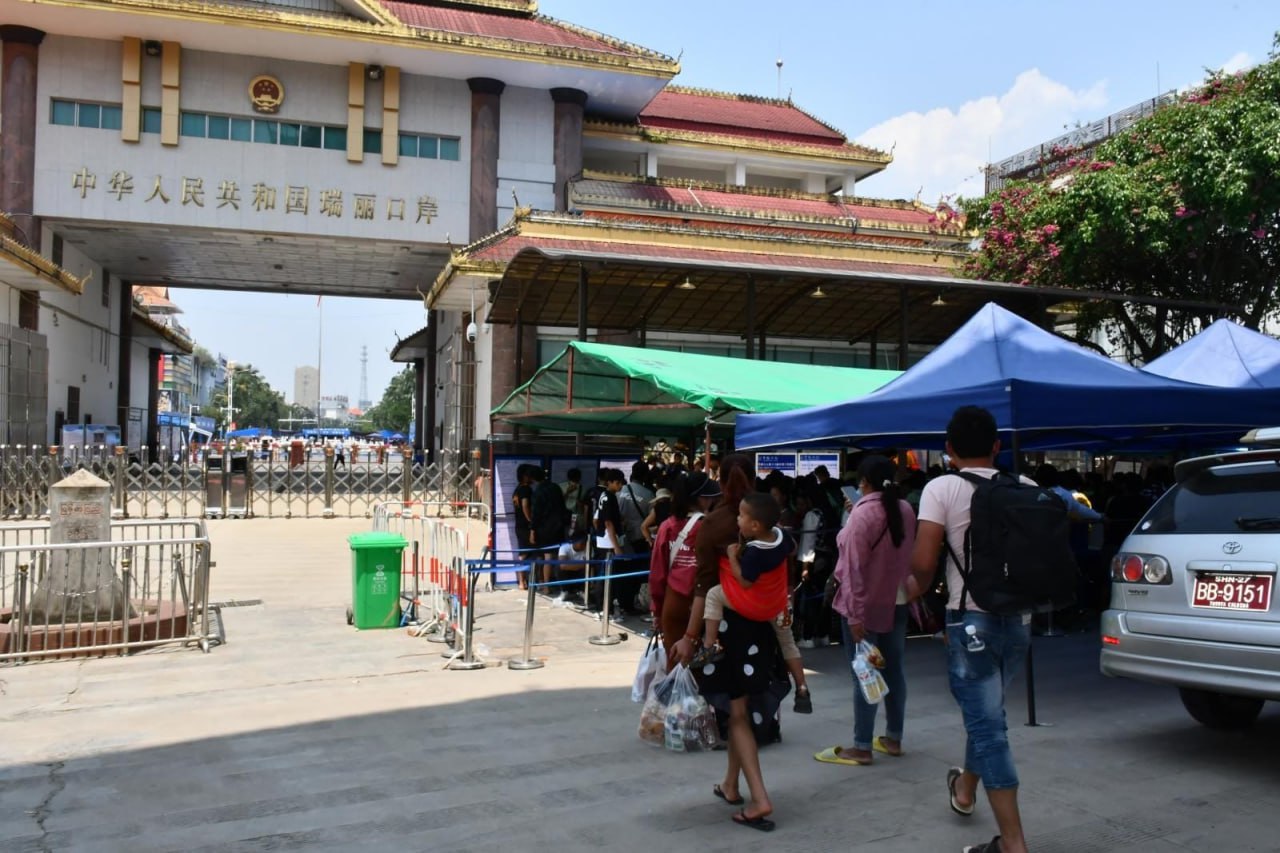
Dehong is an autonomous prefecture in Yunnan Province of China, home to the Dai (Tai/Shan) and Jingpo (Kachin) ethnic communities. Mangshi is the prefectural capital, and Ruili is a key border trade town.
The Dehong region holds strategic importance for China–Myanmar cross-border trade and ethnic relations. On the Myanmar side, Muse is the country’s major land trade gateway and it sits directly across from Ruili.
As China’s assertive foreign engagement grows, including forms of interference in Myanmar, local governments along the China–Myanmar border are preparing to resume strategic ties, particularly in trade, commerce, and infrastructure. Trade and commerce are seen as top priorities in this push for re-engagement.
However, nearly all China–Myanmar border trade routes have been disrupted due to conflict within Myanmar. Since Operation 1027 began on Oct. 27, 2023, most major border transit points—including those bordering in the Denghong region of Yunnan—have fallen under the control of various ethnic armed groups, with only a few gates in Muse still under official Myanmar control.
Over a month ago, the Denghong government held a workshop to assess the feasibility of resuming border trade. Titled “The 21st ASEAN Overseas Chinese Entrepreneurs”.
The workshop brought together overseas Chinese merchants, scholars, rent-seekers, and delegations from neighboring local governments in Yunnan and other provinces. The primary goal was to explore how to resume trade as early as possible while ensuring safe and stable trade routes.
Given the disruption and economic harm caused by the post-pandemic border closures, the urgency from local governments is understandable. Yunnan’s local economies and China’s broader peripheral development goals have suffered significantly.
The Dehong government’s strategy appears to focus on securing stability along key trade routes to Myanmar’s commercial hubs before fully resuming trade operations.
In fact, three land ports Ruili (Muse), Wanding (Kyukoke Pang Hsai), and Zhengfang (Lweje) exist in Denghong Prefecture. Except for Zhengfang (Lweje) bordering Kachin State, the rest are national-level land ports.
As a matter of fact, another land port connecting China Lin Cang prefecture, located opposite the border town of Chin Shwe Haw is under the control of the Myanmar National Democratic Alliance Army (MNDAA), which is a Kokang Chinese armed group
Chin Shwe Haw is the most likely trade route to formally reopen with China. Now Dehong is poised to resume its border trade with Myanmar.
Northern Shan State, which borders Dehong, remains deeply fragmented and complex. Since the MNDAA retreated from the town of Lashio on April 22, the Ta’ang National Liberation Army (TNLA) is the sole armed group still fighting with the Myanmar military in the border region.
Several powerful ethnic armed organizations maintain a presence along the critical Muse–Lashio–Mandalay trade route into China. Between Hsenwi and Muse, at least three other armed groups currently operate with overlapping claims and no clear territorial demarcation besides the TNLA and the MNDAA:
– Arakan Army (AA)
– Kachin Independence Army (KIA)
– Shan State Army (SSA)
Except for the AA, each of these groups represent different ethnic nationalities with unique identities, historical narratives, and elite interests in northern Shan.
Muse and its neighboring townships—Namkham, Hsenwi, and Kutkai—exemplify overlapping governance, armed presence, and ethnic complexity.
Even groups that have captured towns are struggling to assert full administrative control. For example:
– In Kutkai, the TNLA holds the urban center, the KIA controls the north, and the MNDAA operates in the east/northeast (Tar Mong Nye and Mong Si).
– In Namkham, the TNLA has some ethnic support from the ethnic Ta’ang nationality, while other communities are marginalized or disengaged.
– In Hsenwi, MNDAA governance is perceived as an external military presence lacking local legitimacy—comparable to colonial imposition.
Tensions among the SSA, MNDAA, TNLA, and KIA complicate governance and cooperation. The United Wa State Army (UWSA)-led Federal Political Negotiation and Consultative Committee (FPNCC), despite being the umbrella alliance, has failed to resolve these rising frictions.
Apart from the KIA, three groups—the TNLA, the MNDAA, and the SSA—have engaged in discussions and negotiations with the military junta in Naypyidaw.
These groups are seeking legal guarantees for:
– Security and protection of trade routes.
– Formal recognition of tax-sharing mechanisms.
Historically, these groups collected unofficial fees, which are often called protection or checkpoint taxes. Now, they aim to formalize these into legalized revenue-sharing agreements.
Even the KIA, under enormous Chinese pressure, are looking for options that might include a dialogue at a certain point. China has repeatedly encouraged these armed groups to avoid fighting the Myanmar military or each other, especially near the China–Myanmar border.
However, China’s favoritism varies among the groups:
– KIA is seen by Chinese authorities as difficult and defiant.
– MNDAA receives more favorable treatment due to being ethnically Chinese.
– A Chinese scholar noted, “MNDAA receives more trust than the KIO.”
From Beijing’s perspective:
– The MNDAA autonomy in parts of the Salween River region is acknowledged.
– But TNLA demands for state-level autonomy are likely to be rejected.
– Chinese authorities don’t like any ethnic armed group encampments along the vital Lashio–Mandalay corridor, where three townships are now controlled by TNLA and allied People’s Defence Forces (PDFs).
Regarding the UWSA:
– Once a key player in northern Shan, the UWSA has weakened under China’s pressure.
– Their support to TNLA has declined, leading to reduced supplies to groups acting in ethnic Wa interests in the region. But they have got a fait accompli in investing in TNLA for a long time.
The junta’s strategy for northern Shan is now evident. It revolves around three key objectives:
1. Contain armed conflicts in key border areas.
2. Resume cross-border trade with China.
3. Restore sovereign legitimacy through control of strategic corridors.
Owing to the junta forces successfully retaking Nawnghkio last week, the military is expected to push offensives toward Kyaukme and Hsipaw next.
Their broader goal is to reopen the trade corridor to Mandalay by late 2025. As Myanmar’s post-coup crisis nears its fifth year, opposition forces face growing resource shortages and external constraints—particularly from regional powers like China.
China will accept the process of election led by the junta which is likely to take place at the end of 2025. Even most neighboring countries are likely to argue that even a flawed election is better than nothing.
It is a bitter reality for Myanmar resistance forces. The objectives of Dehong authorities and the Myanmar junta appear aligned: both seek to resume border trade—possibly by the end of 2025 or early 2026.
Given China’s weight, there’s little chance of delaying the resumption of trade if Beijing supports it. However, serious problems remain unresolved.
For local residents, the return of trade may provide temporary relief and a chance to go home. But deeper issues persist. Even before trade officially resumes, Chinese business ventures have already returned to towns, and land grabs and monopolization are underway.
The 1990–2010 ceasefire period in northern Shan offers a cautionary lesson:
– The period saw uneven development, ceasefire capitalism, and border trade booms that excluded locals.
– Land confiscation displaced unprepared communities.
– Many Chinese migrants settled along the trade route, altering the region’s demographic and economic landscape.
In summary, this “capitalist truce” brought neither social nor economic justice. The economic structure resembled 17th–18th century feudal capitalism, enriching elites and border lords, while marginalizing locals.
Now, civil society in northern Shan has nearly disappeared in the post-coup environment. For sustainable development, it is critical that local stakeholders, civil actors, and communities regain a voice.
While external players like China and groups like the UWSA are central to any ceasefire, they should be included in strategies to support—not dominate—peace.
However, simply dividing resources and benefits among armed groups will not bring lasting peace. If ceasefire capitalism cannot be avoided, it must be reformed, transformed, and integrated into a federal framework grounded in local governance and people-based power-sharing in the future.
Sai Tun Aung Lwin is an analyst and researcher from Shan State in Myanmar, which borders China. He has over several years of experience in the media sector, with a focus on in-depth analysis and reporting on Myanmar’s peace process and ethnic conflicts.
DVB publishes a diversity of opinions that does not reflect DVB editorial policy. We’d like to hear what you think about this or any of our stories: [email protected]