


Originally published on ABC
Five years after Myanmar’s military coup, the crisis has shifted from emergency to endurance.
In the early months of 2021, the categories were sharp and urgent: persecution, flight, refuge. Violence was visible. Displacement was immediate. Governments issued statements. Civil society mobilised. Diaspora communities organised with extraordinary solidarity and speed. The moral vocabulary was clear.
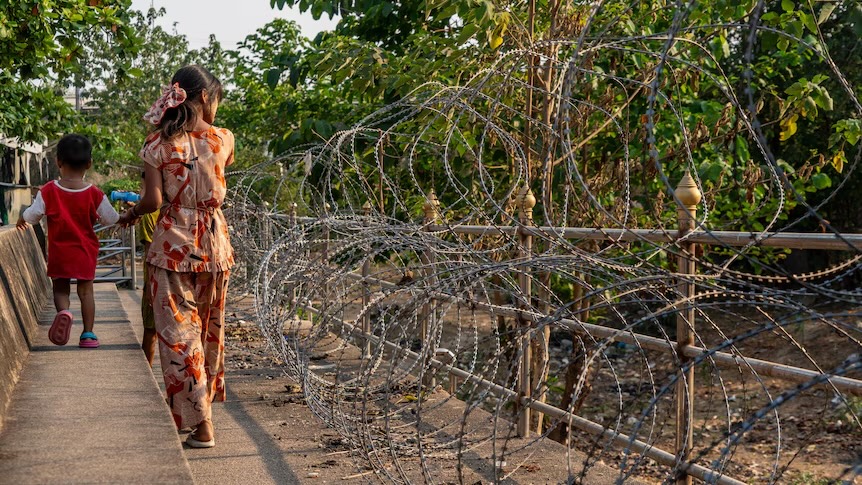
Five years later, the violence inside Myanmar continues. Displacement remains real. Yet what I encountered during a recent visit to Thailand — especially on the Thai-Myanmar border — was not the drama of fresh catastrophe. It was something quieter and more difficult to confront: the consolidation of waiting as a way of life.
The crisis has not ended. It has settled. And what has settled with it is time. Time has accumulated. And when time accumulates under conditions of uncertainty, it does not remain neutral.
Waiting as structure
In humanitarian governance, delay is typically framed as procedural and quota driven. Systems require verification. Capacity is finite. Resettlement pathways demand coordination across jurisdictions. These explanations are not without merit. Humanitarian systems do operate under constraint.
But they also obscure something essential: the political and moral significance of time itself.
The Norwegian scholar Johan Galtung described “structural violence” as harm embedded within social arrangements rather than inflicted through direct physical force. It refers to conditions that systematically constrain life chances without a visible perpetrator. More recently, the literary theorist Rob Nixon has written of “slow violence” as a form of harm that unfold gradually, often invisibly, and therefore escape urgency because they lack spectacle.
Protracted displacement resembles both. No single authority declares that families should live indefinitely in limbo. No policy document announces that children should spend formative years without stability. Yet when legal uncertainty persists for half a decade, the cumulative effects are no longer incidental.
In Mae Sot, families rent small rooms secured through informal arrangements that offer little security of tenure. Employment is precarious and vulnerable to shifting enforcement practices. Schools serving migrant children operate in partial recognition. Access to healthcare depends on patchwork networks rather than durable entitlements. International protection frameworks exist in principle, yet access to formal recognition and resettlement pathways is constrained by limited registration capacity and slow referral mechanisms.
People are not integrated locally. They cannot safely return to Myanmar. Nor are they meaningfully progressing toward durable solutions. They are suspended. And when suspension extends across years, it becomes structure rather than interval.
The social compression of prolonged uncertainty
During my visit, I encountered a situation involving domestic violence between partners in the displaced community. Violence is never defensible. Responsibility for harm remains personal. Yet to analyse the incident solely at the level of individual failure would be incomplete.
Years of unstable employment had eroded economic identity and self-worth. One partner lacked independent legal status and therefore meaningful autonomy. Neither could articulate a credible timeline for change. The absence of certainty had become the defining feature of their shared life.
Prolonged uncertainty does not simply pause decision-making. It compresses emotional capacity. It destabilises expectations. It intensifies frustration. Over time, pressure accumulates without release. The violence I witnessed was not born in isolation. It emerged within a structural environment defined by temporal insecurity.
Humanitarian delay is often treated as unfortunate but neutral. Yet when uncertainty becomes chronic, it alters behaviour and reshapes relationships. The harm is incremental rather than spectacular. But incremental harm, sustained over years, becomes structural.
Children formed by limbo
Perhaps the most confronting dimension of protracted waiting is its effect on children. A child who was five years old in February 2021 is now ten. That span is not bureaucratic; it is formative. It encompasses the shaping of identity, ambition and the sense of what is possible.
Children growing up in prolonged limbo internalise instability as baseline reality. They learn to expect impermanence. They calibrate aspiration to uncertainty. They adapt to the absence of long-term planning. These adaptations are rational responses to unstable conditions. But they are not without cost.
We routinely evaluate humanitarian responses by reference to intake numbers and processing times. We are less inclined to assess the formative consequences of extended uncertainty. Yet when waiting spans childhood, it ceases to be merely procedural. It becomes constitutive of experience. In this sense, time itself becomes an agent.
The erosion of cohesion
There is another dimension of protracted displacement that remains under-examined: its effect on community cohesion.
In Mae Sot, the diaspora in Australia and elsewhere, five years of sustained pressure has begun to test solidarity. Remittances continue, but financial strain deepens. Volunteers remain committed, yet burnout accumulates quietly. Leaders persist in advocacy, even as fatigue settles in. Competition for scarce pathways intensifies. Trust becomes more fragile.
Communities under prolonged stress rarely fracture dramatically. More often, they erode gradually. Resilience, celebrated in the urgency of early crisis, has a half-life. When uncertainty persists without credible resolution, cohesion becomes harder to sustain.
Once solidarity thins, rebuilding it is far more difficult than maintaining it would have been.
Moral outsourcing
Protracted crises also produce what might be called moral outsourcing.
Responsibility disperses. Governments cite capacity constraints. International agencies cite mandate limitations. Host states cite sovereignty. Donor states cite domestic political realities. Each explanation is individually defensible.
Meanwhile, diaspora communities absorb disproportionate burdens — financial support for relatives abroad, emergency assistance, informal casework and sustained advocacy. Civil society attempts to bridge gaps. Philanthropy intervenes episodically.
Over time, waiting becomes normalised. Yet if the consequences of prolonged limbo are foreseeable through family strain, diminished opportunity, weakened cohesion, then continued delay demands more than administrative explanation. It demands moral reflection.
An Australian reckoning
Australia rightly prides itself on a humanitarian tradition grounded in fairness and refuge. That tradition is often expressed in intake numbers and emergency responses.
Protracted crises test something subtler. They test whether we are prepared to interrogate the ethics of time. If prolonged administrative limbo predictably narrows life trajectories and reshapes childhoods, can it be described as merely procedural? At what point does delay become consequential rather than incidental?
This is not a call for partisan denunciation or simplistic prescriptions. It is a call to recognise that time is not empty. Time shapes lives. If humanitarian governance treats delay as neutral while its cumulative effects are anything but, then we risk participating, however unintentionally, in structural harm.
A personal unease
I write this not as an abstract theorist, but as an Australian immigration lawyer who has spent five years working within the systems under discussion. I believe in those systems. I remain committed to them. But I would be less than honest if I did not acknowledge that prolonged crisis alters the advocate as well.
Five years of sustained urgency produces its own uncertainty. It raises uncomfortable questions about whether incremental reform is sufficient in the face of slow structural harm. It tests one’s sense of direction.
My visit to Mae Sot did not leave me with a policy blueprint. It left me with a deeper unease about what time is doing to families, to children, to communities and to those of us who work within humanitarian frameworks.
Perhaps that unease is itself a signal. If we feel the weight of time, it may be because time is no longer background. It has become central to the moral landscape. Five years on, the crisis is not only in Myanmar. It is in the years accumulating beyond its borders.
Waiting is not neutral. Time does not pass untouched. It settles into walls, into childhood, into the narrowing of plans. Five years is not silence. It is accumulation.
Ko Ko Aung is a Sydney-based immigration lawyer and Special Counsel at Albert Arthur Lawyers, practising nationally in migration law with a focus on refugee and humanitarian protection. He serves as Company Secretary at Afghan Women On the Move and is completing a Master of Laws in International Human Rights Law at the University of New South Wales.