


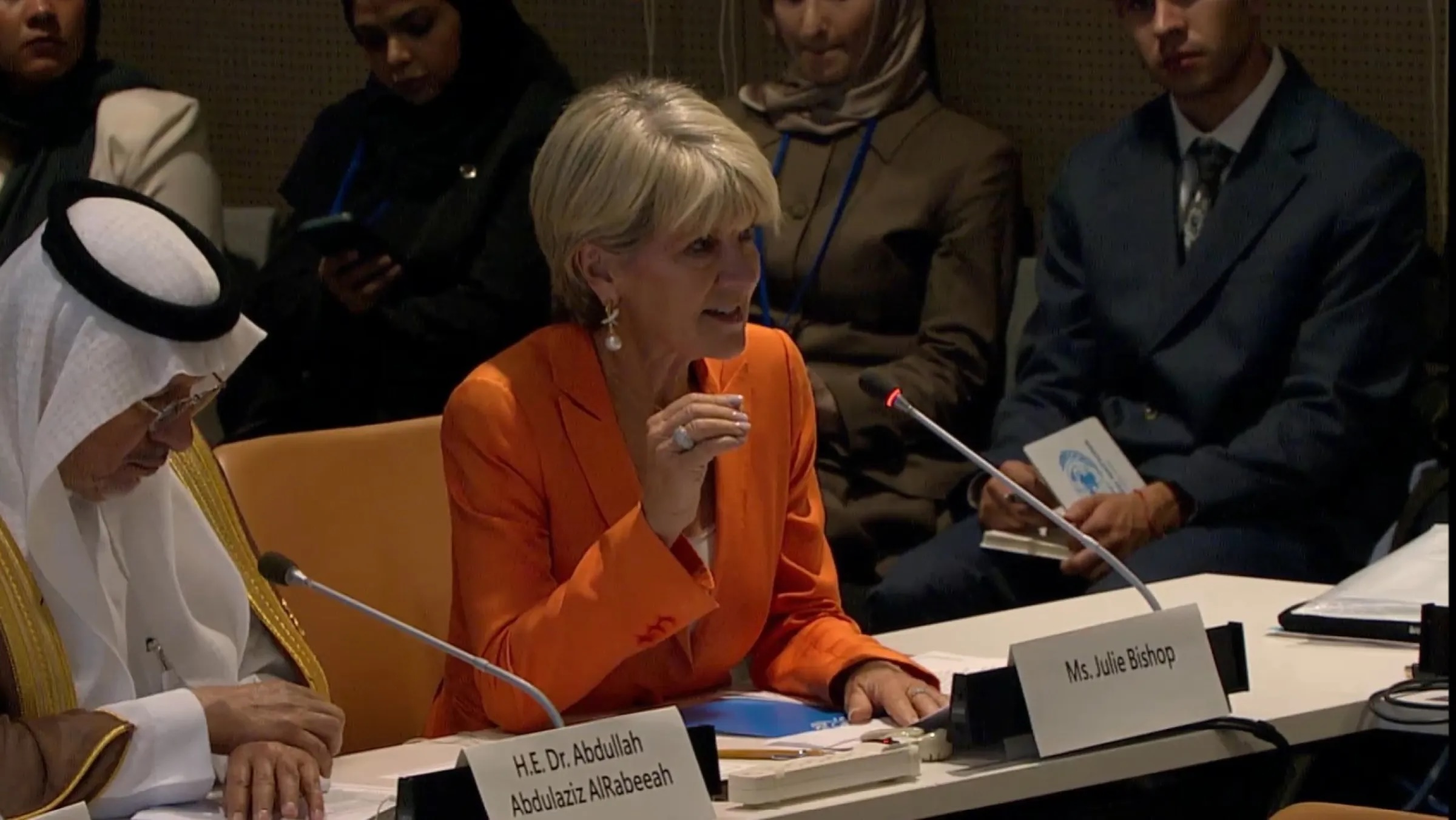
The United Nations Special Envoy on Myanmar, Julie Bishop, briefed the 81st session of the U.N. General Assembly’s Third Committee meeting on Tuesday, laying bare the deeply contested reality of what Myanmar’s regime states and the facts on-the-ground.
Challenging what she called the “myth” that the crisis in Myanmar since the 2021 military coup can ever be resolved by conflict, Bishop underscored that up to 70 per cent of the country’s territory is now either contested or controlled by resistance forces, directly undermining the regime’s claims of governance and stability.
Pointing to the stark divergence on the ground, she noted that while the regime in Naypyidaw characterizes its continued aerial bombardments as counter-terrorism, resistance and civil society documentation reveals that airstrikes systematically target non-combatants.
At least 8,500 civilians have been killed in Myanmar since the February 2021 coup and over 16 million people require urgent humanitarian assistance, according to the U.N.
Bishop highlighted that conditions for safe, voluntary, dignified, and sustainable repatriation of the more than 1.3 million Rohingya refugees in Bangladesh do not exist, warning that any premature return attempts risk violating international protection obligations.
With the Arakan Army (AA) currently controlling 14 of Arakan State’s 17 townships, she emphasized that any viable returns would necessarily require direct security guarantees from those controlling the territory rather than the regime.
Compounding the danger, extensive aerial bombing and artillery shelling have left Myanmar—and Arakan in particular—with one of the highest concentrations of civilian deaths from landmines and unexploded ordnance in the world, making widespread demining a non-negotiable prerequisite before communities can safely return.
Bishop also urged member states to respect the forthcoming findings of the International Court of Justice (ICJ) regarding alleged breaches of the U.N. Genocide Convention, noting that senior military commanders from the 2017 atrocities remain in leadership positions within the regime.
During the committee meeting on Oct. 27, Bishop issued a direct critique of governments seeking to re-engage the regime, arguing that countries engaging in unconditional normalization are throwing away vital diplomatic leverage.
“The idea that one seeks to normalize relations after the decades of fighting and human rights abuses without seeking any conditions is wasting an opportunity to seek nothing in return,” she said.
Bishop insisted that any normalization must be strictly conditioned on an immediate cessation of violence, unfettered humanitarian access, and the release of arbitrarily detained prisoners, including jailed State Counsellor Aung San Suu Kyi, whose recent International Committee of the Red Cross (ICRC) meeting and phone contact with her son, Kim Aris, followed international pleas for proof of life.
The U.N. Special Envoy on Myanmar also called for an urgent end to the killings of civilians, robust protections for local humanitarian workers, and the establishment of measurable progress benchmarks to enforce the Association of Southeast Asian Nations’ (ASEAN) Five-Point Consensus, which is the regional bloc’s peace plan for Myanmar agreed to by regime leader Min Aung Hlaing but not implemented upon his return to Naypyidaw in April 2021.
Furthermore, Bishop urged member states to choke off the regime’s access to military equipment and aviation fuel used in devastating aerial bombardments against communities nationwide.
Bishop confirmed that she is currently in discussions with Naypyidaw regarding a return visit to the country, reaffirming that the U.N. must hold fast to international law and place civilian protection at the center of all diplomatic solutions in Myanmar.