


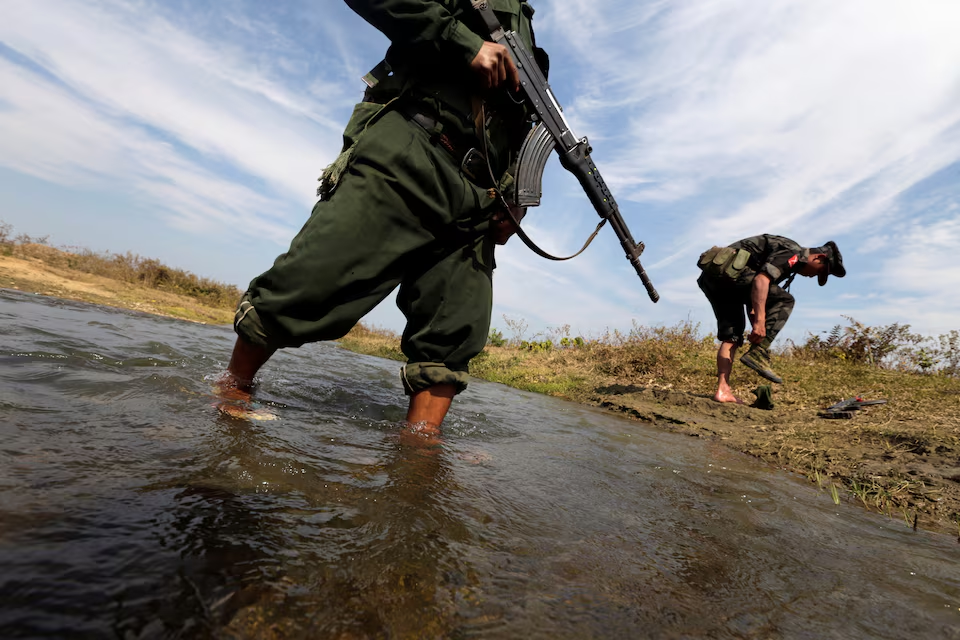
The Trump administration has heard competing proposals that would significantly alter longstanding U.S. policy toward Myanmar, with the aim of diverting its vast supplies of rare earth minerals away from strategic rival China, four people with direct knowledge of the discussions said.
Nothing has been decided and experts say there are huge logistical obstacles, but if the ideas are ever acted upon, Washington may need to strike a deal with the ethnic armed groups controlling most of Myanmar’s rich deposits of heavy rare earths.
Among the proposals are one advocating talks with Myanmar’s regime to get a peace deal with the Kachin Independence Army (KIA) and another calling for the U.S. to instead work directly with the KIA without engaging Naypyidaw. Washington has avoided direct talks with the country’s military following its overthrow of the country’s democratically-elected government in 2021.
The ideas have been proposed to administration officials by a U.S. business lobbyist, a former adviser to Aung San Suu Kyi, in indirect talks with the KIA and some outside experts, the sources said.
The conversations have not previously been reported.
Rare earths are a group of 17 metals used to make magnets that turn power into motion. So-called heavy rare earths are used to build fighter jets and other high-performance weaponry. The U.S. produces very small amounts of heavy rare earths and is reliant on imports.
Securing supplies of the minerals is a major focus of the Trump administration in its strategic competition with China, which is responsible for nearly 90 percent of global processing capacity, according to the International Energy Agency.
Engaging Naypyidaw would be a sharp departure for the U.S. as it has placed sanctions on the military due to the violence committed against the Rohingya minority that Washington calls genocide and crimes against humanity.
Last week, the Trump administration lifted sanctions designations on several military cronies, but U.S. officials said this does not indicate any broader shift in U.S. policy toward Myanmar.
The ideas pitched to the U.S. administration also include easing U.S. President Donald Trump’s threatened 40 percent tariffs on the country, pulling back sanctions against the regime and its allies, working with India to process some heavy rare earths exported from Myanmar, and appointing a special envoy to execute these tasks, people familiar with the matter said.
Some of these suggestions were discussed in a July 17 meeting in Vice President JD Vance’s offices that included Adam Castillo, a former head of the American Chamber of Commerce in Myanmar who runs a security firm in the country, a person close to Vance’s office said.
Among those present were advisers to Vance on Asian affairs and trade. Vance himself did not attend, the source said.
Castillo told Reuters he suggested to U.S. officials that Washington could play a peace-broker role in Myanmar and urged it to take a page out of China’s playbook by first brokering a bilateral self-governance deal between the Myanmar military and the KIA.
Myanmar’s ruling junta and the KIA did not respond to a request for comment.
While Vance’s office declined to comment on Castillo’s visit to the White House, one person familiar with the situation said the Trump administration has been reviewing policy on Myanmar, also known as Burma, since inauguration day in January and had weighed direct discussions with the regime over trade and tariffs.
The White House declined to comment.
Reviewing Myanmar policy
The White House discussions were described as exploratory and in early stages by people familiar with them, who added the talks may result in no shift in strategy at all by Trump, given the administration’s wariness about intervening in foreign conflicts and in Myanmar’s complex crisis.
“The officials took this meeting as a courtesy to the American business community and to support President Trump’s efforts to balance the U.S. $579 [million] trade deficit with Burma,” a senior administration official said when asked about the July 17 meeting.
Castillo, who describes Myanmar’s rare earth deposits as China’s “golden goose,” said he told U.S. officials that key ethnic armed groups – particularly the KIA – were tired of being exploited by China and wanted to work with the U.S.
Mines in Myanmar’s northernmost Kachin State are major producers of heavy rare earths that are exported to China for processing.
He said he had repeatedly urged officials in Washington to pursue a deal with the KIA that includes cooperation with U.S. partners in the Quad grouping – specifically India – for resource processing and eventual heavy rare earths supply to the U.S. The so-called Quad grouping brings together the U.S. with India, as well as Australia and Japan.
India’s Ministry of Mines did not respond to an email seeking comment.
An Indian government official, speaking on the condition of anonymity, said he was unaware of whether the Trump administration had communicated any such plan to India but stressed that such a move would take several years to materialize because it would require infrastructure to be built for processing rare earths.
Another pitch to the White House was more in line with the Myanmar policy Trump inherited from former President Joe Biden.
Sean Turnell, an Australian economist and former adviser to Myanmar’s jailed State Counsellor Aung San Suu Kyi, whose government the regime toppled in 2021, said his rare earths proposal was to encourage the Trump administration to continue supporting Myanmar’s democratic forces.
In a visit to Washington earlier this year, Turnell said he met with officials from the State Department, the White House National Security Council and Congress, and urged continued support for the country’s opposition.
“One of the pitches was that the U.S. could access rare earths via KIA etc,” he said, adding that the group wants to diversify away from China.
There have also been multiple discussions between U.S. officials and the KIA on rare earths through interlocutors in recent months, said a person with knowledge of the talks, which have not previously been reported.
Obstacles
In the years since the 2021 coup, Myanmar has been ravaged by civil war and the regime and its allies have been pushed out of much of the country’s borderlands, including the rare earths mining belt currently under control of the KIA.
A rare earths industry source said that U.S. officials had reached out around three months ago, following the Kachin takeover of the Chipwe-Pangwa mining belt, to ask for an overview of the Kachin State rare earths mining industry.
The person added that any new, major rare earths supply chain, which would require moving the minerals out of remote and mountainous Kachin State into India and onward, may not be feasible.
Swedish author and journalist Bertil Lintner, a leading expert on Kachin State, said the idea of the U.S. obtaining rare earths from Myanmar from under the nose of China seemed “totally crazy” given the unforgiving mountainous terrain and primitive logistics.
“If they want to transport the rare earths from these mines, which are all on the Chinese border, to India, there’s only one road,” Lintner said. “And the Chinese would certainly step in and stop it.”
For its part, the regime appears eager to engage with Washington after years of isolation.
When Trump threatened new tariffs on Myanmar’s U.S.-bound exports this month as part of his global trade offensive, he did so in a signed letter addressed personally to the regime leader Min Aung Hlaing, who responded by lavishing praise on Trump for his “strong leadership” while asking for lower rates and the lifting of sanctions.
He said that his regime in Naypyidaw was ready to send a negotiating team to Washington, if needed.
REUTERS