


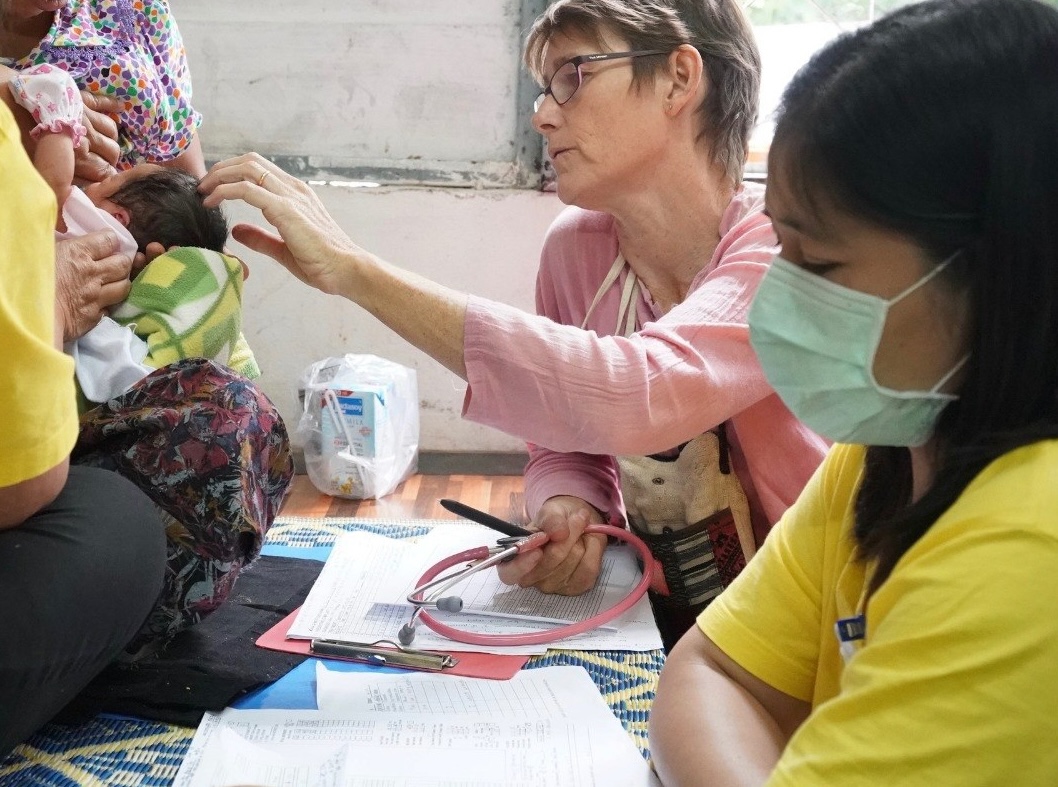
The Australian Embassy in Yangon announced on Monday that Dr. Rose McGready, who has provided healthcare to refugee communities along the Thailand-Myanmar border for over 30 years, was named 2026 Australian of the Year for the Australian Capital Territory (ACT).
McGready, 61, has spent “more than 30 years training local staff to support women from Myanmar through childbirth in difficult conditions and reduce malaria.”
The embassy stated that McGready’s “commitment, compassion and clinical expertise provide life-saving aid to some of the most vulnerable communities in the world.”
Born and raised in Canberra, Australia, McGready first travelled to refugee camps along the Thai-Myanmar border in 1994 for a temporary placement after completing her medical studies at the University of Sydney.
In an award video, she said that she only intended to volunteer as a doctor in the camps along the border for six months.
“I got spellbound by the local Karen and Burmese staff in the camps, thinking that I had something to offer,” she said. “They’ve taught me much more about being a good human than anything I’ve been able to transmit to them.”
The ACT Australian of the Year awards recognises Australians who have made significant contributions to the nation and the international community.
The awards highlight individuals from a wide range of fields, including healthcare, humanitarian work, sports and community service.
Over the years, McGready has trained local health workers and established a network of clinics providing 24-hour maternal care, outpatient services, vaccinations, and community health education in refugee camps.
She established a foundation called the Dr. Rose McGready Foundation in 2022 aiming to support her work and sustain healthcare services for vulnerable communities along the border.
Her research on malaria in pregnancy has also led to new treatments, which have been adopted by the World Health Organization (WHO) as a global standard, according to the NADC.
The recognition for McGready comes as 107,000 refugees in nine camps along the border, who rely on international assistance for basic services, face growing challenges in accessing food and healthcare due to funding cuts from the U.S. last year.
The International Rescue Committee (IRC), which was funded mainly by the U.S. and provided healthcare in the camps, shut down most of its primary services in January 2025, further limiting access to medical care.
Since the mid-1980s, roughly 100,000 refugees from Myanmar have lived in nine camps along the border. The Thai government administers the refugee camps with support from international organizations and civil society groups.
Most of the registered refugees in Thailand, living in the nine camps, are ethnic Karen and Karenni nationalities who have been displaced from their homeland due to decades of conflict in Myanmar.
*story was updated on April 8, 2026