


Regime media reported on Monday that the military recovered the body of one “terrorist” in Salin Township after Nwetame village in Sinphyukyun town was recaptured from resistance forces on Jan. 10. Salin is located 46 miles (74 km) northwest of the region’s capital Magway.
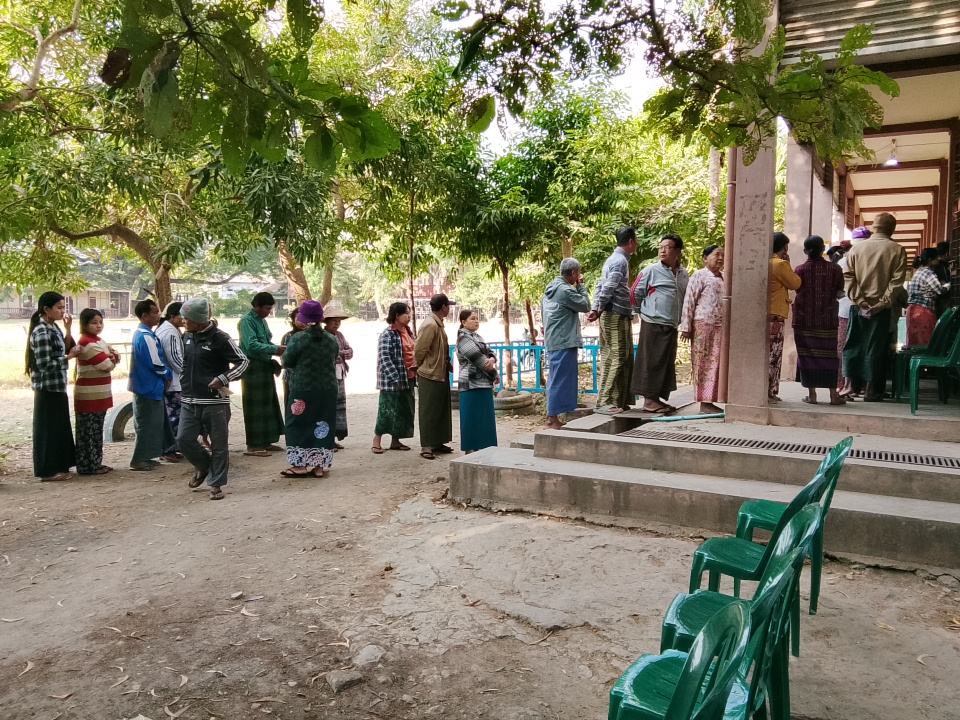
A resident of Sinphyukyun town told DVB on the condition of anonymity that regime administrators were unable to get residents to vote in the second phase of elections – held in 100 townships nationwide – due to fighting between the military and the People’s Defence Force (PDF) on Jan. 11.
Besides Salin, the Union Election Commission (UEC) staged the second round of voting in Magway’s Gangaw, Seikphyu, Natmauk, Myothit, Ngape, Sidoktaya, Kanma, Mindon, Minhla and Sinpaungwe. It plans to hold polls in 20 out of Magway’s 25 townships during the election, which ends on Jan. 25.
The National Unity Government (NUG) stated that PDF units under its command attacked regime outposts in six Magway townships, including Salin, as the first round of voting in the elections began on Dec. 28. The PDF has laid a “siege” to Salin and Sinphyukyun towns since it launched an attack on regime outposts there on Dec. 23.
At least two regime troops were killed and an unspecified number of officials were injured in simultaneous attacks on military positions in Phyu, Htantabin, Minhla and Paungde townships in neighbouring Bago Region on Jan. 11, according to the PDF.
The second round of voting was held in Bago’s Daik-U, Shwekyin, Htantabin, Yedashe, Zegon, Paungde, Kawa, Thanatpin, Paukhkaung, Pandaung, Moenyo and Minhla townships. Bago Region has a total of 28 townships. The UEC has scheduled the third phase of voting in eight Bago townships, including Phyu, on Jan. 25.
In Sagaing Region, 12 airstrikes were carried out by the Myanmar Air Force on Khin-U Township and artillery was fired indiscriminately by regime forces in Ayadaw Township, where voting took place on Jan. 11, according to resistance groups. Ayadaw, Wetlet and Khin-U are located 25-70 miles (40-112 km) northeast of the region’s capital Monywa.
Besides urban areas of Sagaing’s Ayadaw, Kalewa, Chaung-U, Butalin, and Mawlaik, phase two of the elections were held fully in Mingin, Wuntho, Kyunhla, Myinmu, Hpoungpyin, Ye-U townships.
The UEC has planned polls in 25 of Sagaing’s 37 townships during the election, which ends on Jan. 25 with a final round of voting in Kanni and Salingyi townships.
In Karenni State, residents told DVB that fighting between regime and resistance forces resumed near Hpruso Township and in Demoso Township’s Ngwetaung village-tract, which hosts Light Infantry Battalion (LIB) 102, as the second round of voting got underway on Jan. 11.
A Hpruso resident told DVB on the condition of anonymity that 80 per cent of all residents have fled their homes due to the fighting and only military families remained to cast their ballots.
The UEC has held polls in four Karenni townships under regime control, including both Demoso and Hpruso on Jan. 11, which are located 10-22 miles (16-35 km) south of the Karenni State capital Loikaw, where the first phase of the elections was held along with Bawlakhe Township on Dec. 28.
Three of seven Karenni townships, including Mese, Shadaw and Hpasawng, are under the control of resistance forces and were not included in the elections by the UEC.
In Karen State, residents of Paingkyon town in Hlaingbwe Township told DVB that regime administrators had barred them from leaving their homes in three villages, but “forced” them to vote on Jan. 11.
The UEC held polls in both Hlaingbwe and Hpapun townships, located 23-109 miles (37-175 km) north of the Karen State capital Hpa-An, during the second phase of elections.
A third and final phase of voting will take place in 63 townships nationwide, including Karen’s Kawkareik and Kyainseikkyi townships, on Jan. 25. All seven townships in Karen State are included in the 2025-26 elections.
The UEC announced that polls will only be held in 265 out of Myanmar’s 330 townships since the remaining 65 townships “lack conditions to hold free-and-fair elections.”