


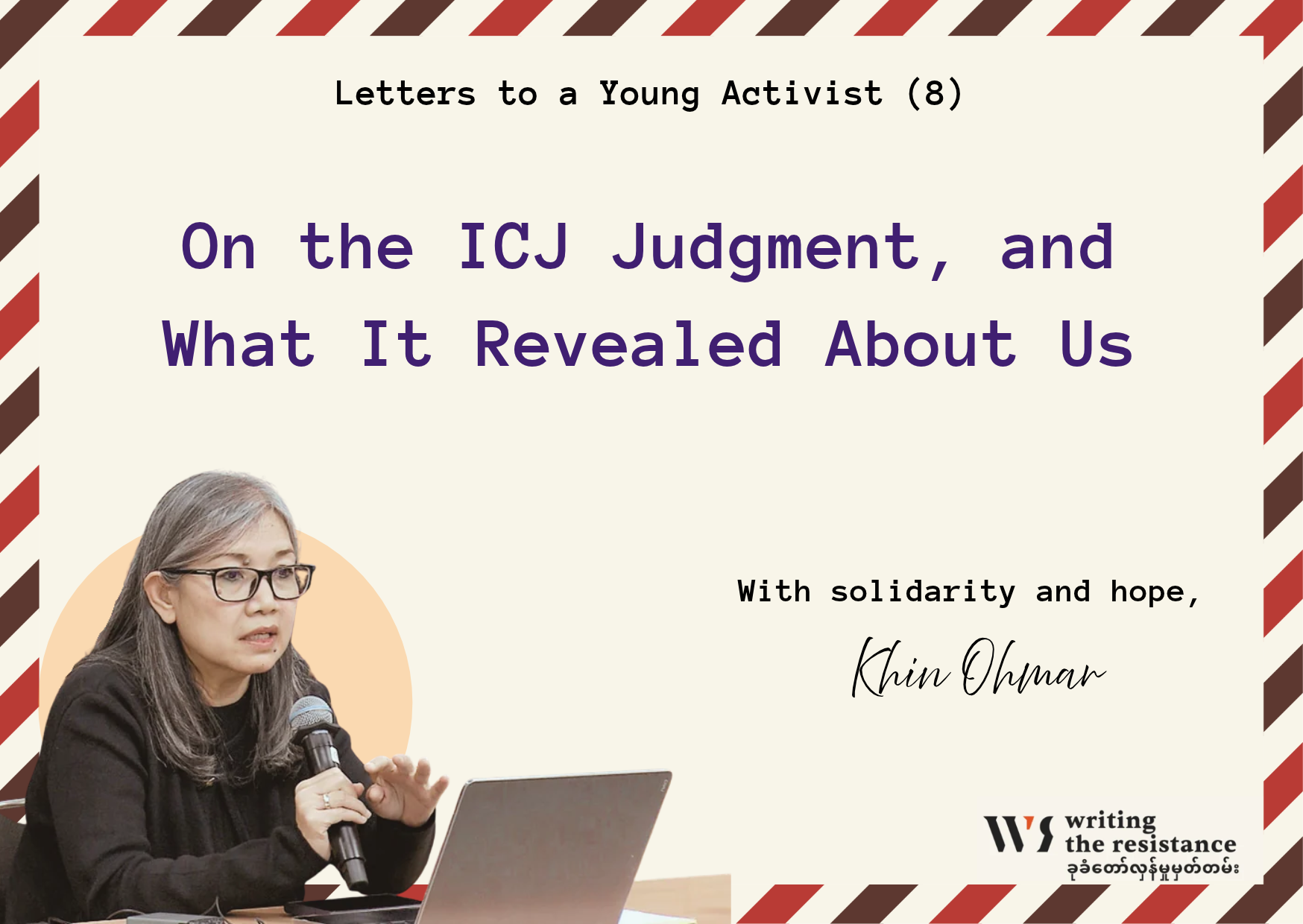
Dear Young Activist,
Seven years. That’s how long it took for the International Court of Justice to say what the Rohingya have always known: Myanmar committed genocide.
For survivors, it confirms that what happened to them was not “clearance operations,” as the military tried to frame it, but genocide.
This case was not an attack on Myanmar or its people. It was about the acts of a military that committed genocidal atrocities against the Rohingya and then lied about those atrocities to the world.
The same military that burned villages and drove out more than 700,000 people in 2017 has waged a campaign of terror against all Myanmar’s peoples since the 2021 coup attempt and for decades prior against the ethnic nationalities in the borderlands.
Before the Court in The Hague delivered its judgment, I wrote in my article that the junta would stir up hatred against the Rohingya again through its ultranationalists. I meant it as a warning to all of us.
There is one perpetrator, and it has never distinguished between us, whether Bamar majority or Rohingya minority. When we allow the Rohingya to be separated out, as if their suffering were different from ours, we accept the military’s oldest strategy: divide us so that it can destroy us one people at a time.
I’ve always talked about how justice for the Rohingya is justice for all the peoples of Myanmar, hoping this message would get across.
But the hatred came anyway, just as I warned.
Nine years after the atrocities, and even after a judgment from the highest court in the world, the genocidal junta still refuses to say the name Rohingya, calling them “Bengalis” instead. That refusal is itself part of the crime.
But what saddened me most was seeing that the hatred doesn’t only come from the junta. The same hateful messages are still spreading through our own movement.
Even people in the human rights community, people fighting to end the dictatorship, are still writing anti-Rohingya and racist messages, denying that the Rohingya are a people of Burma/Myanmar, and repeating the junta’s own words.
Myanmar people must see that the Court’s ruling is a reminder that “never again” in the Genocide Convention is an international legal obligation that every state that has ratified it, including Myanmar, must abide by.
Some Myanmar people might feel ashamed that Myanmar is the first state determined by the Court to have committed genocide.
But what would be shameful is if we neglect our responsibility to comply with the promise we pledged, fail to implement measures to make amends for the wrongdoings, and fail to provide justice to those who have suffered.
Of course, the junta and ultranationalists have spent years trying to blur what happened with a hate campaign against the Rohingya.
They will not stop now. But what is most important is that we activists in the revolution, striving for the transformation of our society, do not allow ourselves to feel swayed, trapped, or held down by this.
We must stand firm on the principles of human rights, humanity and respect for international law.
When we get swayed by the genocidal junta’s and ultranationalists’ racist propaganda, we are doing the junta’s work for it.
When minorities were persecuted, majorities turned their backs on them. The next turn came to the majority. That is why we need to stand together.
Now, let’s look at the other side of this week, because it shows what true solidarity actually looks like.
On November 20, the day after the judgment, the Karen National Union, our oldest ethnic armed resistance organization, issued a statement welcoming the ruling.
And it said, in its own words: “The KNU has long recognized the Rohingya as one of the peoples of Burma and has stood with them in their struggle for justice and equal rights.”
It went further. It reaffirmed the right of the Rohingya to equal citizenship, to identify as Rohingya, and to take part in decisions about Burma’s future.
It said it is ready to work directly with Rohingya representatives, including women and displaced communities.
And it said what all of us should say: “The same Myanmar military that committed genocide against the Rohingya continues to commit atrocities against civilian communities across Burma.”
Look at what followed. On the KNU’s own page, the comments filled with slurs and hate aimed at the KNU. The KNU stood firm anyway.
And the KNU was not alone standing firmly and clearly in solidarity with the Rohingya people.
On the day of the judgment, 219 Rohingya and other Myanmar civil society organizations, including my organization, Progressive Voice, stood together in one statement welcoming the finding.
This is what our revolution looks like at its best, and it is growing.
Standing with the Rohingya is neither a lonely position, nor a foreign one, nor a betrayal of our own peoples. Racism is the intruder against our humanity and our solidarity with one another, and it is what we must defend against.
A country that cannot face what was done to the Rohingya cannot build the federal democracy we are fighting for, because a union built on denial will carry the rot of the old order into its foundations.
If we win the war against the junta but keep its hatred in our own hearts, we will have lost the very thing we were fighting for.
The test of this revolution is not only whether we defeat the junta. It is whether we become the kind of people who can live together afterward, all of us, with our names and our rights intact.
So, let’s not be silent when the people around you repeat the junta’s language, even when those people are our own comrades. Silence in that moment is not neutrality. It is permission.
Genuine solidarity is the recognition that when one community is not free, none of us are free, and that if rights are denied to one community today, another may face the same tomorrow.
That solidarity must extend beyond empathy to shared risk and coordinated action against our common oppressor. It cannot wait until standing together becomes safe or convenient.
On November 19, the Court said what we have known for nine years. Now it is for us to live it and show our true solidarity with Rohingya sisters and brothers, first in our own revolution.
Now the next step is to push for those responsible to be held accountable. A verdict is only words until we act on it.
The verdict has opened a door that the junta would like to see shut again. Here is how we keep it open:
● Stand with the Rohingya.
● Press for the ruling to be honored in full. That means protection for the Rohingya who remain in Myanmar, the restoration of their ethnic identity, citizenship, and rights, accountability for those responsible, and reparations for what was taken.
● Call them Rohingya. It is their ethnic identity and the name they wish to be called. When we recognize that name, we are first able to understand its denial as an act of violence intended to strip them of their humanity.
● Keep pushing for accountability. We must not allow this criminal junta to succeed in its ongoing genocidal campaign against the Rohingya people.
As our revolution commits to a federal democracy, we must demand that no one in our country will be left outside the reach of justice again.
In hope and solidarity,
Khin Ohmar is a Myanmar human rights activist who was involved in organizing the ‘8888’ nationwide pro-democracy uprising. She is also the founder and chairperson of Progressive Voice, a Myanmar human rights organization. She developed the Women Peacebuilding Program for Women’s League of Burma and served as program coordinator from 2000 to 2006.
DVB publishes a diversity of opinions that does not reflect DVB editorial policy. We’d like to hear what you think about this or any of our stories: [email protected]