


Guest contributor
James Shwe
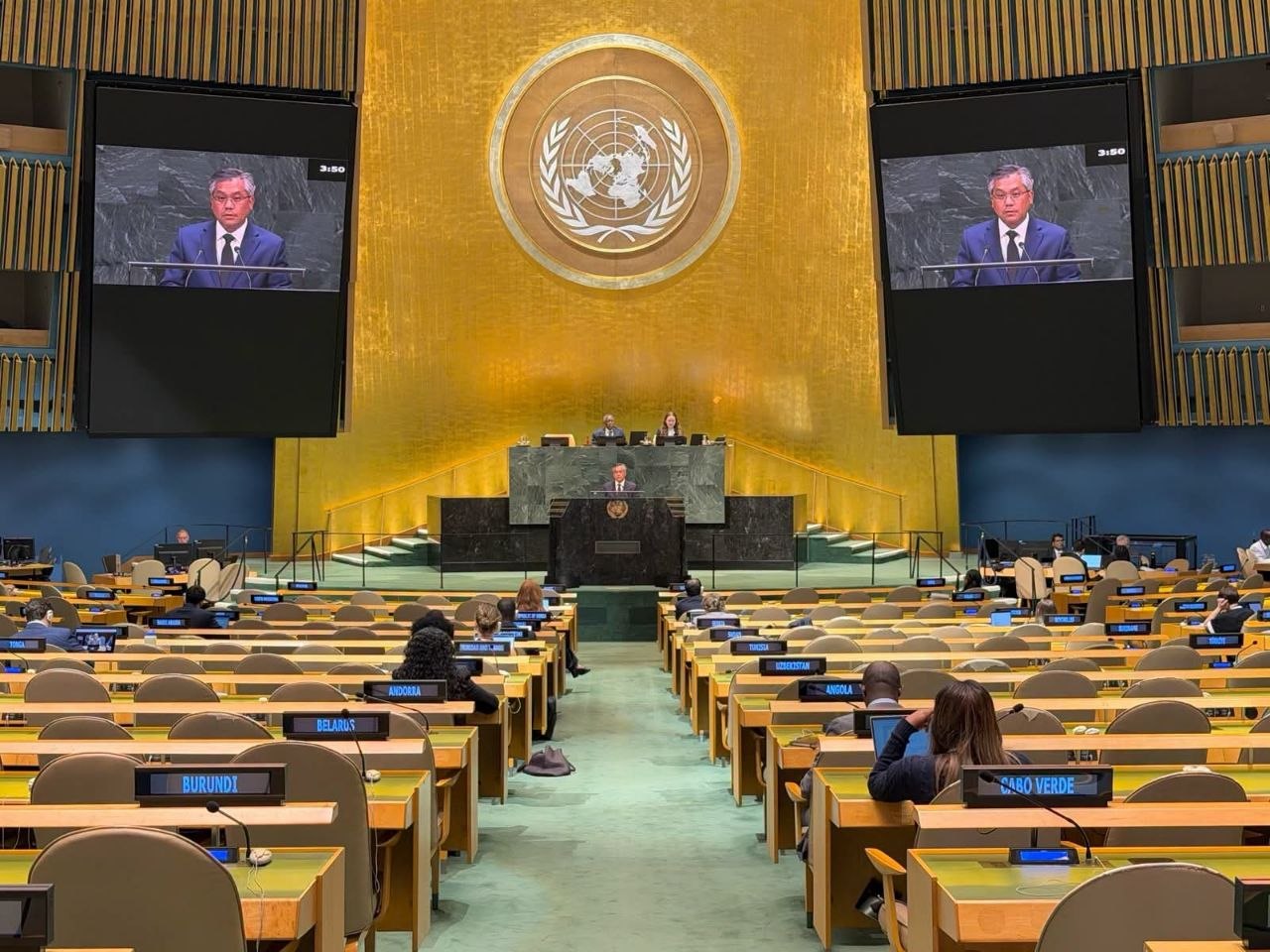
The day before the International Court of Justice (ICJ) delivers its historic judgment in The Gambia v. Myanmar, the United Nations General Assembly’s Third Committee adopted its annual resolution on the human rights of Rohingya Muslims and other minorities in Myanmar by a recorded vote of 128 in favor, six against, and 33 abstentions.
Both the timing of the vote and the explanations behind it matter far more than routine U.N. diplomacy usually does.
Read carefully, they lay the groundwork for international action after the ICJ verdict, cut through weeks of anxious speculation about U.S. policy toward the junta, and underscore why Myanmar’s seat at the U.N. remains vital to the democratic movement.
Although its title highlights the Rohingya and other minorities, the 23-page resolution sponsored by the European Union and the Organization of Islamic Cooperation is a sweeping indictment of the junta’s nationwide war on Myanmar’s people.
It condemns the military’s airstrikes with jets, drones, and paramotors, the burning of villages, forced conscription of young men and women, transnational scam centers, and the obstruction of humanitarian aid.
Crucially, it rejects the regime’s unilateral elections of December 2025 and January 2026 as neither free nor fair, condemning attempts to legitimize the February 2021 coup.
It also explicitly acknowledges the National Unity Government (NUG) 2021 policy recognizing Rohingya citizenship rights and committment to replace the 1982 Citizenship Law.
The timing—tabled and voted on the eve of the ICJ judgment—was deliberate.
After concluding merits hearings in January, the judges in The Hague are set to rule Nov. 19 on Myanmar’s responsibility under the Genocide Convention.
Anticipating that moment, Operative Paragraph 19 of the resolution calls upon U.N. member states, U.N. bodies, and civil society to engage stakeholders, including the Rohingya, “to prepare appropriate follow-up to any orders or findings of the judgment of the International Court of Justice on the merits.”
A court ruling does not enforce itself. By passing this mandate before the verdict, 128 nations have built the diplomatic runway to keep the General Assembly, the Independent Investigative Mechanism for Myanmar (IIMM), and the Security Council engaged once the judges speak.
The vote also broke a five-year pattern. First introduced in 2017 after the military’s mass atrocities in Rakhine State, the resolution faced recorded votes from 2017 to 2020 when Myanmar’s previous government opposed it.
After the 2021 coup, Ambassador Kyaw Moe Tun has retained Myanmar’s U.N. seat on behalf of the elected civilian government and joined consensus, allowing the text to pass without a vote for five consecutive years from 2021 through 2025.
When the draft was forced to a vote this year, two entries on the electronic board stood out: a yellow abstention beside the United States, and a green “yes” beside Myanmar.
At first glance, junta propagandists and worried observers alike might misread Washington’s abstention.
In recent months, many in Myanmar have been conjecturing that America is pivoting toward the generals—pointing to direct U.S. talks with regime officials in Naypyidaw and Tokyo, the selective delisting of sanctioned individuals, and the U.S. Embassy’s new Integrated Country Strategy (ICS), which emphasizes scam centers, trade deficits, ceasefire talks, and rare-earth access while omitting the word “democracy.”
Yet the official Explanation of Vote delivered by American U.N. Ambassador Dan Negrea says far more about actual U.S. policy than months of rumor and tea-leaf reading.
Washington stated plainly that its abstention “is not a reflection of changes on the ground in Burma or of a change in our position towards the situation in the country,” while reaffirming grave concern over ongoing abuses and explicit support for the people of Myanmar.
Instead, the U.S. abstained over a single doctrinal red line: references to the International Criminal Court (ICC) in preambulatory paragraph 35 and operative paragraph 2.
Citing its two-decade objection that the ICC threatens the sovereignty of states not party to the Rome Statute, the current administration refused to endorse ICC language—calling it an unrelated dispute that marred an otherwise important resolution.
One can regret that Washington let its global feud with the ICC cost Myanmar a co-sponsor’s vote, while still recognizing the central political fact: the U.S. did not object to a single word condemning the junta’s bombings, conscription, or sham elections.
Talking to Naypyidaw over scam compounds has not bought the generals diplomatic rehabilitation in New York.
Equally consequential was how Ambassador Kyaw Moe Tun voted. By casting a “yes” vote for Myanmar, he broke decisively with decades of state defensiveness at the U.N. and aligned the country’s official seat with universal human rights and minority protection.
For the Spring Revolution, the implications are clear. First, the vote is a major legitimacy victory.
After the junta’s staged polls, Naypyidaw remained locked out of the General Assembly chamber, reduced to issuing angry press releases while only six governments—China, Russia, Belarus, North Korea, Vietnam, and Nicaragua—voted against the resolution.
Even within the Association of Southeast Asian Nations (ASEAN), Malaysia, Indonesia, Brunei, and Timor-Leste voted in favor.
Second, voting “yes” on the eve of the ICJ verdict draws a moral and legal line between the military perpetrators of genocide and the federal democracy Myanmar’s people are fighting to build.
At the same time, because the resolution also calls out abuses and humanitarian restrictions by non-state armed actors, including in Rakhine State, it serves as a sober reminder to all revolutionary and ethnic forces that international legitimacy depends on strictly protecting civilians and humanitarian access on the ground.
As the ICJ prepares to rule, the message from New York is unmistakable.
The generals remain isolated, Washington has not endorsed their rule, and Myanmar’s democratic movement stands on the side of international law—ready to turn tomorrow’s verdict into lasting accountability.
James H. Shwe is a Myanmar American advocate for democracy in Myanmar and an independent policy analyst based in California.
DVB publishes a diversity of opinions that does not reflect DVB editorial policy. We’d like to hear what you think about this or any of our stories: [email protected]