


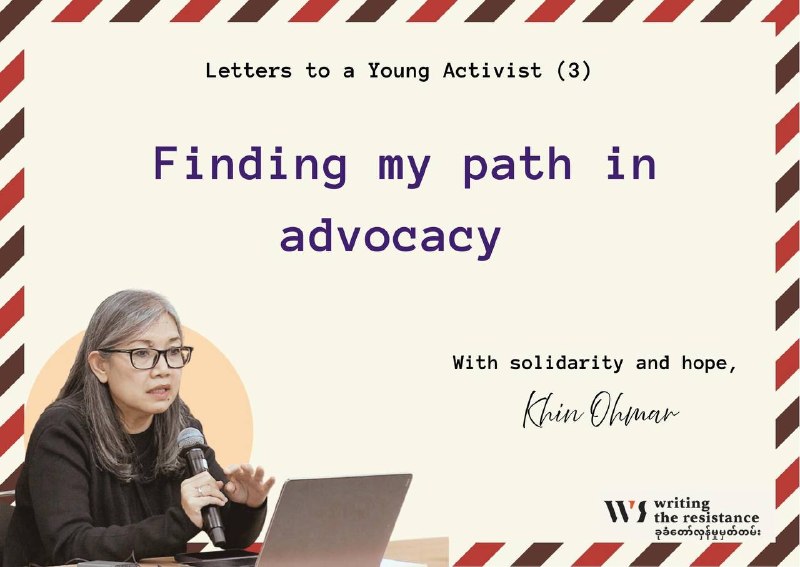
Guest contributor
Khin Ohmar
Dear young activist,
My decades of activism have largely been shaped by the art of effective advocacy. I did not start with formal training, or the exact right words to get my message across.
I began simply because I wanted the world to know what was happening in Burma, and I was determined to use my story and more broadly how the military dictatorship oppressed us, to draw attention and support to our democracy movement.
In the early 1990s I was accepted to resettle as a political refugee in the U.S. When asked at the U.S. Embassy where I wanted to go, I said Washington, D.C., because instinct told me that I needed to be where people make policies and political decisions.
That choice has shaped my entire life as an activist and advocate for a Free Burma.
At first invited to speak to the church congregation that sponsored my resettlement, and later to communities and universities across North America with Amnesty International and Free Burma Coalition, I spoke about the courageous student protests and the ethnic minority nationalities fighting decades of discrimination and military suppression in their ancestral border homelands.
I highlighted our student activists’ deep desire to achieve democracy and end the suffering of our people under the military dictatorship.
I always shared practical ways people in the U.S. to help, such as offering protection and resettlement to fellow student activists and urging the U.S. government to support our democracy movement.
My time in the U.S. provided me knowledge and opportunities that I could never have gotten from a classroom.
Amnesty activists, church organizers, the exiled Tibetan community, and environmental activists all taught me about persistence, solidarity, strategy, and courage.
They reminded me to always speak truth to power.
I’ve written another letter about those early days of my advocacy journey, highlighting the lessons I learned, and the diverse communities that taught me so much through their love and support.
My gratitude for my experiences in the U.S. has sustained me through many dark times.
You can read more details about that time in my life in Letters to A Young Activist: Taking My First Steps in Advocacy which will be the next letter in this series.
Now I am focused on sharing some of my experiences with the younger generation of Spring Revolution activists, because this is your time to deepen your own advocacy journey.
As we enter this post-sham-election period of the illegal junta’s civilian façade, you face the same criminal military institution that we faced from 1988 onward, but with new leaders.
They are more ruthless in their actions yet much weaker institutionally, with more blood on their hands for heinous crimes.
They stand accused under international law of committing war crimes and crimes against humanity against the people of Myanmar.
Throughout my advocacy journey, I remember times when our movement tried to hold the Myanmar military generals accountable under international law, but we were unsuccessful.
Worse, when Myanmar opened up in 2011, our democracy movement’s leaders simply said, “Let bygones be bygones!” I was shaken to my core.
I believe justice and accountability must never be subject to political judgement. No leader has the right to decide the fate of the injustices that victims and survivors have suffered.
Watching my own movement’s leaders block our efforts to end military impunity, seemingly willing to let perpetrators whitewash their crimes, was among the hardest experiences of my life.
But the 2017 Rohingya genocide shifted the global stance.
Rather than merely advising Myanmar’s military to amend laws and change patterns of criminal behaviors, the international community turned to holding perpetrators accountable under international law.
Since then, this criminal military has had nowhere to hide.
The persistent efforts of the organization I founded, Progressive Voice, and like-minded rights-based civil society organization partners through years of documentations and evidence-based advocacy for the establishment of and engaging with U.N. Special Rapporteur mandate, U.N. Fact-Finding Mission, and the International Investigative Mechanism for Myanmar (IIMM), have paid off.
The world now sees that the Myanmar military is neither a legitimate national armed force nor a government. It is an armed criminal entity committing genocide, war crimes, crimes against humanity and other transnational crimes.
However, certain arms-supplying states, including China, Russia, and India, are aiding and abetting the military’s mass atrocity crimes, helping the junta seek a stage of international legitimacy at the Association of Southeast Asian Nations (ASEAN) and the U.N.
The critical question now is how other world leaders will take decisive action to cease the military’s violence and prevent them from gaining international legitimacy.
The International Court of Justice (ICJ) is expected to rule on the Rohingya genocide case in the coming months.
Meanwhile, the junta has ramped up its lobbying campaign for international legitimacy.
Their lobbyists are trying to change certain policies, lift sanctions, and regain access to international funds. They are proactively pushing to seat Min Aung Hlaing at ASEAN and the U.N.
Meanwhile, his criminal gang continues to block international aid, weaponize starvation, block the internet, deny aid to flood victims, and increase daily airstrikes to crush civilians through collective punishment.
While their international allies are aiding and abetting them to continue to commit these crimes, others are either lazy or indifferent to their international obligations to protect the people of Myanmar.
We have much advocacy work ahead. We must prove to the world that Min Aung Hlaing is not Myanmar’s president, nor a dialogue partner for a durable peace in Myanmar, but a criminal who belongs in The Hague.
Dear young activist, now is the time to step up our advocacy. We must keep speaking the truth. Expose Min Aung Hlaing and his criminal gang for their international crimes.
Amplify the voices of our people, affected communities, friends who are imprisoned, and those fighting on the front lines against this criminal junta.
Tell the world about the immense efforts and sacrifices that you, as the young generation of Myanmar, are making with the shared goal of dismantling this criminal military entity and securing a peaceful future for yourselves and for generations to come.
Our people’s lives, livelihoods, food security, sovereignty are under severe attack by Min Aung Hlaing and his illegal, criminal junta. Call on world leaders to stand with you. Shape policies around our people’s fortitude and aspirations.
Our goal is clear: block Min Aung Hlaing from stepping onto the world stage under his fake title of “president of Myanmar”.
He is not a president. He is an international criminal, and the world must treat him as one. The global community must not legitimize him, his rebranded junta, or its fake civilian face.
This is my main advocacy focus now, and it will remain so. I want the world to listen to the real stories of our people, support them, and take action to dismantle this military.
We must stay focused and keep working with calm and steady hearts. In every people’s movement against injustice or tyranny, success never rests on just one person or group.
Many things try to pull us in different directions, but we must hold our ground. We must create and grab every chance we get to deny him and his criminal junta the power and recognition they want so desperately.
Your advocacy path might look different from mine, and that is completely fine. As long as you speak your truth with honesty and integrity, care for the greater good, and stay accountable to others, you are already doing amazing work.
With solidarity and hope
Khin Ohmar is a Myanmar human rights activist who was involved in organizing the ‘8888’ nationwide pro-democracy uprising. She is also the founder and chairperson of Progressive Voice, a Myanmar human rights organization. She developed the Women Peacebuilding Program for Women’s League of Burma and served as program coordinator from 2000 to 2006.
DVB publishes a diversity of opinions that does not reflect DVB editorial policy. We’d like to hear what you think about this or any of our stories: [email protected]