


Guest contributor
James H. Shwe
A ten-day pattern of foreign trips and a quarrel with the U.N. says less about the military regime’s strategy than about what it is trying not to show.
What actually happened this month
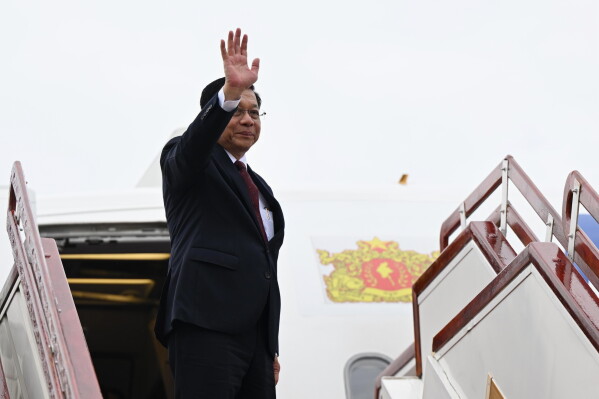
In the last 10 days, Min Aung Hlaing has done two unusual things. He went to Russia August 17-19 and then to Belarus August 20-23. Within 48 hours of landing back in Naypyidaw, his Ministry of Foreign Affairs issued a public rejection of the U.N. Independent Investigative Mechanism for Myanmar (IIMM) in Geneva.
Read those two moves against the rest of 2026 and a pattern emerges. On 10 April, Min Aung Hlaing had himself sworn in as “president” after a stage-managed indirect election.
On March 30, he removed his long-time deputy, Vice Senior General Soe Win, as commander-in-chief and installed his personal loyalist Ye Win Oo, a former intelligence chief.
From May 30 to June 3, he met Prime Minister Modi in India. On August 6-7, he was in Bangkok, welcomed by Prime Minister Anutin Charnvirakul. And on July 23, his Ministry of Foreign Affairs published a formal rejection of the Association of Southeast Asian Nations (ASEAN) Five-Point Consensus — the peace plan the region set for Myanmar in 2021.
Any one of these moves would isolate a normal government. Taken together, and taken just before the U.N. Credentials Committee meets later this month, they look like the opposite of what a leader seeking international recognition should do.
So, what is Min Aung Hlaing doing? We don’t claim to know for certain. But the pattern is clearer than most of the individual moves.
Bravado, not strategy
There is a useful old distinction. Courage is action taken in the presence of real fear, in service of something valued more than personal safety.
It doesn’t need an audience. Bravado is a performance of fearlessness aimed at an audience. It denies fear rather than facing it. It miscalibrates risk. And it collapses the moment the audience walks away.
The test is simple: what does the actor do when no one is watching?
Applied to a regime, the distinction is diagnostic. A government confident in its own capacity does not need to stage a self-declared election.
A government that controls its territory does not need to fly to Minsk twice.
A government that trusts its own legitimacy does not pick fights with U.N. mechanisms whose central factual claim it cannot rebut.
Read this way, the last ten days are not a strategy. They are a performance — and the performance is telling us what it is trying to hide.
The Geneva statement collapses on its own evidence
The clearest case is the August 25 IIMM quarrel.
The ministry’s statement made three claims: that Human Rights Council (HRC) Resolution 39/2 was not adopted by consensus, that it doesn’t name the Arakan Rohingya Salvation Army (ARSA), and that ARSA violence caused the 2017 refugee outflow.
Every claim collapses on documents the junta’s own opponents have already published.
- HRC 39/2 was voted in 2018 (35-3-7, with Burundi, China and the Philippines against) — a mechanism-establishing resolution, not an indictment. Two more recent resolutions — HRC 61/30 (March 31, 2026, European Union-tabled) and HRC 62/3 (July 6, 2026, Organization of Islamic Cooperation-tabled) — were both adopted without a vote, by consensus. The “no consensus” argument does not survive 2026.
- The IIMM’s 8th Annual Report, A/HRC/63/19 (August 11, 2026), names ARSA twice — paragraph 38 lists it among non-state armed groups, and paragraph 40 discusses “particularly the Arakan Rohingya Salvation Army” in relation to the 2016–17 clearance operations.
- IIMM head Nicholas Koumjian said on August 24, 2026 that the mechanism is “investigating not only members of Myanmar’s security forces but also the Arakan Army, the Arakan Rohingya Salvation Army, and other armed groups.”
The junta built a public campaign on a claim that its opponents’ documents disprove on the first page.
This is not the choice of a confident actor. It is the choice of one betting that its intended audience — domestic supporters, uncommitted U.N. member states — will not read the underlying documents.
That is the defining bet of bravado: that the display will be more compelling than the checkable truth.
The Rohingya question deserves honesty
Before going further: the atrocities against Rohingya civilians in 2017 were serious, well-documented, and cannot be minimized.
Arakan’s history also contains real cycles of violence between communities — including the 1942 violence documented by Jacques Leider — and structural drivers of distrust that neither community can wish away: the 1982 Citizenship Law, the 2012 violence, the 2017 clearance operations.
A durable settlement requires honesty about violence one’s own side committed.
That kind of honesty is a form of courage, and it cannot be performed. It is precisely what the junta cannot offer, because bravado can only assign blame.
It is also why the democratic movement’s Rohingya position, when stated clearly, is stronger than the junta’s — even when the junta claims to speak for the same country.
What the display is covering for
If the pattern is bravado, the useful question is: what does the display cover for?
We can’t read the regime’s mind. But four possibilities are consistent with the evidence, and each of them, if right, points to a real weakness.
1. The military’s internal loyalty is no longer secure. Min Aung Hlaing’s removal of Soe Win, his deputy since 2011, and his installation of Ye Win Oo, is not the behavior of a confident commander-in-chief. The move is a display; the insecurity it covers is the substance.
2. The regime needs to reset the domestic mood. Civil servants, business elites and the public have absorbed the perception that the junta is losing. The self-declared election, the presidential trappings, and the foreign trips are aimed at that audience — evidence that the regime “still matters.”
3. The regional trips seek to normalize the junta as an ordinary government. Russia, Belarus, India, and Thailand together allow Min Aung Hlaing to say Myanmar is not isolated. But Singapore, Malaysia, Indonesia and the Philippines continue to hold the line on the 5PC. Thai academic Thitinan Pongsudhirak calls the junta’s ASEAN rejection “a slap in the face” of the bloc. The International Institute for Strategic Studies (IISS) analyst Morgan Michaels reads Min Aung Hlaing’s moves as consolidation, not weakness. Michaels is right that MAH has consolidated domestically. But a regime confident in its domestic position does not need to perform confidence internationally. The international displays — Minsk, Delhi, the Geneva statement, the ASEAN rebuke — are the ones that require an audience. That is bravado.
4. The International Committee of the Red Cross visit to Aung San Suu Kyi (August 3, 2026) was proof-of-life, not release. Four photos were released; only two showed the meeting itself. Continued ASEAN access requests are refused. Courage would release her. Bravado releases four photographs.
The economics won’t rescue him
The eight-country partnership list Min Aung Hlaing is presenting to the domestic audience — China, Russia, Thailand, India, Belarus, Cambodia, Vietnam, Laos — is bravado’s supporting cast. Every partner has a specific reason it cannot rescue him:
- China wants stability and — since Liu Zhongyi’s tenure at the Ministry of Public Security — an end to the scam compounds that once operated under military-linked protection. Chinese authorities executed 11 people over Myanmar-based scams in January 2026. Beijing is not going to underwrite Min Aung Hlaing; it is going to manage him.
- Russia is fighting a war. The oil deal signed April 15, 2026 and Putin’s investment-treaty ratification are politically useful but economically marginal.
- Thailand talks about a $12 billion USD trade target, well above the recent baseline of about $6.5 billion USD. But Prime Minister Anutin Charnvirakul’s government is one leader away from losing that opening — and in February 2025 Bangkok cut off electricity, internet and fuel to five Myanmar border areas. Bangkok can turn the tap off whenever it wants.
- India wants counter-terrorism cooperation and containment of China. Trade is around $1.7 billion USD — a seventh of Thailand’s. Delhi is transactional, not an underwriter.
- Belarus has an $80 billion USD economy and is itself under Western sanctions. Lukashenko’s August 21, 2026 statement talked about launching joint projects “next year” — the words themselves concede nothing has actually started. Any agreement adds photo-ops, not capital.
- Cambodia, Vietnam, Laos are ASEAN vote-only support, not significant economic partners.
Meanwhile three international enforcement processes are converging on Myanmar and are not moved by photo-ops:
- The Financial Action Task Force (FATF) has kept Myanmar on the high-risk list since October 2022. The June 2026 plenary warned that countermeasures would follow if the regime does not act on 13 of 15 identified areas. Countermeasures would put Myanmar in Iran/Democratic People’s Republic of Korea (DPRK)-tier isolation from the global financial system.
- The United States (US) Scam Center Strike Force has sanctioned the Democratic Karen Benevolent Army (DKBA), which the US Treasury has tied to a $10 billion USD scam ecosystem; sanctioned Cambodian senator Kok An; and coordinated the extradition of Yatai International / Asia-Pacific New City and the Shwe Kokko operator She Zhijiang on November 12, 2025.
- Operation Economic Outcast, announced by Treasury Secretary Scott Bessent on August 24, 2026, extends secondary-sanction exposure to any bank or company that transacts with the Iran sanctions target list. Myanmar’s procurement of Iranian unmanned aerial systems (UAS), and its use of false-flagged tankers documented by Asia Times, puts it inside that exposure.
The World Bank’s June 2026 monitor reports a 2.0 per cent contraction and 24.6 per cent inflation, with the growth outlook cut from 3 to 2 per cent. The Myanmar kyat trades around 4,500 to the USD on parallel markets.
A regime with a functioning economic base does not need to fly to Minsk twice. The travel exists because the underlying position cannot sustain a serious diplomatic outreach.
The UN seat: self-inflicted damage
The U.N. Credentials Committee decides which delegation represents Myanmar. Its decision turns on undecided states in the middle — Latin American, African, Pacific and Caribbean countries whose votes are not locked in.
Every one of Min Aung Hlaing’s recent moves makes it harder for those states to vote for him. The August 25, 2026 IIMM statement. The July 23 Five Point Consensus rejection.
Feuding with ASEAN. Two trips to Minsk. These are not the moves of a leader courting undecided votes; they are the moves of a leader performing defiance for a domestic audience.
Bravado is a strategic failure mode because it calibrates for the wrong audience. The votes that matter belong to people who read the underlying documents.
What the democratic movement should do
Bravado has a definite weakness: it needs an audience, and it collapses when the audience refuses to be impressed. The democratic movement’s work is the opposite — patient, unglamorous, aimed at people who will never applaud in real time.
Five items, none of them exciting:
- Speak to the military’s internal cracks. Soe Win loyalists, wavering middle officers, and their families are already reading the situation. Maintain safe channels for questions and defections.
- Exploit ASEAN’s internal divisions with concrete benchmarks. Support Singapore’s 2027 chairmanship. Give the holdout states — Singapore, Malaysia, Indonesia, the Philippines — measurable tests the junta cannot pass without releasing Aung San Suu Kyi and admitting a special envoy.
- Push the IIMM point everywhere. Send one-page briefs to foreign ministries, human-rights journalists, and UN diplomats: the junta’s 25 August statement was disproved by the IIMM’s own text on the same day.
- Use HRC 63 (opening September 7, 2026). Prepare evidence packages tailored to the Latin American, Western European and African group states that have not yet declared.
- Defend continued deferral at the UNCC. Do not force a vote the junta could win by attrition; defend the status quo of unresolved credentials.
Every one of these items is boring compared to a state visit to Minsk. That is the point. Bravado gets photographs. Courage gets outcomes.
The test
A useful test of any leader is what they do when no one is watching. Min Aung Hlaing’s regime has answered clearly.
When no one is watching, it keeps Aung San Suu Kyi away from every ASEAN envoy.
It has dropped its long-time deputy commander into a decorative council. It lets scam compounds it once protected be raided by Chinese public-security officers on Myanmar soil.
What it does when it thinks the world is watching — the election, the trips, the Geneva statement — is bravado. What it does when it thinks it can escape notice is the truth about its position.
The IIMM statement, with its central factual claim collapsing on the mechanism’s own pages, is one signal in that pattern. It is a signal worth reading.
And it is a moment the democratic movement should be able to win — not by matching the regime’s bravado, but by outlasting it with the quieter, steadier work of building an alternative the world can trust when the display is over.
James H. Shwe is an independent policy analyst and writer on Myanmar and Southeast Asian affairs based in California, USA.
DVB publishes a diversity of opinions that do not reflect DVB editorial policy. We’d like to hear what you think about this or any of our stories: [email protected]