


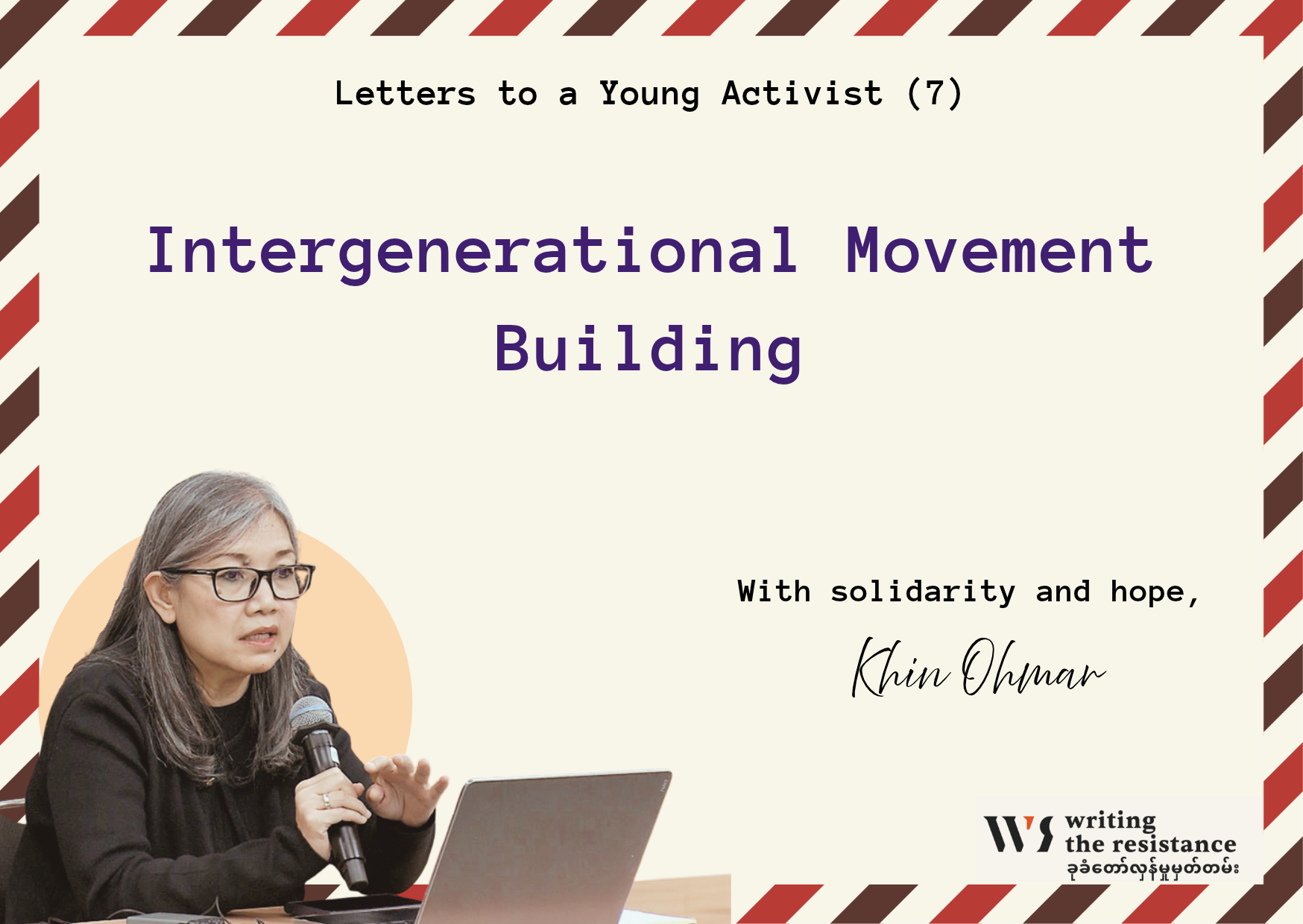
Guest contributor
Khin Ohmar
Dear young activist,
As an activist from the ’88 generation, I have experienced movement activism as both the younger generation in relation to the ethnic resistance movements and now as an elder to the Spring Revolution.
I deeply believe that the success of our movements, and social transformation more broadly, is in the deepening of trust, respect and recognition between generations.
For me, trust comes first. I offer it as a choice, even before respect is there. Trusting someone gives them the confidence to act, to grow, and to show us who they are.
Respect comes more slowly. It builds through what people do, how reliable they are, and the integrity they show over time. Respect is hard to foster, particularly when we disagree, and is often driven by our own emotions and viewpoints.
Recognition, by contrast, is more mature and calm, and free of personal judgment. Recognition acknowledges a person for their effort, dedication and experiences, regardless of our own beliefs about their choices or actions.
So my practice is to try to trust people early, without deciding in advance whether they will succeed or fail, recognize them for their efforts and perspectives, and slowly develop respect when our values, principles, and actions are in alignment.
This matters across generations. As a younger activist once myself, I remember that I needed to feel trusted to carry on the struggle in our own way.
Now as I’ve become an elder activist, I think elder generations also need to feel recognized for their commitment and sacrifice that sowed the seeds of resistance and paved the way for the younger generations.
Recognition encourages the passing of the torch from one generation to another as the fight for justice carries on. For this journey to be successful with shared power, recognition, trust and respect all play key roles.
In this context, trust means letting go of assumptions of how things should be done.
Recognition means seeing the value in each person’s journey as it contributes to the collective. Movements grow and sustain when trust is given unreservedly, recognition grows through real listening, and shared values are upheld and respected.
Peoples’ movements have always depended on intergenerational exchange and wisdom. Each generation is shaped by different politics, technology, and social conditions.
In my early days of activism joining the border-based movement for federal democracy following the 1988 nationwide democracy uprising, I sought out and listened to older Karen, Karenni and Mon revolutionary leaders.
I didn’t always agree with them, but their experiences, wisdom and perspectives helped me think about my own aspirations.
We started from different places and we named our struggles differently, but ultimately we all wanted freedom for ourselves and for our people.
Shared purpose is the bridge between generations. When we can really set aside our ego and listen, our struggles turn out to be more alike than they look.
Feminist practice asks us to challenge patriarchy in society and also in ourselves, and generational differences can make that harder. Many older activists grew up under strict patriarchal rules, when even naming identities of lesbian or bisexual was seen as shameful and taboo.
Younger generations have widened our understanding and acceptance of gender and identity, vastly increasing visibility and participation of people across the LGBTIQA+ spectrum in the movement.
It’s important to remember that what feels natural today was made possible by many people who pushed boundaries earlier. When younger activists recognize what came before them, and elders acknowledge the bold courage of the next generation, solidarity and learning goes both ways.
But power struggles between generations are real. Elders can cling to leadership, sometimes without seeing their own biases and shortcomings.
Younger people bring freshness, clarity, and an intersectional lens we didn’t have. Your critique of militarism and misogyny has pushed the revolution closer to liberation.
If we truly want to change the system, we need to reflect on how we are sharing power, and developing trust, recognition, and respect between generations.
Karenni State is showing us what this can look like. The recent appointments of Maw Theh Mar as Joint Secretary 2 of the Karenni National Progressive Party (KNPP), and Mu Angela as chair of the Karenni State Consultative Council (KSCC) are an encouraging sign of systemic change.
Both are young Karenni women, and each is the first woman and the first young person to hold her leadership position.
To see this happen in political bodies that have long been dominated by men and most often elders marks a new era with the potential to make our institutions stronger, more representative, and better prepared for the future.
The Steering Council for the Emergence of a Federal Democratic Union (SCEF) should follow this lead and appoint women in top policy-making leadership roles.
Of course, both the KNPP and the KSCC, as well as the SCEF, can do better by adopting the policy of at least 30 per cent women participation in leadership.
The key to intergenerational movement building, to me, is in the balance of listening deeply and challenging respectfully. Elders carry stories, lessons and scars that may help the next generation of revolutionaries find their own way more strategically and effectively.
From my experience, when people feel recognized and heard, they are more able to listen and learn from others’ perspectives. When that exchange can happen across generations, trust can be strengthened and hope and clarity sustained.
The path of change for our people is long. After 38 years in this struggle I confess I am exhausted.
But in every generation, people have resisted oppression and fought for justice, whether or not they lived to see the fruits of the struggle in their lifetime.
We owe it to one another, and to future generations, to strengthen the ecosystem of our collective fight for freedom, rights, justice, and equality. And I believe we can do this through sustaining our commitment to intergenerational exchange.
With hope and solidarity,
Khin Ohmar is a Myanmar human rights activist who was involved in organizing the ‘8888’ nationwide pro-democracy uprising. She is also the founder and chairperson of Progressive Voice, a Myanmar human rights organization. She developed the Women Peacebuilding Program for Women’s League of Burma and served as program coordinator from 2000 to 2006.
DVB publishes a diversity of opinions that does not reflect DVB editorial policy. We’d like to hear what you think about this or any of our stories: [email protected]