


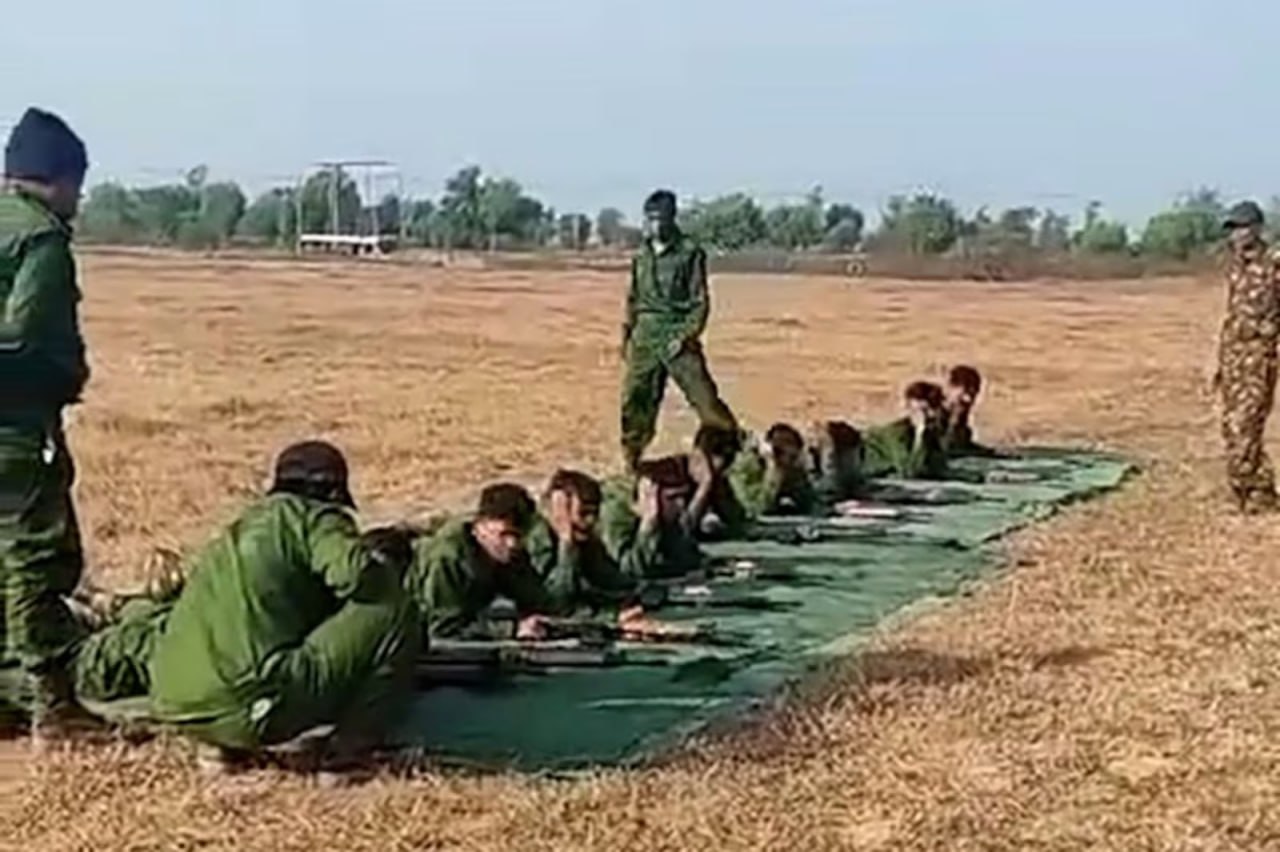
The Myanmar military and the ethnic Rakhine armed group, the Arakan Army (AA), have been forcibly conscripting and recruiting Rohingya and other Muslim youth in Arakan State to deploy them to active frontlines surrounding the state capital of Sittwe, according to accounts from local residents and diaspora networks.
In regime-controlled territory, military commanders have ordered the direct arrest of men in Rohingya communities and internally displaced persons (IDP) camps if local leaders fail to hand over designated quotas of recruits.
These coercive mobilizations fall entirely outside the regime’s formal 2024 conscription law—which mandates two years of service for men aged 18 to 35 and women aged 18 to 27 under threat of up to five years’ imprisonment.
The pressure follows an August directive issued by the regime’s former Arakan State Security and Border Affairs Minister, Kyaw Thura, who ordered five Rohingya wards and displacement camps in Sittwe to supply 20 new recruits every month.
Forced enlistments have exacted a deadly toll on the disenfranchised minority; after local leaders confirmed that 1,000 Rohingya men were pressed into service in northern Arakan in 2024, former National Unity Government (NUG) Deputy Human Rights Minister Aung Kyaw Moe revealed that at least 150 of those conscripts were subsequently killed in frontline combat.
Concurrently, the AA has faced mounting accusations of forcibly recruiting Muslim youth and conscripting minors under the age of 18 into its military apparatus.
While the AA’s 2025 “National Defence Emergency Provision” establishes mandatory two-year military service for men aged 18 to 45 living within areas under its administration, family members told DVB that younger males have been swept up into training formations.
The dual conscription drives have effectively trapped Rohingya and Muslim civilians between opposing warring factions, leaving them vulnerable to forced recruitment regardless of which force controls their immediate surroundings.
The intense drive for manpower comes as armed clashes escalate around Sittwe’s outer perimeter following a regime counteroffensive launched on Sept. 4.
Heavy ground fighting has engulfed the outlying villages of Amyintkyun, Yechanpyin, and Warbo, alongside recurring artillery exchanges around the regime’s strategic Shwemingan Naval Base.
The regime’s territorial foothold in Arakan has been reduced to Sittwe, the strategic deep-sea port hub of Kyaukphyu, and Manaung Island, with both Sittwe and Kyaukphyu facing active encirclement by the AA.
Against the backdrop of the fighting and forced recruitment, the regime’s Ministry of Foreign Affairs issued an update on Oct. 26 regarding stalled repatriation discussions with Bangladesh, stating that immigration authorities have verified 449,193 individuals out of an 828,824-person registry submitted by Dhaka.
According to the ministry, 326,376 people were confirmed as former Arakan residents, while 118,563 were labeled “unverifiable” and an additional 4,254 were flagged for alleged participation in attacks carried out by the Arakan Rohingya Salvation Army (ARSA) in 2016 and 2017.
The regime continues to strip the Rohingya community of legal recognition, refusing to use their ethnic identity and classifying them under the discriminatory 1982 Citizenship Law.
The regime acknowledged that over 740,000 people resided in northern Arakan prior to the 2017 military clearance operations that forced more than 540,000 across the border into Bangladesh—acts that now form the basis of the ongoing genocide proceedings at the International Court of Justice (ICJ)—while claiming that over 200,000 remained behind under systematic marginalization.