


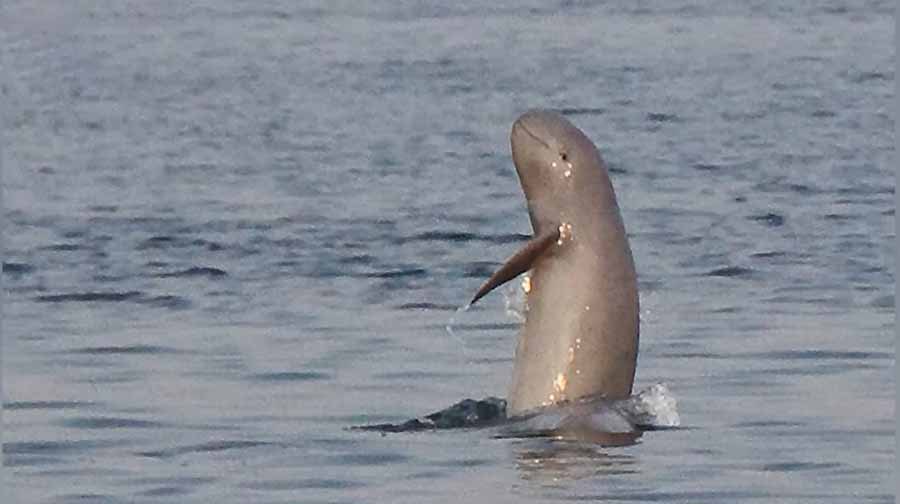
A four-foot (1.2 meters) long Irrawaddy dolphin was released after being caught in a fishing net on Jan. 19 by a fisherman in the sea near Kyeinmetaung village of Bokepyin Township, located 282 miles (453 km) north of the Tanintharyi Region capital Dawei in southeastern Myanmar. Locals there call the dolphins “linshu.”
“We used to see three-to-four linshu in groups, when we were young in the sea near our village. But lately, they are seen less frequently,” Nyein Htet Aung, a fisherman in Kyeinmetaung village, told DVB.
“I want everyone to know that the Irrawaddy Dolphin is a rare species. We should protect and preserve these lovely creatures. It should be released in the sea if it is caught in fishing nets,” Nyein Htet Aung added.
The Irrawaddy dolphin, known officially as Orcaella brevirostris, is a species of oceanic dolphin which has a rounded head and a short snub nose first seen in the Irrawaddy River in 1879. They are now facing a grave risk of extinction.
“The main threats for these species are humans,” an environmental conservation organization called Native Species Conservation & Identification told DVB.
Orcaella brevirostris has been recorded as far away as Chilika Lake in India, or Papua New Guinea, but now it is only found in Myanmar’s Irrawaddy River, the Mekong River in Laos and Cambodia, or the Mahakam River in Indonesia. It was once called the “River Pig” and has existed for thousands of years, according to ancient Chinese records.
They inhabit the wetlands along riverbanks and in the Andaman Sea. The greatest threat to the dolphin’s survival is electrofishing. This is a method using an electric current to attract fish, including dolphins. The electric current can kill the dolphins.
Gold mining and excavation activities also devastate the marine environments that these dolphins depend on for their survival. Another major issues is heavy fishing practices using gillneting, which can entangle dolphins and lead to their deaths.
Myanmar fishermen in the Irrawaddy River said that they use a traditional method that involves calling the dolphins by banging on the side of their boats. The dolphins then herd fish into their fishing nets.
The number of Irrawaddy dolphins documented in 2019 was 72 down from 76 the previous year. In June 2020, this number increased slightly to 79. No documentation of the dolphins has been carried out since then.
The Native Species Conservation & Identification told DVB that conservation efforts for the Irrawaddy dolphin are underway, but remains a challenge due to security issues because of the conflict since the uprising to the 2021 military coup began.
In Myanmar, two conservation areas set up in the Irrawaddy River from Mandalay to Shwegu Township in Kachin State, by the National League for Democracy (NLD) government in 2018 allow the dolphins to thrive.
Conservation experts urge everyone in Myanmar to cooperate in order to save the dolphins from the threat of extinction due to fishing nets, plastic trash, industrial pollution and electrofishing.