


Guest contributor
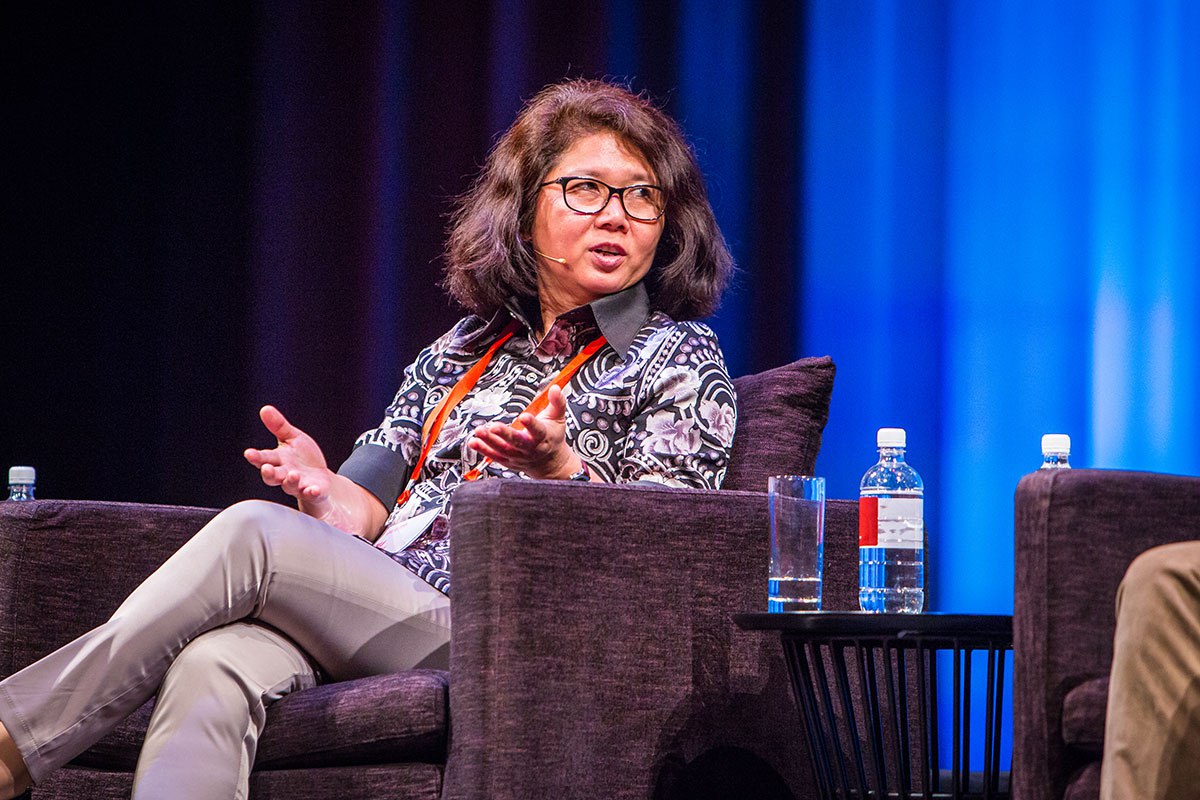
Ma Thida
During my journey to Japan, I came to perceive with greater clarity both the depth of Japanese interest in Myanmar’s situation and the quiet yet vital role played by the Myanmar community living there.
Though the cold of Europe and Japan may seem alike, I arrived from a Europe starved of sunlight, and in Japan I found myself unexpectedly buoyed by the sun’s frequent appearances.
Against the cold, one can always add another layer; against a sun that will not rise, there is no remedy. The long winters of Berlin, in particular, had often weighed heavily on my spirit for that reason alone. Perhaps this is why Japan felt so gently, insistently uplifting.
Alongside the many practical arrangements for my journey to Japan—visa applications among them—there loomed a quieter but no less demanding task: finding a title for my talks.
When the organizers first asked me to name them, I was already absorbed by competing obligations, and the decision arrived only after some delay.
In truth, I have never felt at ease fixing a title too early. I prefer to let it emerge at the threshold of the event itself, after listening attentively to the rhythm of local speech, to the atmosphere of the place, to the unspoken concerns that hover in the room.
Only then, I believe, can words find their proper alignment.
In the end, I chose the title Today Is for Tomorrow. Yet the simplicity of a single title concealed a complication: there would be four events, spread across three Japanese cities, each one livestreamed.
Under such conditions, repetition felt both unnecessary and unfaithful to the spirit of the journey. A single title, yes—but not a single, replicated talk. What was needed was an underlying architecture, something that would allow each lecture to differ while remaining tethered to a common idea.
Gradually, a structure revealed itself beneath the title. “Tomorrow” would stand as a horizon—a point of aspiration toward which we are drawn. “Today,” by contrast, would be our ground: the present moment, with all its constraints and possibilities, from which any movement must begin.
Two talks would be devoted to these poles—the destination and the terrain—while the remaining two would explore the passages between them: the choices, strategies, and crossings that might carry us from where we are to where we hope to arrive.
From there, the content took shape. In one talk, I reflected on how we ought to imagine the future in its fullest detail, both in our private lives and in our collective existence as a nation.
I spoke about the meaning of a federal structure and why democracy is not merely a political system but a cultural foundation that sustains social life. In another, I turned my attention to the present—to the necessity of understanding, examining, and honestly confronting our current condition.
Only when we clearly recognize where we stand, I argued, can we responsibly prepare for what comes next and shape a credible path forward.
The third session focused on choice itself: the importance of consciously and deliberately selecting our route from today toward tomorrow. The final talk extended this idea further, emphasizing that any strategic and mindful journey depends on reading and learning.
I urged the audience to read widely and deeply—not as an academic exercise, but as a way of cultivating judgment and awareness, so that our decisions, both personal and national, might be informed rather than impulsive.
What remained with me most powerfully, however, was the response. At all four events, I was met with remarkable warmth, openness, and thoughtful engagement.
I am deeply grateful to the audiences, as well as to the organizers and volunteers in Nagoya, Tokyo, and Osaka, whose dedication made these gatherings possible.
The trip itself has stayed with me as a vivid and enduring memory. Although I struggled at times with a cold and exhaustion, the experience of moving through Japan—from the snow-covered village of Shirakawa-go to the Hakone Open-Air Museum, from the Mount Fuji region to Nara Park, and through countless historic buildings and landmarks in Tokyo, Nagoya, and Osaka—left a profound impression.
Castles, peace memorials, and folk craft museums together deepened my admiration for Japanese culture and architecture, and gave the journey a resonance that extended far beyond the lectures themselves.
Among all the journeys folded into this visit, the one to Kyoto felt singular—almost inevitable. We had come to Japan for many reasons, but the quiet center of this particular pilgrimage was our long-delayed plan to see Noriko Otsu.
The author of A Letter for Daw Aung San Suu Kyi had, in recent years, been living in a nursing home. I had heard that news reached her only dimly now—that even the passing of her husband, Sadayoshi Otsu, had touched her awareness only faintly, and that at times faces blurred into uncertainty. For that very reason, I felt a deep urgency: if I were to come this far, I must not fail to see her.
Before the meeting, I tried to prepare myself. I rehearsed, inwardly, the possibility that she might not remember me, that our time together might be brief or fragmentary.
There was no assurance of another opportunity—no promise that a future meeting would find her fully present, or that circumstances would permit one at all. The fragility of time, which had been an abstract theme in my talks, now pressed close and personal.
The reunion itself was made possible by our old friend, the Japanese photographer Yuzo Oda—known to us by his Burmese name, Ko Khine Tin.
Thanks to his careful arrangements with the nursing home, everything was gently in place when we arrived. And then, unexpectedly, grace intervened.
Noriko-san seemed to recognize me. Her eyes were clear, bright with alertness, and she spoke with a liveliness that dissolved my earlier fears. For a long while, her voice carried strength and intention.
When the conversation turned to Daw Aung San Suu Kyi, she exclaimed with surprise, “Oh, has she already turned eighty? To me, she is still young.” It was as if, in her heart, time had preserved Daw Suu in a state of enduring youth.
Yet her affection was accompanied by indignation. More than once, she said, with unmistakable sorrow, “I had thought there must be at least a few intelligent people in the Myanmar military. But no—it is truly tragic for the country, how thoughtless they are, how they continue to make mistake after mistake.”
The repetition was not forgetfulness; it was conviction.
At first, she spoke to me in English. But as Ko Khine Tin, Ko Ta, and Ma Khin Myat—who had accompanied me—translated fluidly into Japanese, something shifted.
Hearing her own language echo warmly in the room, Noriko-san grew more animated. She spoke freely in Japanese, her sentences flowing with renewed energy, and my companions faithfully carried her words back to me.
We touched on many memories: her phone conversations with Kim Aris a month ago, my visits in 2013 and 2017, scattered recollections that surfaced and drifted away.
Yet, wherever the conversation wandered, it circled back to her unwavering belief that the tragedy of Myanmar lay in the absence of wisdom within its military leadership. And again, she said she was praying—praying for Daw Aung San Suu Kyi’s release.
After some time, her voice softened. She confessed she was feeling sleepy. We gathered close for photographs, then gently helped her into bed, drawing the covers up around her shoulders as one would for a beloved elder.
Our farewells were quiet. From her bed, she continued to wave at us—again and again, long after words had ceased to matter.
I could not bring myself to say sayonara, Noriko-san. Instead, I carried away a silent prayer of my own: that she might one day meet again, in full clarity and awareness, the Daw Aung San Suu Kyi she has loved with such steadfast devotion.
What struck me first during my literary talks in Japan was the presence of Japanese participants themselves. Although we offered translation services at only one of the talks, some Japanese participants attended all four events.
They stayed from the beginning to the end of each session and, interestingly, used Google Translate to grasp at least the essence of my message. Their attendance was not incidental; it was the fruit of years of quiet labor by Myanmar communities across Japan.
Week after week, in the ceaseless flow of railway stations and transit corridors—places so distinctly vibrant in Japan—fundraising and donation drives for the Spring Revolution that began in 2021 have continued with unwavering dedication.
Local police and civic authorities, rather than obstructing these efforts, offered cooperation. Yet more powerful than any institutional support was the perseverance of the Myanmar people living far from home. Through their constancy, they stirred in ordinary Japanese citizens an awareness of, and a compassion for, Myanmar’s plight.
Yet alongside this welcome openness, there was caution. When Japanese officials learned of my circumstances—that I carry no national passport and travel on a stateless document—they granted a visa, though with the instruction that my itinerary be followed without deviation.
Later, I discovered they had anticipated something altogether different: fiery rallies, raised fists, impassioned slogans echoing in the halls. Even elderly members of a local civic group in Japan, who had lent their support to the organizers, confessed that they had imagined much the same.
But once they attended, their expectations dissolved. In place of agitation, they found composure; instead of anger, reflection. They came to realize that it was not only members of the Myanmar diaspora, but Japanese attendees as well, who were not stirred to fervor, but instead quietly touched by the ideas and reflections shared during my talk.
It was then that I recalled a conversation with an old friend, Aiko-san, who once asked me what forces had shaped political change and social momentum in the past decade in Myanmar. My answer surprised her.
“Literary talks [Sar Pay Haw Pyaw Pwe],” I said, “were themselves a form of grassroots movement between 2010 and 2020. They were never directed by a single authority, nor choreographed from above.
They arose organically—within neighborhoods and classrooms, universities and workplaces, political circles and social organizations. Each gathering stood on its own, unfolding in its own time and place.
Rarely does a movement of such national breadth emerge so voluntarily and spread so widely. If any popular current transformed the political consciousness of the public in those years, it was these literary talks.”
After attending both events in Tokyo, she asked nothing further.
And yet, the most resonant response came not in Tokyo, but in Nagoya. An elderly Japanese woman, who had attended two of the four talks, was asked by the organizer what she thought. She answered with disarming simplicity: “Myanmar has a future.”
In that brief sentence lay a depth no speech could rival. It was enough for the organizers, for me, and for the Myanmar people wherever they may be. Yes, Myanmar’s future rests in the hands of its own people. Tomorrow is not a distant promise; it is already cradled within today.
Ma Thida is a writer who believes in freedom of expression, and once, a medical doctor loved doing surgery and revolution. She was also a prisoner of conscience. She is currently the chair of the Writers in Prison Committee of PEN International and is joining the Writers in Exile program of PEN Germany. She published 26 books in Burmese and 3 books in English.
DVB publishes a diversity of opinions that does not reflect DVB editorial policy. We’d like to hear what you think about this or any of our stories: [email protected]