


Guest contributor
Kannikar Petchkaew
When the Kawthoolei Army (KTLA) declared a “Kawthoolei Republic” in territory it controls in Karen State on January 5, most of Myanmar’s ethnic armed groups stayed silent. Some dismissed it as fantasy. Others treated it as a fringe political stunt. The media report on it as a theater.
Four days later, one organization broke ranks.
On January 10, the Kachin National Organization (KNO) became the first and only political group anywhere to formally recognise the KTLA declaration, calling it a lawful act of self-determination under international law.
“This declaration is not an act of secession for convenience or political gain,” the KNO said in its statement, citing the U.N. Charter and the International Covenant on Civil and Political Rights (ICCPR).
It described the KTLA move as “a measure of survival and protection for a people facing ongoing existential threats under continuous military rule in Burma.”
Why a Kachin political organisation — operating far from Karen territory — would take such a step is one of the most consequential questions now facing Myanmar’s fractured resistance.
In interviews with two senior KNO leaders, General Secretary Hkun Htoi Layan, and its Foreign Secretary and spokesperson Hkanhpa Tu Sadan, a picture emerges of a movement that no longer believes Myanmar can be repaired.
It views Kawthoolei not as an outlier, but as the first visible crack in a collapsing political order.
A Kachin movement misunderstood
The KNO was founded in January 1999, when the ethnic armed group Kachin Independence Organization (KIO) was locked into a ceasefire with Myanmar’s military.
“That ceasefire neither became peace building nor peacemaking,” Hkanhpa Tu Sadan said. “It rather became militarisation… and incredible amounts of environmental destruction in our land.”
Because the KIO was politically constrained, Kachin elders inside Myanmar and in exile created a separate political platform.
“They set up another political platform to raise what’s going on inside Kachin State,” he added.
KNO leaders stress that they are not a breakaway from the KIO, but a parallel political current.
“This confusion is understandable,” said Hkun Htoi Layan, the KNO general secretary. “But it is also a result of an incomplete understanding of Burma’s political reality. Thailand, as Burma’s immediate neighbor, must understand all key stakeholders, not just the most visible ones.”
The KNO supports the Kachin Independence Army (KIA) in Kachin State. “Almost every KNO family today has members serving on the frontlines,” he added
Not just politics: A quiet military footprint
What has not been publicly known — until now — is that KNO also maintains its own armed wing.
According to Hkun Htoi Layan, the organisation operates the 108th Special Regiment of the Jinghpawland Army, a guerrilla unit that has fought inside Kachin and northern Shan states, where the KIA has long battled for control against the Myanmar military.
The regiment, he said, conducted jungle warfare before and during Operation 1027, the offensive launched by the Brotherhood Alliance – the Myanmar National Democratic Alliance Army (MNDAA), the Ta’ang National Liberation Army (TNLA), and the Arakan Army (AA).
The KNO claims it took part in operations that led to the capture of strategic sites including the 105-Mile trade zone, the northern Shan city of Lashio, and nearby Kyaukme.
“These actions were part of a broader, multi-actor resistance effort against our common enemy,” he said, referring to the Myanmar military.
The KNO’s former armed wing, the United Kachinland Army, was formally merged into the KIA in 2012. Some former KNO fighters became senior KIA commanders but many have been killed in combat.
The revelation challenges the perception that KNO is merely a diaspora political group without leverage on the ground.
For decades, the KIO and much of Myanmar’s ethnic resistance pursued a federal solution. But KNO leaders say that the strategy collapsed under the weight of military manipulation.
“The 2008 Constitution offered no political solution,” Hkun Htoi Layan said. “The divide-and-rule strategy of the Burmese military weakened collective bargaining.”
In 2019, KNO convened a Kachin Public Conference in Chiang Mai, Thailand. Delegates from across Kachinland voted that the Kachin people should pursue full independence.
“That is the mandate under which we now act,” he said.
Why does Kawthoolei matter?
The KNO’s recognition of the KTLA declaration of a “Kawthoolei Republic” in its territory of Karen State did not come out of nowhere.
“The founding members of Kawthoolei and our leadership have been fighting together for many years,” Hkanhpa Tu Sadan said. “We have a long relationship and mutual respect.”
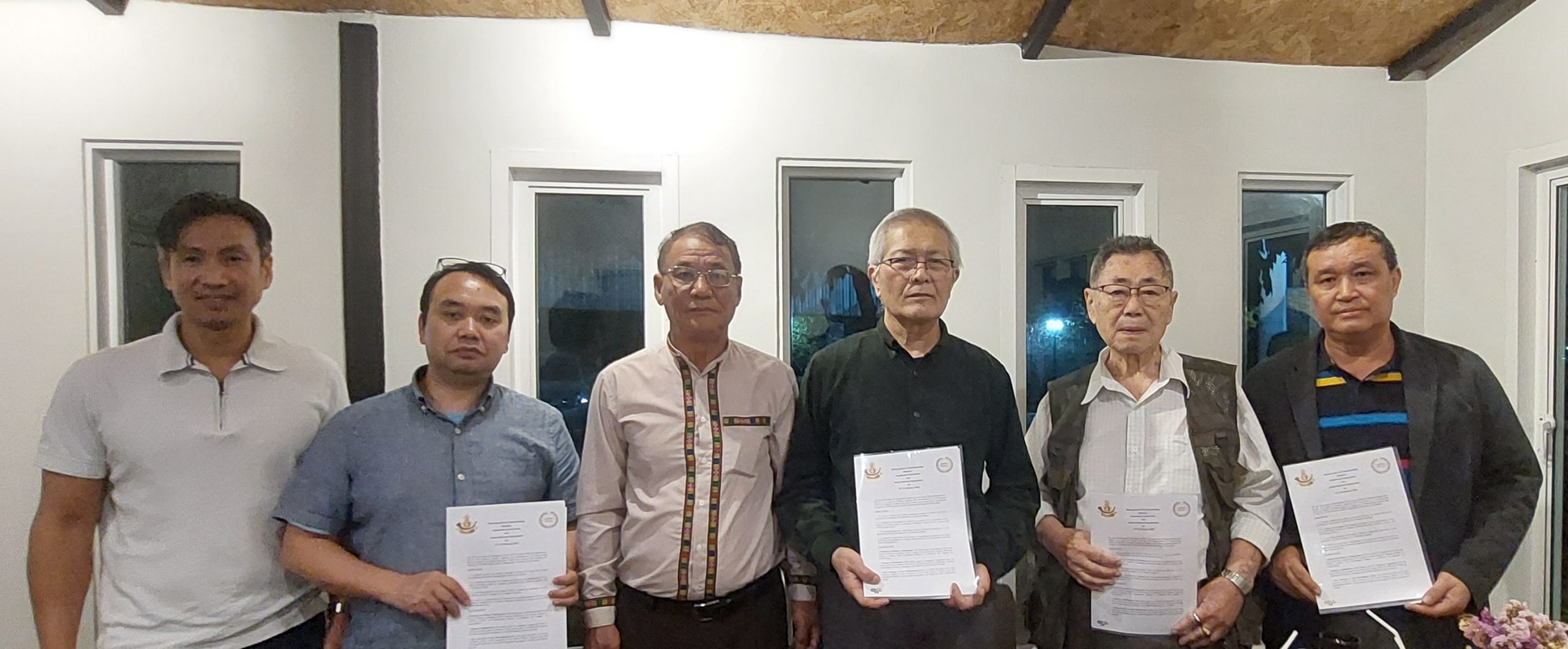
The two sides signed a memorandum of understanding in 2025, pledging political cooperation. “Our political aims are in line,” he said. “We will support each other.”
He said the idea did not emerge out of anger or despair, but from more than 70 years of undeniable reality.
“Our forefathers deeply respected and steadfastly pursued the principle of federalism. They signed the Panglong Agreement and upheld it as a top priority, proving their commitment with their lives. We honor them with our own lives. To truly respect their sacrifice is to fulfill their dream of living free,” Hkanhpa Tu Sadan added.
During the interview, I asked whether backing a ‘Kawthoolei Republic’ also meant the Kachin leadership was prepared to take a similar path.
“Exactly,” Hkanhpa Tu Sadan replied. “We will be hand in hand to build the Kawthoolei government, and they will help us to build the Kachin nation.”
When asked when that would happen. He has a big smile saying he was not allowed to disclose. “But you will see”
Critics have dismissed the KTLA’s “Kawthoolei Republic” as a fringe project led by a small group of insignificant players. Hkanhpa Tu Sadan rejects that framing.
“If we look at the history of liberated nations, every nation started with a small group of people,” he said, pointing to China’s 1911 revolution led by Sun Yat Sen who led his group to overthrow China’s Qing empire, the founding of the KIA by seven students, and the rise of the AA which just years earlier had a handful of ambitious men.
“They have planted these inspirations,” Hkanhpa Tu Sadan said of the KTLA. “And those seeds will grow into a big tree. And we are all well aware, starting a new nation is not easy.”
The KNO does not yet control an administrative region, or territory, of its own.
“For our administrative land, we don’t have it yet,” Hkanhpa Tu Sadan said. “But ideology or political inspiration is incredibly important. I can assure you that the Kachin people want an independent nation.”
KNO’s vision is not endless fragmentation.
“Our vision is clear,” Hkun Htoi Layan said. “An independent Kachinland and a new Burman majority nation can become peaceful neighbouring countries. The so-called union has failed. Forced unity is over.”
Whether the ‘Kawthoolei Republic’ is taken seriously remains uncertain. But something more profound has already happened. For the first time, some Myanmar people have started speaking out loud, saying that Myanmar itself is no longer their future.
Kannikar Petchkaew is an independent Thai journalist covering mainland Southeast Asia for over 30 years.
DVB publishes a diversity of opinions that does not reflect DVB editorial policy. We’d like to hear what you think about this or any of our stories: [email protected]