
Thursday, July 23, 2026
Home Blog Page 79

Viewing Myanmar’s future through the lens of climate change

0
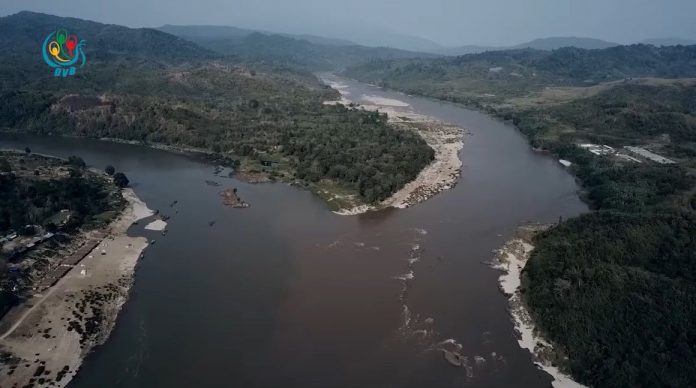
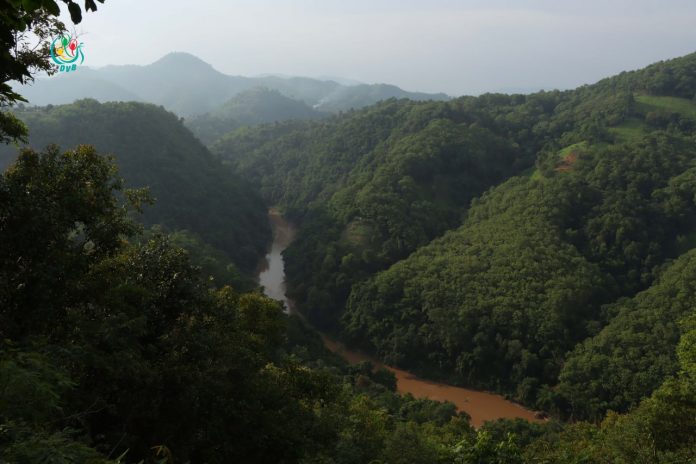
The Kok River in northern Thailand's Chiang Mai Province enters from Myanmar's Shan State, where rare earth mining has been reported and has caused arsenic contamination. The Kok is a tributary of the Mekong River. (Credit: DVB)

Guest contributor

Tun Naung and Thet Wai

“Chaos is a ladder”, Littlefinger says to Lord Varys in the hit HBO series Game of Thrones. Before saying this, Varys talks to Littlefinger about how he serves only the realm. 

Amusingly, Littlefinger responds by saying that the realm is just a lie which people told again and again until they forget it is a lie. Varys then argues that if this lie is removed, everything will fall into chaos. 

Without denying it, Littlefinger simply whispers,“Chaos is a ladder”.

The 2021 military coup in Myanmar created this kind of chaos. Before that, Myanmar was living under a dominant political story of gradual democratic reform. 

Under this narrative, explicitly confronting the military was considered outside the mainstream, and alternative visions of the country’s future were sidelined. 

The 2021 coup radically altered this arrangement. Alongside the widespread anti-junta movement which far exceeded the military’s expectations, the collapse of the old political order created a political vacuum: a rare opportunity to rethink and reimagine the country’s future from the ground up.

Political discourse before and after the coup

The political discourse before the coup was different from the discourse today. Words like national reconciliation, peace, federalism, and constitutional reform were a part of this discourse.

These issues are often discussed in the mainstream political platforms such as the parliament, the media and the political conferences which prospered back then. 

The importance and relevance of these issues sprang from the pre-coup political climate. To some extent, it reflected some of the problems of the country. 

However, it did not reflect some of the most dire problems that require our serious attention. After the coup, there were radical shifts in the political landscape. 

Consequently, there were changes in the political discourse too. The ideas of national reconciliation and constitutional reform seemed to be left dusted in the attic of history.

Terms like armed revolution, civil disobedience and political alliances came under the spotlight. These shifts in the discourse also reflected the changes in the nationwide political conditions. Still, the same problem continues to exist as before. 

Some critical problems remain sidelined by the mainstream discourse. And one of those untouched problems is climate change.

Why climate change matters for Myanmar

Why does climate change matter and why should it be in our political discourse? Scientific data and recent natural disasters reveal the answer. 

According to Germanwatch’s 2026 Global Climate Risk Index, Myanmar was the second most climate-affected country between 1995-2024. 

During that period, Myanmar experienced 55 extreme events, resulting in close to 141,000 fatalities, more than nine million people affected and over $8.6 billion USD of economic damage. 

The physical consequences are already reshaping everyday life. In dry zone regions of Magway and Sagaing, intensifying heatwaves are pushing temperatures to dangerous levels, adding a new wave of internal climate migration to an already devastating conflict-driven displacement crisis. 

At the same time, Myanmar’s coastlines face the growing threat of rising sea levels, with projections warning of significant inundation risks by mid-century. Myanmar is not waiting for a climate crisis. It is already living in a serious one.

However, the prevailing assumption is that the current political situation leaves no room for it. 

Since 2021, political battles have become so intense that compromise has become nearly impossible, even in the face of other shared national crises such as the COVID-19 pandemic and the 2025 Sagaing earthquake. 

Political survival has taken priority over everything else. 

Moreover, climate-related aspects are rarely taken seriously into consideration. Even when natural resource management is being discussed, it is more focused on the possible economic opportunities rather than on the environmental impacts. 

This does not mean that the political actors are not aware of climate related problems though. Rather, they are making a conscious choice between political goals and climate change. 

They, along with much of the general public, genuinely believe that democracy, freedom and federalism are far more important than climate change and that climate change is an issue that can wait.

This prevailing assumption needs to be questioned. Climate change should be a starting point for reimagining Myanmar’s future. 

Because climate change will reshape the country’s underlying social, economic and political conditions, it cannot be treated as a technical issue which can be solved after the dust settles. 

Rather, it should be treated as a fundamental factor in addressing the country’s core political questions. Modern Myanmar’s political debates have largely centered on the state structure, territory claims, and power distribution. 

These issues remain at the heart of ongoing constitutional and political discussions today and they have traditionally been framed through the lens of historical grievances and ethnic identity. 

Climate change must enter these debates as its impacts will alter the physical realities of the country: its coastlines, its river systems, its agricultural lands, and its habitable zones within which any future political systems must operate. 

A power-sharing agreement that does not account for climate-driven displacement or a state structure designed without anticipating the impact of rising sea levels and intensifying storms, risks becoming irrelevant in the decades ahead.

Natural resource governance as an entry point

In the short-term, serious attention must be paid to natural resource governance. Competition for natural resources has been one of the major drivers of Myanmar’s conflicts. 

Historically, the central government, dominated by the Burmese majority, extracted natural resources from ethnic territories for state coffers. 

In response, ethnic groups took up armed struggle for equity and self-determination, aiming to protect their land. Nevertheless, financing those costly operations required them to rely on the very same extractive industries. 

Over time, fighting over natural resources has become a major source of disputes even among the ethnic groups. At the same time, excessive reliance on extraction causes serious damage to the environment. 

As these industries push beyond the limits of ecological recovery, they pave the way for deforestation, soil erosion, river sedimentation and the destruction of watersheds, threatening the very ecological foundation of the country.

Moreover, this environmental destruction does not stop at Myanmar’s borders. Unregulated mining operations in Shan and Kachin states, mostly run by Chinese companies, have been sending toxic runoff into Thailand, contaminating the Kok, Sai, and Ruak rivers in the Golden Triangle region. 

Satellite data has identified 513 rare earth mining sites across Myanmar’s major river tributaries, with the pollution already causing an estimated $40 million USD in losses to farming, fishing, and tourism communities in Thailand’s Chiang Mai and Chiang Rai provinces. 

This transboundary harm creates regional tension at a time when Myanmar’s political actors need goodwill and support from neighbouring countries.

The current model is therefore not only environmentally damaging, it is politically self-defeating. The cost of armed struggle has tempted armed groups to rely excessively on extraction as a primary revenue source. 

But this risks weakening the very communities they claim to protect and eroding the ecological foundations upon which any future settlement must rest. 

For these reasons, crafting a natural resource governance model that operates within ecological limits by recognising the finite nature of forests, rivers, and mineral deposits becomes a political necessity.

Alongside this, any governance framework must incorporate environmental and social impact assessments for extractive projects. 

This would give local communities a meaningful voice before projects begin, protect neighbouring countries from transboundary harm, and build the environmental credibility to secure regional and international support. 

Therefore, rethinking climate change must begin with constructing a natural resource governance model that guarantees a sustainable environment and produces responsible political actors.

Chaos as a ladder

The 2021 coup created chaos but it also opened up a window to generate alternative visions for the country. The post-coup political landscape paved the way for new ideas and considerations, yet climate change is still left out of the political discourse. 

Amidst the intense political struggle, it is understandable that climate change is widely regarded as an issue to be dealt with later. Nonetheless, scientific and historic data suggest otherwise, revealing its indispensability in future political arrangement. 

Given this condition, natural resource governance presents itself as an entry point to prepare for the climate-resilient political structures. In short, chaos can be used as an opportunity to create a more inclusive political agenda that was almost unapproachable before. 


Tun Naung is a student studying political economy and Thet Wai is a student studying political science.

DVB publishes a diversity of opinions that does not reflect DVB editorial policy. We’d like to hear what you think about this or any of our stories: [email protected]

Will ICC issue arrest warrant for Min Aung Hlaing? [VIDEO]

0
Oriane Maillet is the spokesperson for the International Criminal Court at The Hague, in the Netherlands. She joined us in the DVB Newsroom on April 14. (Credit: DVB)

The International Criminal Court (ICC) has affirmed that Min Aung Hlaing’s recent maneuver to shed his military uniform and assume the civilian title of Myanmar’s president will not provide him legal protection against a pending international arrest warrant for crimes against humanity. Read more.

Myanmar refugees seek risky sea routes to safety

0
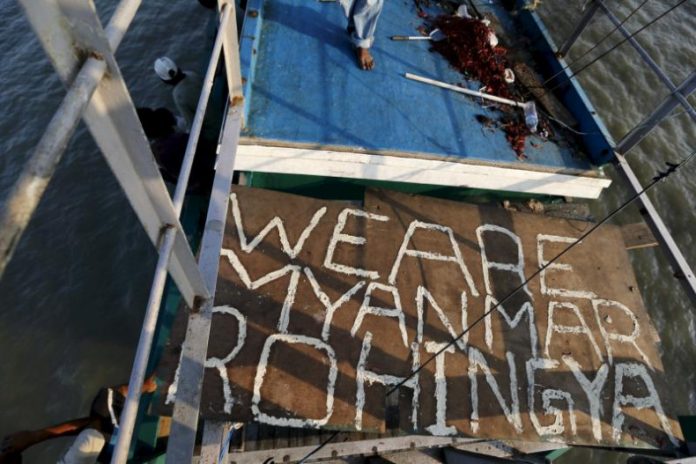
"We are Myanmar Rohingya" written on an abandoned boat found off the coast of Indonesia. (Credit: Reuters)

Deadly maritime journeys have become a recurring feature of a long-running humanitarian crisis, as refugees from Myanmar continue to risk their lives on overcrowded, unseaworthy boats in search of safety and opportunity.

For years, members of Myanmar’s Rohingya Muslim minority have risked their lives on flimsy wooden boats, driven by violence at home and desperate conditions in crowded refugee camps in Bangladesh, hoping to reach safety and opportunity in countries such as Malaysia, Indonesia or Thailand.

Routes people fleeing Myanmar take

These journeys refer to people fleeing from Myanmar by land or sea or traveling onwards from a country where they sought refuge and international protection.

Most Myanmar refugees escape overland from western Myanmar into Bangladesh’s Cox’s Bazar, while others travel onward through India toward major cities. A second stream follows sea routes, with boats crossing the Bay of Bengal and Andaman Sea from Myanmar and Bangladesh toward Thailand, Malaysia and Indonesia. A smaller number move through regional air routes.

Most refugees flee by land. Of roughly 367,000 people from Myanmar who attempted to migrate in search of safety and protection in the four years to January 2026, only about 7% travelled by sea or river, according to the United Nations Refugee Agency.

Despite the risks, the agency says, increasing numbers of Rohingya were making similar risky journeys via sea.

Refugees fleeing Myanmar by boat

More than 27,000 refugees fled Myanmar by boat in seven years to 2025

Yet, many continue to die or go missing enroute. Of about 25,300 people who embarked on boat journeys between February 2022 and March 2026, more than 2,300 died or went missing enroute.

Of all the refugees who embarked on a maritime journey in this period, more than 60% travelled within Myanmar. Indonesia was the second most sought after destination, followed by Bangladesh.

In 2017, Myanmar’s armed forces launched an offensive that ​forced at least 730,000 Rohingya from their ​homes and ⁠into neighbouring Bangladesh, where they recounted killings, mass rape and arson. A U.N. fact-finding mission concluded the 2017 military ⁠offensive ​had included “genocidal acts”. Buddhist-majority Myanmar has denied ​genocide, and says the U.N. fact-finding mission was not objective or reliable.

REUTERS

ICC confirms Min Aung Hlaing presidency grants no immunity from arrest warrant

0
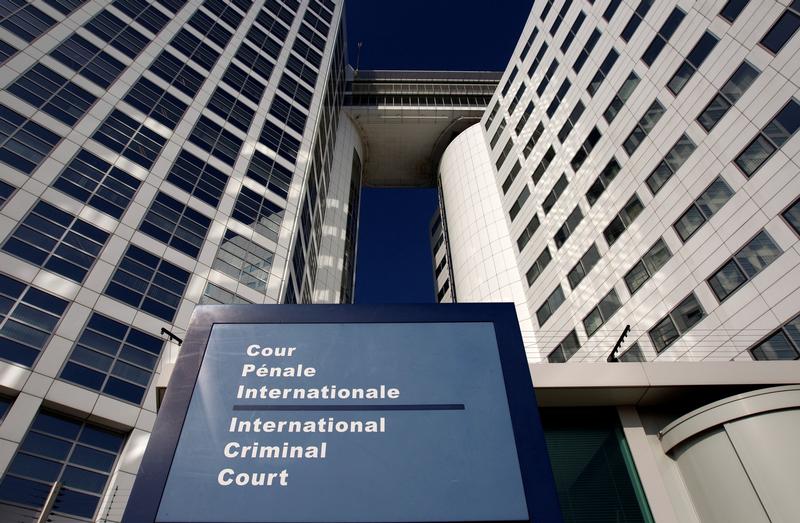
The entrance of the International Criminal Court in The Hague, Netherlands, on March 3, 2011. (Credit: Reuters)

The International Criminal Court (ICC) has affirmed that Min Aung Hlaing’s recent maneuver to shed his military uniform and assume the civilian title of Myanmar’s president will not provide him legal protection against a pending international arrest warrant for crimes against humanity.

“The decision of the judges on whether or not to issue the arrest warrant is solely based on the evidence,” Oriane Maillet, the ICC spokesperson, told DVB in a Newsroom interview on April 14.

“The fact that this person’s election was announced doesn’t change the fact that an arrest warrant was requested against him. The founding treaty of the ICC, the Rome Statute, outlines that the ICC applies equally to all persons without any distinction based on official capacity.”

A pending warrant caught in judicial review

The legal process against Myanmar’s military leader has been in motion since November 27, 2024, when the ICC Chief Prosecutor Karim Khan applied for a formal arrest warrant.

Min Aung Hlaing faces allegations of bearing criminal responsibility for the deportation and persecution of Myanmar’s ethnic Rohingya Muslim community between August and December 2017.

The warrant application is currently sitting with the ICC’s Pre-Trial Chamber judges, who must review the evidence to ensure it meets the necessary standards before formally issuing the warrant.

The ICC states that there is no set timeframe for the judges to make a decision, as it depends entirely on the specific circumstances of the case.

Enforcement and the Sword of Damocles

If the ICC judges officially grant the arrest warrant, Min Aung Hlaing’s diplomatic and personal mobility will be severely permanently restricted.

Because the ICC is a judicial body without its own police force, it relies on its 125 member states to execute its decisions. If Min Aung Hlaing steps foot in any of these member countries, those nations have a strict “legal obligation” to detain him and hand him over to The Hague.

“Once an arrest warrant is issued, this warrant is valid for life,” Maillet told DVB. While the ICC cannot try suspects in absentia—meaning Min Aung Hlaing must be physically present in the courtroom for a trial to begin—the threat of arrest will hang over him indefinitely.

Expanding the scope of justice

While the current ICC warrant application specifically targets the 2017 atrocities against the Rohingya, Maillet added that the Court is closely watching the ongoing violence in Myanmar, which has spread nationwide after the military coup on Feb. 1, 2021.

Although Myanmar is not a state party to the Rome Statute, the ICC established jurisdiction because part of the 2017 crime of deportation occurred on the territory of Bangladesh, which is a member state.

The ICC confirmed it is actively “monitoring the situation in Myanmar following the [2021] coup,” noting that thousands more Rohingya have fled their homes due to violence and have been forced across the border into Bangladesh over the last five years.

The Office of the Prosecutor is currently assessing these recent developments to determine possible further legal steps.

In the meantime, the ICC welcomed complementary justice initiatives, such as the international arrest warrant issued for Min Aung Hlaing by a federal court in Argentina last year under the legal principle of universal jurisdiction.

“We welcome any initiatives that complement the work of the Court,” Maillet told DVB, emphasizing that the ICC serves as a court of last resort to fight impunity for the world’s gravest crimes.

Opposition to revived Myitsone hydropower dam project in Kachin State grows

0
The revived Myitsone hydropower dam project is located at the confluence of Maykha and Malikha rivers, which is the source of the Irrawaddy River, in Myitkyina Township, Kachin State. (Credit: DVB)

Residents in the Kachin State capital Myitkyina told DVB that it is difficult to publicly oppose the regime’s plans to resume the Myitsone hydropower dam project due to the fear of arrest and persecution since Naypyidaw announced in December that it will take legal action against anyone who opposes its planned projects.

“We have been told by the [regime administration] about the benefits of operating the project during meetings. No questions have been raised by residents as no one dares to confront the military,” a Myitkyina resident told DVB on the condition of anonymity. 

The Myitsone hydropower dam project, which started in 2009, was resumed by the regime on Dec. 16 after being suspended in 2011 by then-President Thein Sein due to public opposition over earthquake risks as it is located 16 miles (25.4 km) northeast of the Sagaing Fault. 

The proposed location for the Myitsone hydropower dam is along the confluence of the Maykha and Malikha rivers, which is the source of Myanmar’s Irrawaddy River, in Kachin State. 

The project is worth $3.6 billion USD and includes six sites along the rivers with a total capacity of 19,099 megawatts of electricity, of which 6,000 megawatts will be generated from the Myitsone dam. 

Regime deputy Soe Win stated in December that hydropower should be prioritized as it is the most cost-effective energy source at 82 MMK ($0.02 USD) per unit, compared to 171 MMK ($0.04 USD) for solar, 215 MMK ($0.05 USD) for coal and 235 MMK ($0.05 USD) for natural gas. 

Residents of Myitkyina told DVB that the Myitsone hydropower dam project, which has been suspended for over 15 years, was revived after a request from China following the Feb. 1, 2021 military coup, which ousted the democratically elected National League for Democracy (NLD) party government led by Aung San Suu Kyi, who’s been held in detention by the regime in Naypyidaw ever since. 

The “Kachin State Local Committee for Support and Collaboration,” established by Myitkyina residents and military personnel in December, held public consultations with regime officials on April 3, regime media reported. 

“The committee claimed that it was formed with local people but we don’t know if it represents [local sentiment],” a Kachin environmental activist told DVB on the condition of anonymity. 

The regime claimed that the “Ayeyarwady-Myitsone-Myitnya-Myintwan Hydropower Project,” which is the new name given to the Myitson hydropower dam, could help attract investment and create job opportunities in Kachin State. 

At least 10 public meetings between residents and regime officials have been hosted by this committee over the past three months to “collect residents’ views.”

The National Unity Government (NUG), an anti-regime parallel administration led by elected lawmakers ousted in the 2021 coup, claimed that the regime is “selling out” Myanmar to China by moving forward on the Myitsone hydropower dam project

A Chinese government-run corporation owns 80 per cent of the Myitsone hydropower dam project with Myanmar owning 15 per cent and Asia World Company owning 5 per cent, according to Institute for Strategy and Policy-Myanmar (ISP-Myanmar). 

It estimated that the dam would generate roughly 20,000 megawatts annually with China receiving 90 per cent and Myanmar receiving the remaining 10 per cent of electricity.

The Kachin Human Rights Watch (KHRW) told DVB that nearly 11 villages have already been evacuated and resettled to Aung Myin Tha and Maliyan villages in Myitkyina Township to make way for the proposed dam project. 

“There is the potential for more villages to be evacuated. The military’s resumption on the project could worsen local instability,” Jacob, the KHRW spokesperson, told DVB. 

Naw Bu, the Kachin Independence Army (KIA) spokesperson, told DVB that resistance forces will stand with the Kachin people to oppose Naypyidaw and Beijing’s plans to revive the Myitsone hydropower dam project.   

The regime Minister of Electricity and Energy Ko Ko Lwin reportedly paid a one-day visit to Kunming, China, on April 12 to discuss the potential for constructing solar and wind power plants in Myanmar with Chinese state-owned companies.

This includes China Southern Power Grid, Yunnan Energy Group, Union Resources & Engineering Co. Ltd. and Yunnan Xianshang Export and Import Co. Ltd.

The regime Ministry of Electric Power reportedly wants to accelerate the implementation of hydropower, solar, wind, and Liquefied Natural Gas (LNG) power plant projects currently underway in Myanmar.

Ko Ko Lwin and his delegation are currently in Russia until April 18 “to strengthen cooperation in the electricity and energy sector between Myanmar and Russia.”

Three ethnic armed groups in Myanmar ‘welcome’ Min Aung Hlaing presidency

0
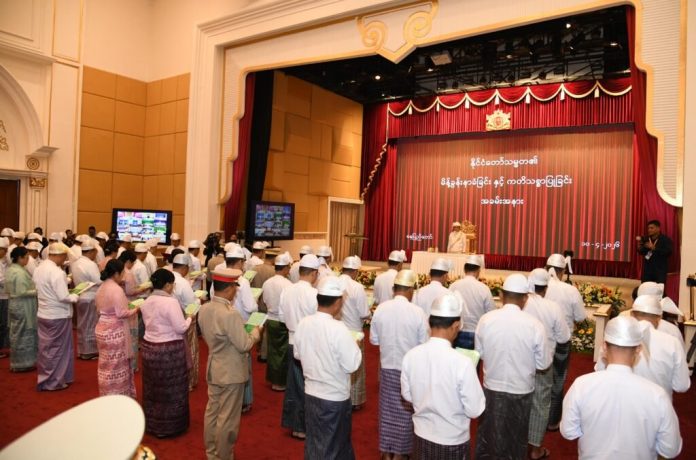
Min Aung Hlaing’s presidential inauguration and swearing-in ceremony in Naypyidaw on April 10. (Credit: Regime)

The ethnic armed group Ta’ang National Liberation Army (TNLA) joined the United Wa State Army (UWSA) and the National Democratic Alliance Army (NDAA) in welcoming Min Aung Hlaing’s ascension to the presidency on Wednesday after the military regime leader was inaugurated president at the Pyidaungsu Hluttaw, or Myanmar’s bicameral legislature, in the capital Naypyidaw on April 10.

The TNLA political wing, the Palaung State Liberation Front (PSLF), claimed in a statement on April 15 that it hoped to settle its problems with Naypyidaw through political means while maintaining its ceasefire agreement with Min Aung Hlaing’s pro-military government led by the proxy Union Solidarity and Development Party (USDP) administration. 

The USDP won a landslide victory in the regime’s 2025-26 elections, which ended on Jan. 25, despite no opposition parties on the ballot. The National League for Democracy (NLD) party administration from 2016-21 was ousted by Min Aung Hlaing in his Feb. 1, 2021 military coup. Both NLD State Counsellor Aung San Suu Kyi and President Win Myint have been held in prison ever since.

The ethnic Palaung TNLA, alongside its former allies the ethnic Kokang Myanmar National Democratic Alliance Army (MNDAA) and the ethnic Rakhine Arakan Army (AA), seized Kutkai, Namtu, Namhkam, Namhsang, Manton, Mongngaw, Monglon, Momeik, Kyaukme, Hsipaw and Nawnghkio in northern Shan State, as well as Mogok Township in Mandalay Region, after it launched an offensive called Operation 1027 on Oct. 27, 2023

Lashio, the largest city in northern Shan and home to the military’s Northeastern Regional Military Command (RMC) headquarters, was seized by the MNDAA on Aug. 3, 2024.

But after the MNDAA signed a  China-brokered ceasefire agreement with Naypyidaw on Jan. 18, 2025, it handed Lashio back on April 22, 2025, as part of this deal.  

After losing control of Kyaukme, Hsipaw and Nawnghkio to regime forces in 2025, the TNLA signed its own China-brokered ceasefire with Naypyidaw on Oct. 28. It relinquished control of Mogok and Momeik to regime forces on Nov. 28.

The MNDAA seized full control over Kutkai, 47 miles (75 km) north of Lashio, from the TNLA on March 15 after a territorial dispute between the two former allies due to the installation of closed-circuit television (CCTV) cameras on Feb. 13, according to the TNLA.

The AA offensive against regime forces in Arakan State, which began on Nov. 13, 2023, has led to the seizure of 14 out of 17 Arakan townships, as well as Paletwa Township in southern Chin State. It has expanded its offensive into neighbouring Ayeyarwady, Bago and Magway regions.

The TNLA controls Namhsan and Manton, which is constitutionally recognized as the Palaung Self-Administered Zone (SAZ), as well as the recently-seized towns of Namtu, Namhkam, Mongngawt, and Monglon in northern Shan.

The NDAA is headquartered in Mongla, located in the Eastern Shan State Special Region 4. 

The UWSA administers the Wa Self-Administered Division, comprising Hopang, Mongmao, Panwai, Nahpan, Metman and Pangsang along the Myanmar-China border in eastern Shan. It also controls territory along the Myanmar-Thailand border, which it considers the southern part of its autonomous “Wa State.”

Besides the three ethnic armed groups, regime media reported that the governments of China, India, Russia, Belarus, Thailand, Brunei, Laos, Cambodia, Nicaragua, Bhutan, Nepal, Pakistan, and Kazakhstan sent congratulatory messages to Min Aung Hlaing and representatives to attend his inauguration and swearing-on ceremony in Naypyidaw on April 10. 

Contact