


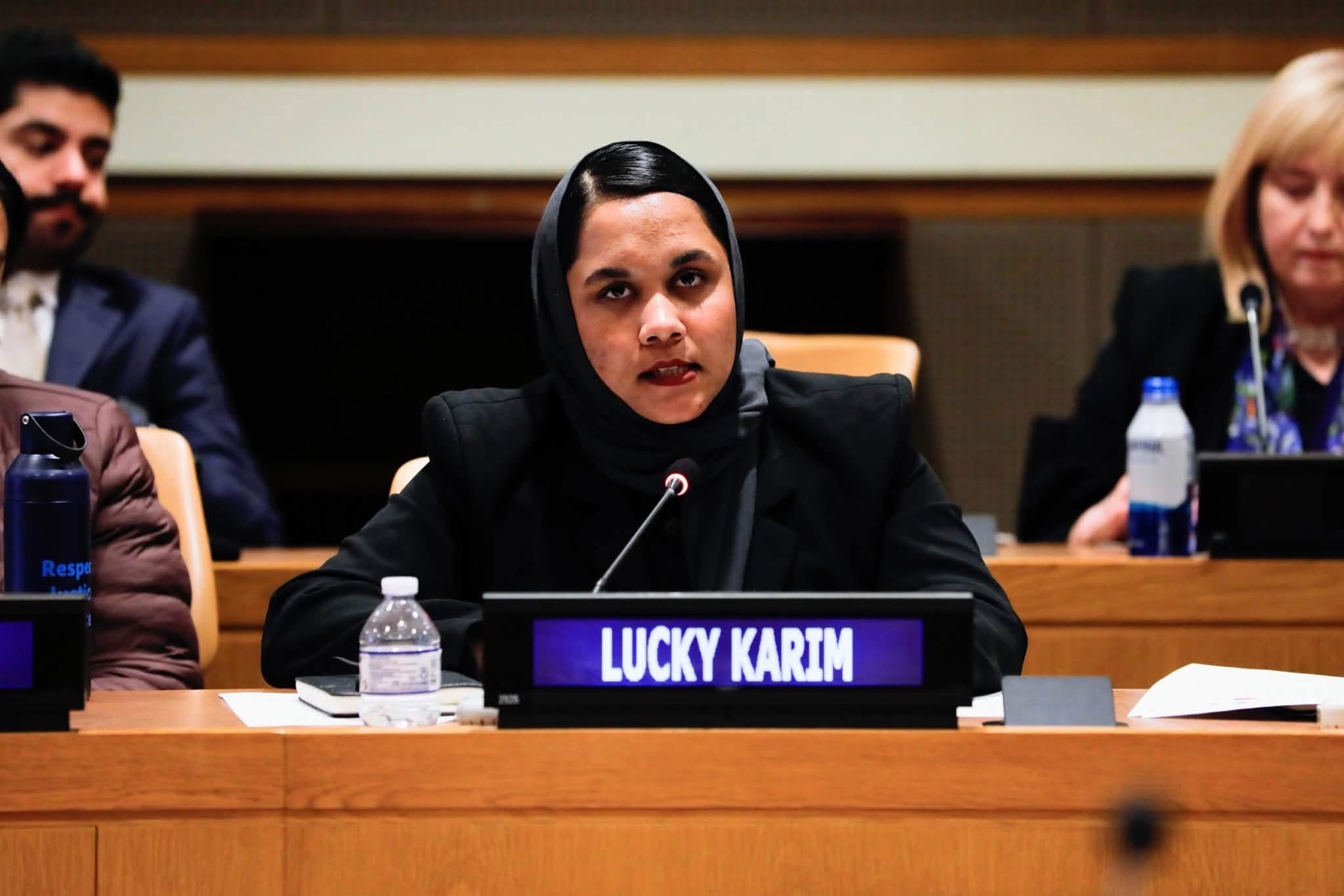
When the International Court of Justice (ICJ) ruled on Nov. 19 that Myanmar committed genocide against the Rohingya during its 2017 military crackdown, Rohingya activist and author Lucky Karim sat inside the courtroom in The Hague listening as the judgment was read aloud—nine years after fleeing Myanmar as a 14-year-old survivor.
Founder of the women-led organization Refugee Women for Peace and Justice (RWPJ) and author of the upcoming memoir Born Lucky (scheduled for release in fall 2027), Karim spoke with DVB about witnessing the historic judgment, why regional deportations violate international duties, what non-negotiable guarantees must precede any return to Arakan State, and why the World Court’s ruling belongs to every ethnic community across Myanmar.
This interview has been edited for length and clarity.
DVB: Having fled Myanmar’s military crackdown at age 14 in August 2017, what does the International Court of Justice ruling mean to you personally?
LK: It is a historic moment and a comprehensive victory for us—and for The Gambia as well, which brought the case before the International Court of Justice in The Hague. Personally, as someone who survived genocide in 2017, who was one of the fortunate millions to escape and spend many years in the camps as a refugee, being in the courtroom in person to witness this historic moment and hear the verdict read out by the president of the court was deeply emotional and personal. It is a huge milestone in our history.
DVB: Who were you thinking of when you heard the ruling?
LK: I left millions of people behind—especially refugees in Cox’s Bazar. I was thinking of every single individual who crossed the border with me and spent years in the camps alongside me, as well as missing family members back home, friends, colleagues, and community members. I wished I could be with them immediately to celebrate this moment.
DVB: You noted that this historic court ruling must lead to tangible change for refugees. Beyond establishing a legal record of state responsibility, what concrete enforcement steps must follow?
LK: This is the highest legal standard—genocide—from the world’s highest court. The ICJ not only found Myanmar guilty of committing genocide against us, it also found Myanmar failed to prevent it and failed to protect us as people of Burma and members of the Rohingya community.
The language in the judgment is strong. Beyond genocide itself, the court recognized that we belong to the country as one of its ethnic groups. Our name—Rohingya—was recognized, something that has always been denied by the military and other armed actors in Burma. The court recognized us as people of Burma and original nationals in many ways.
Now, member states, major donor countries, and our supporters must use this judgment as a tool and open every possible door to protect and aid the Rohingya remaining in Rakhine State and across the country, and ensure immediate public conversations with us about our future until it is safe for us to return home.
DVB: UN experts have warned that Rohingya inside Rakhine State now face severe repression under both the Myanmar military and the Arakan Army. How can international justice mechanisms ensure protection and accountability?
LK: There must be an active, credible international monitoring mechanism inside the country. Every single day, we receive overwhelming reports from sources and community members back home that people continue to suffer violence from armed actors and continue to die from starvation and abuse. We need international monitors on the ground to ensure civilians and Rohingya remaining in Rakhine State are protected and safe.
DVB: Regional blocs like ASEAN continue to debate engagement with Naypyidaw. What is your message to diplomats arguing for engagement with the regime?
LK: The ICJ verdict is the final, legally binding determination from the world’s highest court. Now it is up to every state—in ASEAN, the European Union, and North America—to decide whether they will continue engaging with a genocidal perpetrator or stand in solidarity with genocide survivors.
This was a nearly seven-year legal process involving hundreds of witnesses, testimonies, and credible human rights documentation—and Myanmar participated actively throughout, including in the courtroom when the judgment was delivered. It is no longer a complaint; it is a legally binding public judgment. ASEAN and regional countries have betrayed us in many ways already. It is time for them to pause and reconsider their relationships with the junta in Naypyidaw.
DVB: Why do peace processes and repatriation frameworks repeatedly fail when Rohingya women are treated merely as aid recipients rather than decision-makers?
LK: The ICJ verdict itself proves that nothing should be about us without us. The case succeeded because victims and community members contributed from day one—providing documentation, collecting evidence, and finding the courage to travel and testify. Without their courage, the court could not have learned what happened to us in 2017.
From now on, the world must include Rohingya representatives in every conversation and decision-making process, because we know our country and our situation better than anyone else. Rohingya must be the agents of our own lives—not just women in peace talks, but across every humanitarian, political, regional, and international table concerning our future.
DVB: What led you to establish Refugee Women for Peace and Justice (RWPJ)?
LK: While working with international humanitarian organizations across different blocks in the Bangladesh camps, I met thousands of neighbors and learned the realities of their daily lives. I realized women face 99 percent of the problems and are the primary victims of daily hardships, yet they are the ones most often left behind without a chance to speak.
I wanted to create an independent, safe space where women and girls could find their voice, politically organize, receive training on democracy and human rights, and hold a pen to advocate for their inclusion at every level.
DVB: You were resettled to the United States in 2022 after facing threats inside the camps due to your leadership. How can authorities restore civilian security without restricting refugees’ freedom of movement and community organizing in Bangladesh?
LK: First, I have to thank Bangladesh—they opened their border and their hearts to us in 2017 and have hosted us for nearly a decade. Sustaining that requires active coordination between the host country and major donor states to ensure timely food rations, protection, and humanitarian aid.
At the same time, refugees’ ultimate goal is to return home when it is safe. While in the camps, our focus is preparing our community—through education and political training—so we do not have to rely on third parties forever. Implementation of the ICJ judgment must begin with the primary genocide survivors in Cox’s Bazar without further delay.
DVB: Neighboring countries like Malaysia and India have deported thousands of Myanmar nationals this year. Given the ICJ ruling and the Genocide Convention’s duty to prevent genocide, what responsibility do regional governments have right now to halt forced returns?
LK: Any state that deports our people back to Myanmar after this court verdict is sending them directly into the hands of the genocidal perpetrator that committed genocide against us in 2017 after decades of systematic discrimination.
Our question to those governments is simple: Where are you sending these people back to? Their homes no longer exist, and the World Court has formally determined that what happened to us was genocide. Regional countries must acknowledge the judgment and build a coordinated regional mechanism to protect displaced people rather than deporting them.
DVB: What should ASEAN specifically do?
LK: ASEAN has failed to respond to the needs of the Rohingya and the people of Burma as a whole. Now that the genocide determination is in hand, ASEAN must reconsider its engagement with the junta and ensure political inclusion for the Rohingya in every regional dialogue on Myanmar. The court made it clear: Myanmar is Rohingya, and Rohingya is Myanmar. No one can separate us from our country. Any dialogue about Myanmar that excludes the Rohingya will never achieve a sustainable or democratic future.
DVB: Bangladesh’s government is drafting a comprehensive repatriation strategy. What guarantees must be met in Rakhine State before any Rohingya refugee can safely return—and what should be done while refugees wait?
LK: We work closely with Bangladesh and appreciate its support as our primary host. Having the ICJ’s clear legal language—defining what was taken from us versus what the military tries to offer—will help Bangladesh and international partners shape policies that genuinely protect refugees.
Because the verdict does not take us home overnight, refugees are still languishing in tiny shelters. While they wait, three things are urgent: donor countries must commit sustained funding for food and essential programs; authorities must guarantee safety and security inside the camps; and refugees must be included in every decision affecting their future.
DVB: You are the first Rohingya woman to write a memoir, Born Lucky, tracing your family’s history across multiple waves of displacement since the 1970s. What motivated you to write it, and what was the hardest part?
LK: I first had the idea in 2019 when I entered university in Bangladesh, and began writing in 2023 after resettling in the United States. It took nearly three and a half years to write and edit while I was a full-time student dedicated to community advocacy, and we have just completed copy-editing ahead of its global release in fall 2027.
Coming from Rakhine State, the camps, and now the diaspora, I wanted a detailed written record of our community’s history and suffering across generations—even before my parents were born—so the world can read what happened from day one. The book has three parts: my family’s story, life across the Cox’s Bazar camps, and Myanmar’s broader political history. We are also preparing a Burmese translation so our brothers and sisters from other ethnic groups inside Burma can read and understand our story in our shared national language, alongside an English audiobook.
The hardest part was conducting hundreds of interviews with elders and other ethnic groups—recording, transcribing, and translating their pain—and realizing my grandmother’s generation endured even worse horrors than we did in 2017. Reliving the worst moments of my own life hour after hour on paper brought many tears.
DVB: You taught yourself English in the camps watching YouTube while refusing to give up on your education. What is your message today to young Rohingya girls in Cox’s Bazar and Rakhine State who feel their futures are on hold?
LK: As a child in the camps, options were painfully limited—choosing between school and work, or between food, shelter, and protection. In those moments, we have to discipline ourselves and wake up every morning saying, “I am going to figure this out.” I never took a “no” as an absolute “no” to my life. When I had no school, I found a private tutor; when I couldn’t afford tuition, I turned to free online lessons to practice English and math.
My message to young people in the camps and in Rakhine State is to push forward and seize every tiny window or resource available. Survival is not just escaping genocide in 2017—survival is an everyday choice to stay disciplined, resilient, keep learning, and keep working.
DVB: Finally, what is your closing message to the Rohingya and all people across Myanmar?
LK: [The] ICJ verdict is not just positive news for the Rohingya—it is a milestone for all of Burma. Our brothers and sisters from other ethnic groups continue to suffer similar violence and displacement at the hands of the very same military. We are proud to have had the courage to bring this case to the world’s highest court and win, and we see this victory as a contribution to the entire country as everyone seeks justice and accountability.
Stay tuned for our Newsroom interview with Lucky Karim on DVB English News YouTube or Spotify. Listen on Apple, or wherever you get podcasts.