


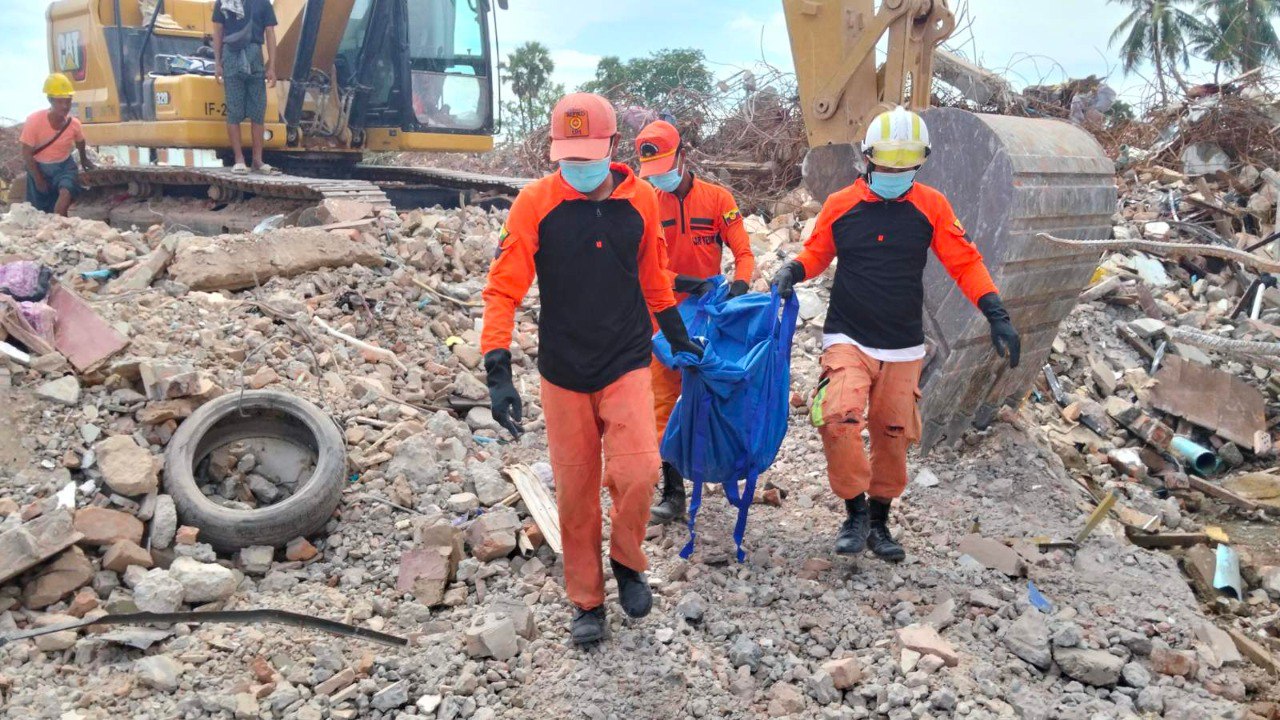
Six months after Myanmar was struck by its strongest earthquake in a century, survivors told DVB they are still struggling to secure basic needs and rebuild their homes.
“We still can’t even demolish the [collapsed buildings]. We still can’t rebuild properly. [The regime] say they’re giving us support money, but we haven’t received anything,” a Mandalay resident told DVB.
Mandalay is one of the six hardest-hit regions during the quake, including Sagaing, Magway, Bago, Naypyidaw, and southern Shan, with 2,916 bodies recovered from the rubble of collapsed buildings.
At least 4,477 people were killed during the quake nationwide on March 28, according to DVB data.
The regime in Naypyidaw has only recorded 3,773 killed with 653 survivors rescued and 851 bodies recovered from the rubble of collapsed buildings.
Over 797.9 billion kyats, or $3.8 billion USD, in total losses have been documented across 10 states and regions, according to Naypyidaw.
Infrastructure, including government buildings, residential homes, religious structures, roads, bridges, schools, hospitals, and various public and private facilities were destroyed on March 28.
The regime’s Department of Meteorology and Hydrology has recorded 227 aftershocks since the quake.
The National Unity Government (NUG) announced in April that an initial $1 million USD was disbursed to support emergency rescue. It added on June 2 that it had provided 5,507,632,230 MMK, or $1.2 million USD, to 19,588 households across the hardest-hit regions.
Save the Children states that nearly one-sixth of the population is estimated to be in need of shelter, with children making up almost one-third of those affected.
“Myanmar’s earthquake was over in minutes but the damage done to the lives of children will last much longer,” it stated in a press release on Sept. 26, warning that unrepaired infrastructure and the lack of mental health support could leave a long-term impact.
The International Committee of the Red Cross (ICRC) stated that access to safe drinking water is one of the most urgent challenges. It estimated that more than four million people are in need of clean water and sanitation facilities.
“Our priority has been to deliver emergency relief, but also to begin restoring sustainable access to clean water. Communities should not have to rely indefinitely on water trucks,” the ICRC stated in a press release on Sept. 25.
The regions hardest hit by the quake have also been battered by a strong wind and rain since June with even more damage to infrastructure, homes, and relief efforts.
“Houses were newly built or recently repaired. [But] severe rain and wind destroyed many houses as well as newly built and repaired homes. Roofs were blown away,” a resident of Inle in southern Shan State told DVB earlier this month.
The regime is carrying out counteroffensives across the country to retake control of territory seized by resistance forces since the uprising to the 2021 military coup began.
The regime has scheduled elections to begin on Dec. 28, citing the need to restore “stability” to the country following the 2021 coup and 2025 earthquake.
Regime forces have regained control of at least eight out of 101 towns previously captured by resistance groups, according to the Myanmar Peace Monitor.
The U.N. states that nearly 3.6 million people have now been displaced from their homes nationwide. It added that conflict across the country continues to drive displacement and civilian casualties, compounding the crisis left by the earthquake.
Humanitarians reached at least 3.5 million people with assistance in the first half of 2025, with only 12 percent of the U.N. funding acquired for this year’s response plan received, leaving millions without sustainable life-saving support.