


Guest contributor
Seán Barry
“Why can’t we build up a nation with everyone all together?” asks Myanmar community organiser and human rights activist Thet Swe Win, one of four protagonists in Jeanne Hallacy’s new film Thabyay. It’s a deceptively simple question, but it encapsulates what the film sets out to do.
Myanmar is a place where storytellers risk getting swallowed up by factional detail, and outsiders are met with a thicket of acronyms, alliances, betrayals, counter-alliances, and historical footnotes, often leading them to check out.
Thabyay offers a simpler story for the viewer, one of two sides: the military, and the people resisting it. This simplicity is not naïve. The film instead spends its energy on showcasing some of the breadth of civilian resistance to the Myanmar military that exists beyond the frontlines.
This in turn sets it up as both an accessible entry point for the casual viewer, and for the well-informed, an intimate look at four very likeable characters, without the burden of unnecessary context.
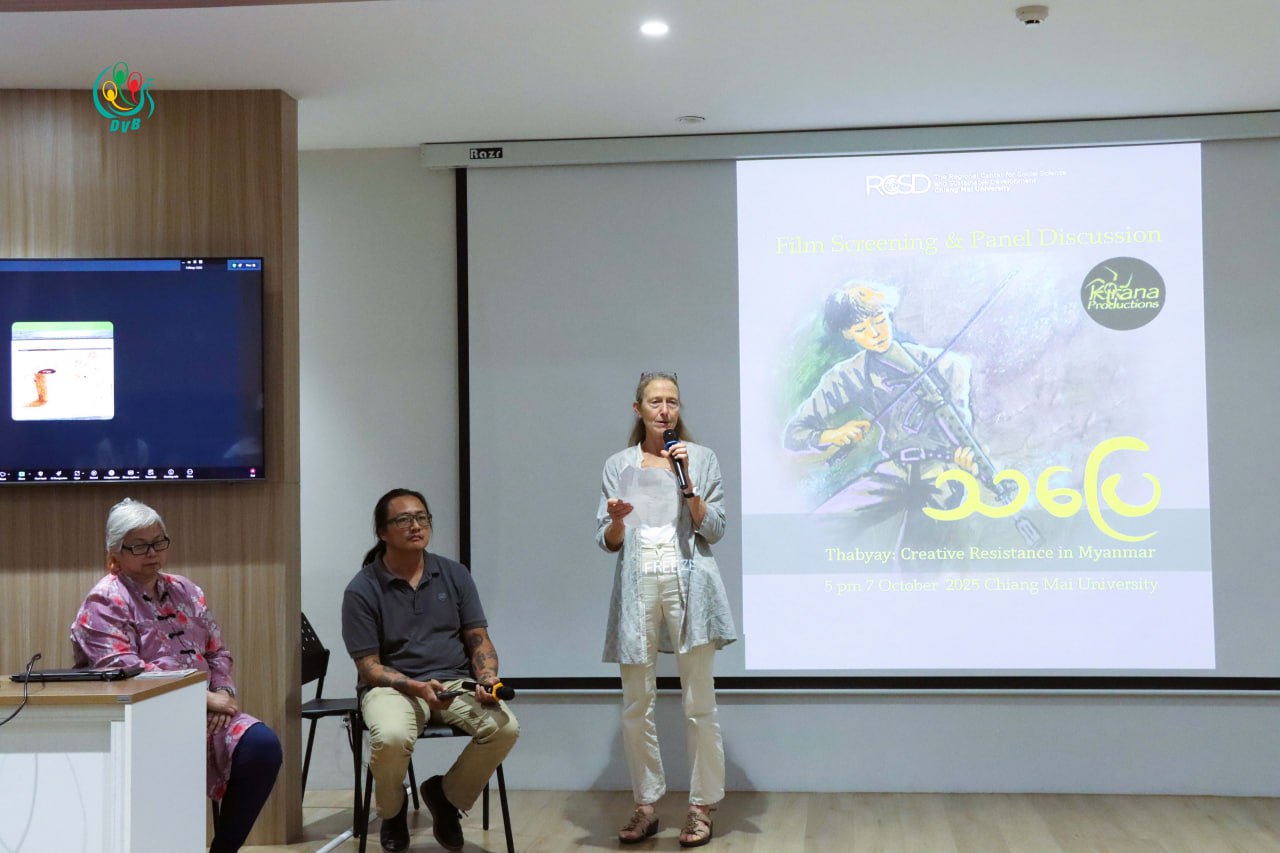
At the film’s premiere in Bangkok, Thailand, Hallacy spoke about wanting to highlight the “mosaic” and “multi-layered” movement underpinning Myanmar’s resistance, which otherwise tends to be described, for the most part, through armed rebels in the jungle.
Hallacy referenced the many millions who do not hold rifles; teachers, medics, artists, students, and parents, who quietly form the backbone of a Civil Disobedience Movement (CDM) that is ultimately not about violence but ideas.
The film’s ostensible premise is in its title: providing intimate snapshots of “creative resistance in Myanmar” via the stories of a poet, a musician, an artist, and an organiser.
But Thabyay also ends up touching on something else. At a moment when optimism around the future of a single Myanmar state is perhaps at its most strained for many decades, the film backs not just ‘revolution’ but ‘one revolution’.
That decision, carried through in its subtitling of “revolutionary-controlled area” rather than the name of a specific armed group or ethnic administration, to its synthesising of storylines, becomes arguably the film’s most striking message.
From scenes of Thet Swe Win speaking at a Rohingya genocide memorial event in Mae Sot, Thailand, which he himself organised, to the storyline of artist and National Unity Government (NUG) Minister Naw Susanna Hla Hla Soe who continues living and working in a Karen community despite having had opportunities to leave Myanmar, Thabyay makes a clear effort to show the post-coup shift in relationships between Bamar city-dwellers and ethnic communities.
We see sincere attempts at familiarisation and reconciliation.
But this is also where the film sets itself a very meaty storytelling task. While we hear these reflections on unity, they mostly come from the Bamar perspective.
We rarely hear the same message voiced from anyone in those ethnic communities. Ideas around one revolution, and one nation, may well differ.
In a film that positions itself as a broad look at Myanmar’s creative resistance, this absence should be noted. However, in the world that Thabyay explores, there are broadly two sides – the military, and the revolution. And that enhances its overall message.
An hour-long film can only do so much when the world it shows is already vast, thanks to fantastic access and an impressive variety of scenes in different locations. But it does leave you wondering what a fully inclusive set of stories about Myanmar’s resistance might look like.
The film’s major achievement is showing that a revolution is not made up of fighters alone. And by including reflections on unity while avoiding getting dragged down by detail about factions, Hallacy foregrounds the one constant of the post-coup years: the refusal of millions to accept military rule.
Thabyay shows a movement sustained by people whose work is rarely seen, and whose resilience remains the quiet core of Myanmar’s resistance.
It will be screened at the DVB Peacock Film Festival in Chiang Mai, Thailand on December 9.
Check out DVB Peacock Film Festival on Facebook or follow DVB English News for updates.
Seán Barry is a Chiang Mai-based freelance journalist and audio producer, with a focus on authoritarianism, human rights, and humanitarian aid. He first visited Myanmar in 2015.