


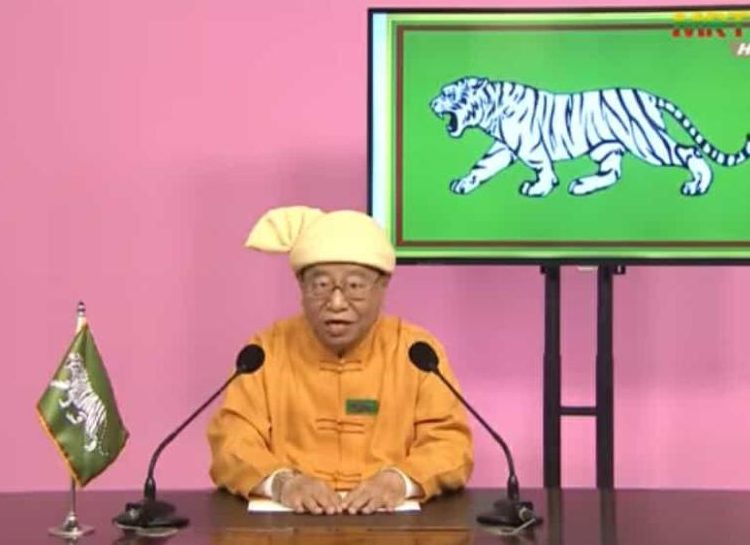
The Shan Nationalities Democratic Party (SNDP), also known as the White Tiger Party, won one parliamentary seat in the Pyithu Hluttaw, or lower house, for Langkho Township, located in southern Shan State 126 miles (202 km) southeast of the state capital Taunggyi, after ballots were counted in the first phase of voting in the regime’s 2025-26 elections on Dec. 28.
Sai Aik Paung, the SNDP chairperson, told DVB that he filed a complaint about the fairness of the elections to regime leader Senior General Min Aung Hlaing after the Union Election Commission (UEC) announced the preliminary results showing the military-proxy Union Solidarity and Development Party (USDP) had won 88 out of 96 seats in the Pyithu Hluttaw after ballots were counted following the first round of voting.
“I requested the elections to be conducted in a free and fair manner,” Sai Aik Paung told DVB. Founded in 2010, the SNDP won 58 parliamentary seats in the 2010 elections and one parliamentary seat in the 2020 elections – both considered free and fair by international election observers.
Sai Aik Paung said that, if elected, the SNDP would prioritize peace in Myanmar’s crisis, which erupted in response to the military coup on Feb. 1, 2021. “Our party will first focus on achieving peace and work on behalf of the Shan [nationality] in Myanmar,” he added.
The military coup ended 10 years of a democratic transition led by Aung San Suu Kyi’s National League for Democracy (NLD) party, which won back-to-back landslide victories against the USDP in the two previous elections but was ousted from government by the 2021 coup.
The UEC announced that the USDP also won 10 out of 18 parliamentary seats in the Amyotha Hluttaw, or upper house. The official election results will be shared by the UEC following the final round of voting on Jan. 25. A second round of voting will take place Jan. 11.
“This election is not fair. We sent [complaint] letters to the commander-in-chief,” a political party spokesperson told DVB on the condition of anonymity. Hsan Sint, a former USDP minister and independent candidate, competing for a seat in Yekyi Township, Ayeyarwady Region, told local media that complaints were filed to the UEC on Dec. 27 – one day before voting began.
Hsan Sint added that when he asked UEC officials whether seals or padlocks with passcodes were used to secure ballot boxes containing advanced votes, they told him that they did not know. He said that the UEC should record passcode numbers, because if these numbers change or the ballot boxes cannot be opened, it would indicate that it had been tampered with or compromised.
Than Soe, the UEC chairperson, said during a meeting with 57 political parties in Naypyidaw on Jan. 5 that the first phase of voting in the regime elections was “transparent” despite the complaints from candidates over advanced voting.
An independent candidate competing for a parliamentary seat in Bago Region told DVB that the UEC failed to address complaints about advanced voting from several other parties, including pro-democracy activist Ko Ko Gyi’s People’s Party and the pro-regime National Unity Party (NUP).
“We were not there when the advanced ballots were collected, only the USDP and the regime administrators were,” the independent candidate in Bago Region told DVB on the condition of anonymity.
Data for Myanmar, an independent research group, announced that 81 USDP candidates had garnered 342,642 advanced votes, which is 17 percent of the total 2,058,808 votes cast. It added that this data was based on the UEC’s advanced ballot count in 81 out of 102 townships.
It added that only four percent of candidates from other political parties, including independent candidates, received advanced votes. Advanced voting was conducted on Dec. 18-27, according to the UEC.
The second phase and third phase of voting will take place in 163 townships. Polls will not be held in 65 townships due to ongoing conflict, while 16 townships will have polling stations in urban areas only, according to UEC.
Only 131 of Myanmar’s 330 townships will hold elections in full and 118 will do so only in designated areas, according to DVB data. Fifty-seven political parties registered with the UEC. Six, including the USDP and the SNDP, will contest nationwide.