


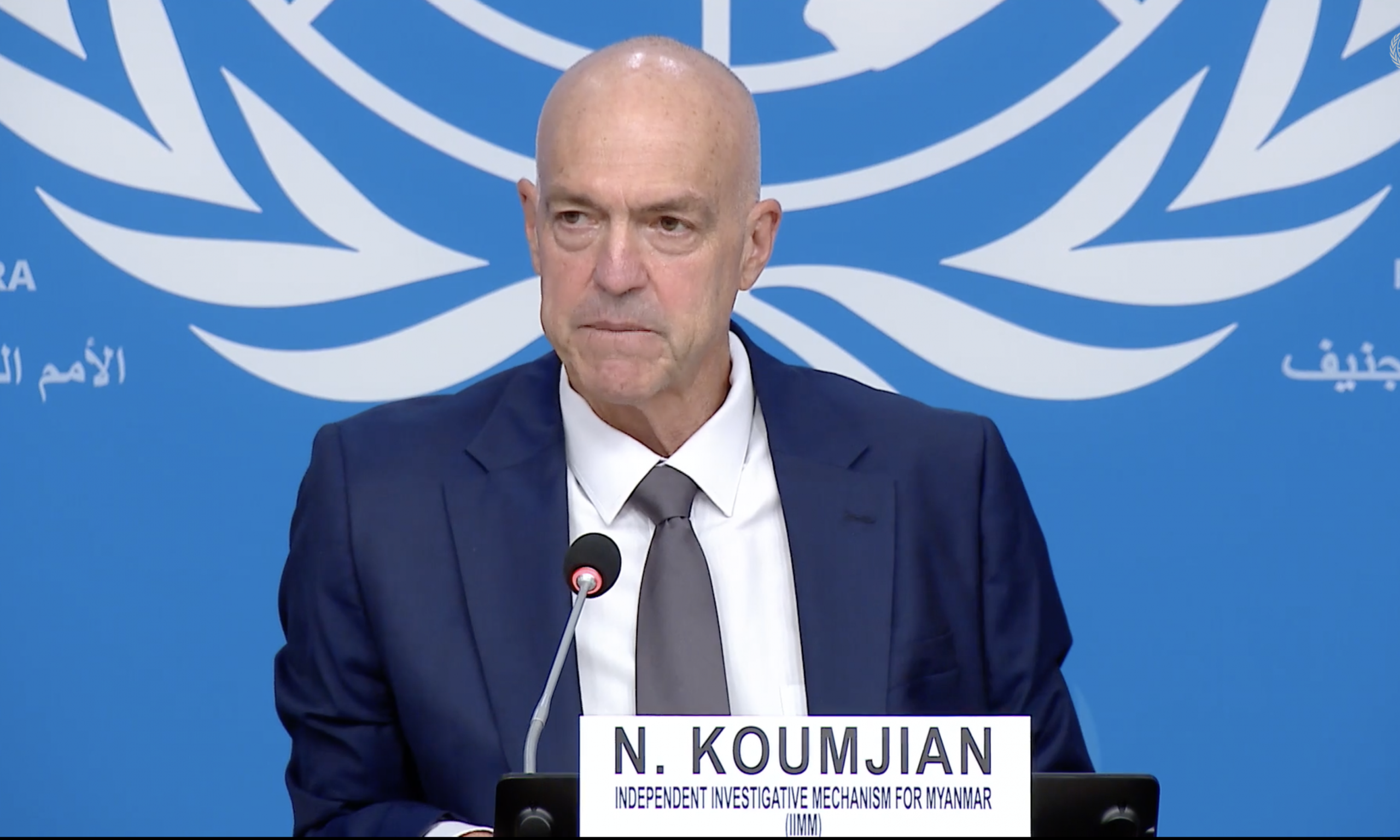
The human rights situation in Myanmar has deteriorated significantly as the military sharply escalates its reliance on aerial strikes, torture, and sexual violence, the head of the Independent Investigative Mechanism for Myanmar (IIMM) told the 81st Session of the U.N. General Assembly’s Third Committee on Tuesday.
“Since I last appeared before you, the situation in Myanmar has further deteriorated with a growing number of its people falling victim to war crimes and crimes against humanity,” stated Nicholas Koumjian, the IIMM lead investigator, on Oct. 27.
“We have intensified our investigations into indiscriminate or targeted attacks – including by drones and paramotors – which hit civilians in their homes, hospitals, places of worship, displacement camps and schools,” Koumjian added.
The IIMM has documented several recent strikes, including bombings at a monastery in Sagaing Region and a church complex in Chin State, following the attack in Arakan State that killed over 50 people in a crowded marketplace.
Koumjian told the U.N. committee that the IIMM has made major breakthroughs in uncovering command responsibility for systemic abuses inside military interrogation centers, directly identifying commanders and interrogators.
“Witnesses have given us horrific accounts of sexual and gender-based crimes, torture, strangulation and electrocution,” he said.
“We are also investigating an increasing number of allegations of atrocities by armed groups opposed to the military. We follow the evidence and investigate perpetrators regardless of their ethnicity or political affiliation,” Koumjian added.
Detailing a recent fact-finding mission to Bangladesh—where over 1.2 million Rohingya now shelter in the world’s largest refugee camp, including more than 155,000 who arrived since early 2024—Koumjian described the immense civilian trauma caused by renewed conflict in Arakan.
“Everyone I met carried pain from their experiences. All want to return to Myanmar and expressed hope that pursuing justice could hasten the day when it would be safe for them to go home,” he said.
To support accountability efforts in Myanmar, the IIMM has amassed documentation from over 1,600 sources alongside more than 750 witness testimonies, sharing extensive dossiers with the International Criminal Court (ICC), the International Court of Justice (ICJ), the Argentina Federal Court, along with several other states conducting universal jurisdiction inquiries.
Koumjian urged the U.N. not to let international humanitarian law falter in the face of widespread atrocities. “Member States must send a message that the people of Myanmar are not forgotten and the crimes being inflicted upon them will not go unpunished,” he concluded.
Watch our Newsroom interview with Nicholas Koumjian: Investigating International Crimes in Myanmar on DVB English News YouTube.