


Guest contributor
Igor Blazevic
There is a view now widely shared in policy and diplomatic circles among Myanmar’s neighbors and countries dealing with the post-coup crisis.
One example captures this thinking well. Joanne Lin, co-coordinator at the ASEAN Studies Centre at the ISEAS–Yusof Ishak Institute, told The Wire that India’s approach is “driven by pragmatism”.
She noted that “New Delhi sees its connectivity and economic interests—such as the Kaladan project, cross-border trade corridors, and its broader Act East policy—as tightly bound to whatever stability it can extract from Myanmar’s deteriorating situation.”
Lin added that “although India is fully aware that the junta’s elections will be deeply flawed and lack credibility, it still views them as a potential inflection point after years of paralysis—an imperfect process that might allow limited recalibration, even if it offers no real solution. In this view, engagement is not an endorsement of the junta’s roadmap but a pragmatic hedge in a context where few alternatives appear available.”
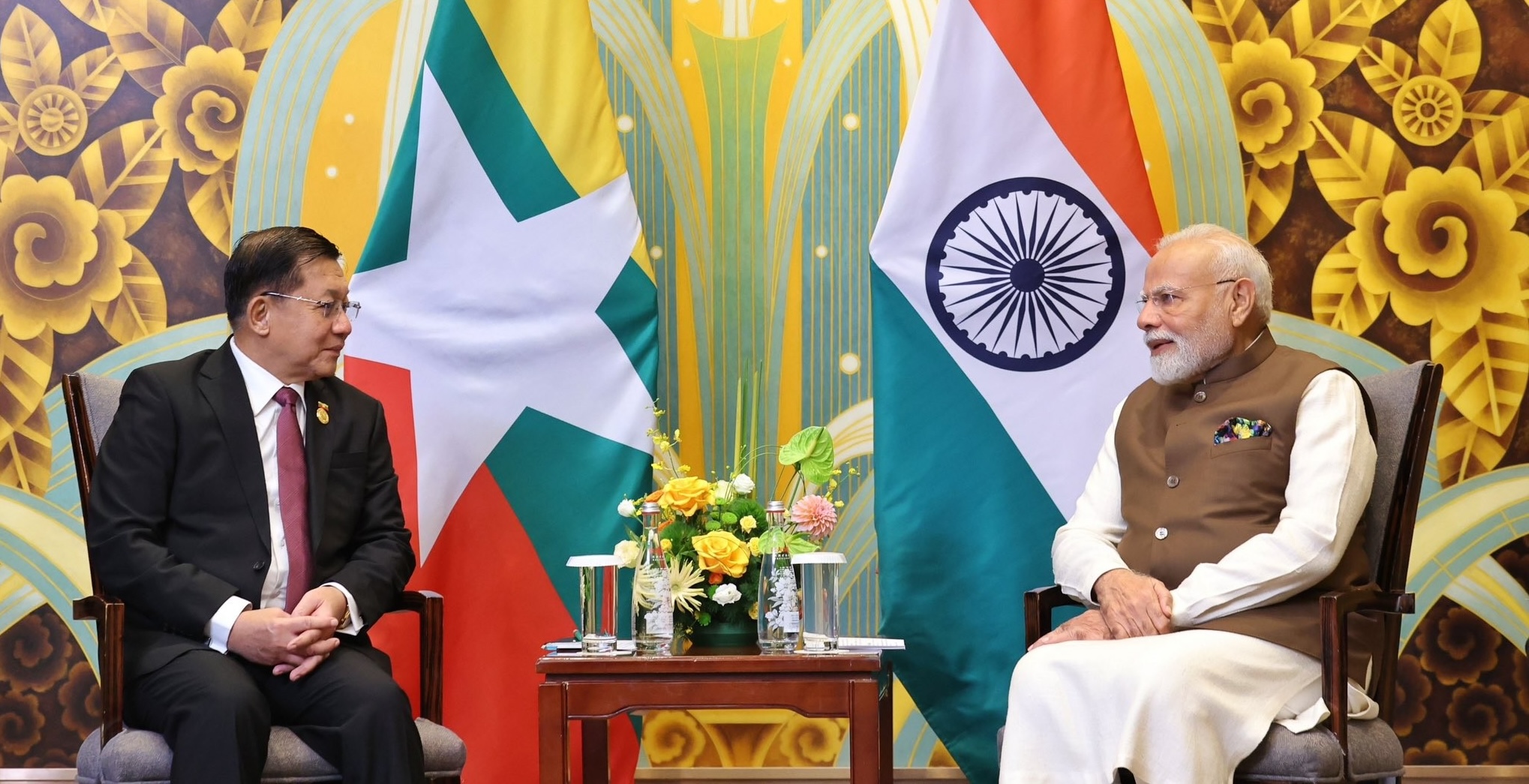
Myanmar’s neighbors have thus constructed a narrative convenient to themselves: that Min Aung Hlaing and the military will moderate their behavior after elections, becoming more conciliatory once their power is formally secured through a controlled political process.
China, India, and a hesitant ASEAN have effectively given Min Aung Hlaing an enormous and undeserved gift. By accepting the legitimization of his rule through sham elections, they assume he will become more “reasonable,” de-escalate the war, place Aung San Suu Kyi under some form of house arrest, allow humanitarian access, and open a path toward negotiations and ceasefires.
The expectation is that his junta, rebranded in civilian attire, will restore stability within a year—ending refugee flows, curbing transnational crime, and reopening Myanmar as a space for investment and extraction.
Everyone involved knows the elections will be fraudulent. They will take place in limited territory, under tight military control, with low turnout, coerced participation, and extensive fabrication of results.
Yet many actors—those openly supporting the process and those quietly endorsing it by sending token observer missions—are eager for the charade to proceed.
They want the elections to happen so they can embrace familiar narratives: a “new opportunity,” a “chance for de-escalation,” a “path to peace and humanitarian access,” and the supposed need for “political dialogue.”
These expectations are deeply misguided.
The opposite of what is expected and hoped for will happen. Min Aung Hlaing will interpret post-election recognition as a strategic victory. He will feel vindicated and emboldened to intensify both repression and war—pursuing total military victory against the People’s Defense Forces (PDFs) and ethnic resistance organizations, except those willing to transform themselves into “business partners” aligned with the military, predatory investors, and criminal networks.
After the elections, there will be more war, not less.
Within the military, a hardened worldview is taking hold. In this narrative, “traitors” from the National League for Democracy (NLD) and manipulated youth weakened the Bamar nation and allowed ethnic groups to exploit the moment to expand their territories. The appropriate response, in this mindset, is not compromise but revenge and radical punishment.
While softer, manipulative diplomatic voices within the junta have persuaded neighbors that the elections might resemble a return to the Thein Sein era, the hard core of the military and radical Ma Ba Tha monks believe that punishment—not compromise—is necessary.
A hard year ahead
The coming period will bring intensified pressure on both the resistance and the civilian population.
On one side, there will be relentless calls for ceasefires, peace talks, and acceptance of an “inevitable” political process. On the other, the military will continue its war—better armed, better funded, reinforced by forced conscription, Russian training, and a renewed ideological conviction of entitlement to rule.
Under such conditions, some ethnic revolutionary organizations that control liberated territory and have begun building governance structures may find it tempting to accept ceasefires. These arrangements could offer limited autonomy, restricted economic opportunities, and temporary relief for exhausted and traumatized civilian populations from air bombardments, raids, and blockades.
However, once left on their own—cut off from supply lines through liberated border areas—PDFs and broader resistance in Bamar majority areas would struggle to hold ground against more focused, better-equipped military pressure.
After securing regional and partial international recognition of its fake “civilian government,” the military can afford strategic patience. It would use this political victory to pursue a gradual, phased plan to recapture liberated territories over the next two to three years.
Once resistance in Bamar areas is suppressed, the military will consolidate control, expand recruitment, and reignite aggressive Bamar nationalism among an angry, demoralized population.
Ma Ba Tha–style ultranationalist religious movements would be mobilized once again to promote the narrative that ethnic groups exploited a moment of Bamar weakness to expand their territories. This narrative will then justify renewed mobilization and war.
Only then will the military turn fully against the remaining liberated ethnic territories. With expanded resources, external backing, and renewed confidence, it will attempt what it previously failed to achieve.
Having erased Aung San Suu Kyi from political life, the regime will no longer feel the need to accommodate ethnic armed organizations to legitimize its rule.
Neighbors want stability while the junta wants total victory
China seeks a weak, compliant, military-backed quasi-civilian government controlling the Bamar heartland. At the same time, it favors ceasefires between the military and ethnic armed groups so that Chinese state and private companies can pursue lucrative business deals with both the military and its cronies on one side, and with ethnic armed organizations, border guard militias, and local power brokers on the other.
Beijing aims to position itself as the ultimate security guarantor, while excluding Western influence. India appears increasingly comfortable following a similar path—maintaining ties with Naypyidaw while quietly strengthening relations with ethnic forces along its borders. ASEAN, preferring elite bargains and “stability” over prolonged conflict, largely accepts this arrangement.
But this is not what Min Aung Hlaing intends—and that contradiction matters.
External actors believe they are buying stability. In reality, they are empowering a regime preparing for renewed and intensified war. For the junta’s hardliners, elections are not a step toward compromise but a mechanism to gain legitimacy, resources, and time—much as Sri Lanka’s government did before launching its final offensive against the Tamil Tigers (LTTE) in 2009.
In Sri Lanka, years of diplomatic normalization allowed the state to rearm and prepare. The final offensive destroyed the LTTE, killed its leadership, and crushed civilian populations trapped in conflict zones. Tens of thousands died. War crimes went largely unpunished.
This precedent shapes the strategic imagination of Myanmar’s generals. It is the outcome they believe elections and international normalization can eventually enable.
By accepting fraudulent elections—actively or passively—external actors will grant Min Aung Hlaing time, legitimacy, and resources. He will use them to pursue total victory and prolong a war the military ultimately cannot win.
After one hard year in 2025, Myanmar’s people and resistance forces will be forced to endure another. Revolutionary forces must remain united and resolute—defending liberated areas and sustaining multidimensional resistance: armed, political, civic, humanitarian, cultural, and diplomatic—throughout 2026.
Only then, when regional and international actors finally recognize that their gamble on the junta and its fraudulent elections has failed, will the political balance begin to shift.
Igor Blazevic is a lecturer at the Educational Initiatives Myanmar and Senior Advisor at the Prague Civil Society Centre
DVB publishes a diversity of opinions that does not reflect DVB editorial policy. We’d like to hear what you think about this or any of our stories: [email protected]