


Guest contributor
Ma Thida
Myanmar’s military campaign since the 2021 coup can be described in many ways—but “peace-building” is not one of them.
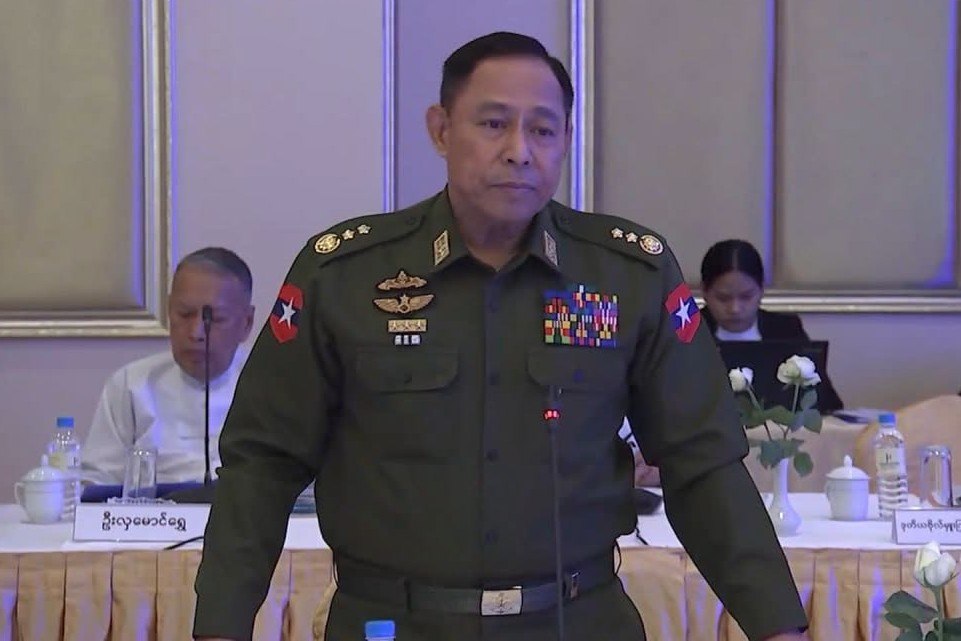
Yet that is precisely what Myanmar’s Defence Minister, Lt-Gen Yar Pyae, attempted to do when he claimed that the junta’s airstrikes are measures taken to achieve peace.
The statement is not merely dishonest. It is an insult to the thousands of civilians who have been killed, injured or displaced by the military’s relentless aerial bombardment.
Let’s be honest: bombing villages is not a peace strategy. It is a strategy of fear.
Nearly five years after seizing power, Myanmar’s military has failed to crush resistance to its rule.
Rather than bringing stability, the coup has pushed the country into the most widespread conflict in its modern history.
The military has lost territory, lost legitimacy and lost the support of much of the population.
Unable to regain control on the ground, it has increasingly relied on air power, targeting communities far from active frontlines and leaving ordinary civilians to pay the price.
Now, as criticism grows, the junta wants the international community to believe these attacks are part of a peace process.
The claim would be laughable if the consequences were not so devastating.
No reasonable observer could look at destroyed schools, damaged religious sites and shattered homes and see the foundations of peace. No parent running from an airstrike with their children believes bombs are being dropped in the name of reconciliation.
No family forced from their community can be expected to view military aircraft as tools of national unity.
Peace is not the silence left behind by destruction. It is not submission achieved through fear. It is not what remains after people have been bombed into exhaustion.
The junta’s narrative deliberately confuses peace with obedience. In its view, peace exists when resistance disappears, regardless of the methods used to achieve it.
That is not conflict resolution. It is coercion.
What makes Yar Pyae’s statement even more troubling is that he serves both as Union Defence Minister and as the head of the military’s peace negotiation mechanism.
The contradiction is striking. One moment he oversees military operations; the next he presents himself as a peacemaker.
Few examples better illustrate the junta’s approach: negotiating with one hand while bombing with the other.
The international community should reject this fiction outright.
For years, Myanmar’s generals have wrapped military aggression in the language of stability, national unity and peace.
Every escalation is framed as necessary. Every atrocity is presented as an unfortunate step toward restoring order.
Every call for accountability is dismissed as a threat to reconciliation.
These arguments were unconvincing in 2021, and they remain unconvincing today.
Governments that genuinely want to support peace in Myanmar should judge the junta by its actions, not its rhetoric.
If the military were serious about peace, the evidence would be visible: no more airstrikes, no more civilian casualties, unrestricted humanitarian access and meaningful political dialogue.
Instead, the evidence points in the opposite direction.
That is why efforts to restrict the junta’s airstrike capability remain so important.
Some countries’ sanctions on entities linked to aviation fuel supply chains were a positive step, but they cannot be the last.
As procurement networks adapt, sanctions must adapt with them.
Every litre of aviation fuel delivered to the military strengthens its ability to attack civilian communities. Every loophole left open creates an opportunity for further abuses.
Critics often argue that sanctions alone will not end Myanmar’s conflict. That is true. But it misses the purpose of sanctions.
Their role is not to deliver peace on their own; it is to make it more difficult for the military to wage war against its own people.
The choice facing the international community is straightforward. It can accept the junta’s cynical attempt to rebrand airstrikes as peace-building, or it can call things what they are.
Bombing civilians is not a peace process.
It is violence.
And every time Myanmar’s generals try to portray it as peace, they reveal just how detached they have become from the suffering they continue to inflict.
Ma Thida is a writer, physician, and human rights advocate whose work has promoted democracy, freedom of expression, and civic resistance for over three decades. A former prisoner of conscience from Myanmar, she is a prominent global advocate for writers and journalists at risk. She chairs the Writers in Prison Committee of PEN International and is the Founding President of PEN Myanmar. She currently coordinates the Myanmar Campaign Network in Australia.
DVB publishes a diversity of opinions that does not reflect DVB editorial policy. We’d like to hear what you think about this or any of our stories: [email protected]