


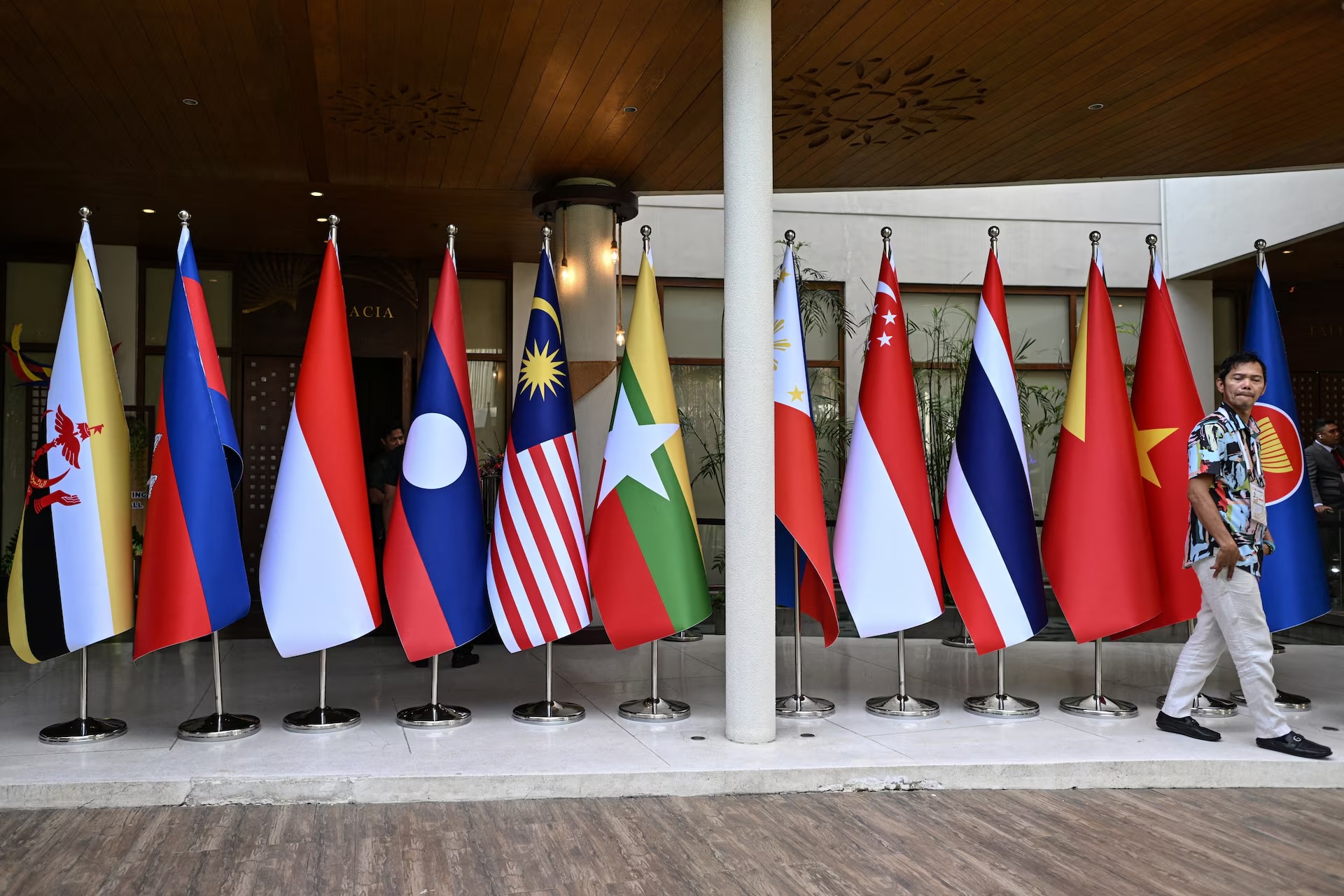
The Association of Southeast Asian Nations (ASEAN) is under increasing pressure at its upcoming summit to ease a five-year ban on Myanmar’s senior regime officials attending high-level meetings, after Thailand and several other members stepped up engagement despite the country’s ongoing civil war.
Leaders of ASEAN are set to review their decision to exclude Myanmar when they meet in Manila, Philippines, from Nov. 15-17.
Myanmar has been in turmoil since 2021, when then-military Senior General Min Aung Hlaing ousted the elected government in a coup, unleashing armed conflict across much of the country that has killed more than 100,000 people.
Its political leadership has been barred from ASEAN summits and foreign ministers’ meetings over its failure to implement the Five-Point Consensus, a peace plan agreed to by Min Aung Hlaing after the coup in April 2021.
But nearly half the bloc’s 11 members have stepped up bilateral engagement since elections in December and January, won overwhelmingly by the military-proxy Union Solidarity and Development Party (USDP) in the absence of any viable opposition.
Laos, Thailand, Vietnam, Cambodia and Malaysia have this year welcomed Min Aung Hlaing on official visits.
Malaysian Prime Minister Anwar Ibrahim pledged in October to work towards Myanmar’s full reintegration into the bloc.
Thailand is now openly calling for restrictions to be eased.
“For Thailand, we believe that the next step is to have the Foreign Minister of Myanmar participate in the ASEAN meetings at the level of Foreign Minister,” Thai Foreign Minister Sihasak Phuangketkeow told reporters after visiting Myanmar on Thursday.
He hoped sufficient progress would allow a decision on Myanmar’s participation by Thailand’s chairmanship in 2028 at the latest.
Engaging policymakers would help convey ASEAN’s concerns directly to decision-makers, he said, while stressing that the decision rested with the bloc’s foreign ministers.
Separate diplomatic tracks
Analysts say the shifting approaches put pressure on the Five-Point Consensus, which calls for an end to violence, inclusive dialogue, humanitarian assistance and mediation by an envoy able to meet all parties.
Leaders will issue a negotiated document reviewing its implementation at the upcoming ASEAN summit, Dominic Xavier Imperial, a spokesperson for the Philippines, said on Friday.
“I think the Five-Point Consensus now has been overtaken by events,” said Thitinan Pongsudhirak, a political scientist at Bangkok’s Chulalongkorn University.
Implementation has made little headway.
Civil war continues, millions remain displaced and efforts to bring the warring parties into dialogue have yet to produce a breakthrough.
Aung San Suu Kyi, the country’s civilian leader and a Nobel Peace Prize winner, has been detained since the coup.
She was moved to house arrest in April, following the military-engineered election, but while a Red Cross official was allowed to meet her in August, no foreign leader or envoy has been able to despite requests.
Thailand has repeatedly offered to facilitate talks between Myanmar’s regime and ethnic armed groups along its border.
Sihasak said Myanmar had agreed in principle to send a delegation to any talks, but gave no date.
Philippine Foreign Secretary Theresa Lazaro, ASEAN’s special envoy, visited Myanmar on a humanitarian mission in October.
But the envoy’s role, which changes each year with ASEAN’s rotating chairmanship, is also under scrutiny.
“Myanmar’s been keen to do away with the Special Envoy entirely,” said a Southeast Asian diplomat who declined to be named, adding that ongoing discussions had also covered appointing a permanent envoy.
“But if no consensus on either of these approaches, then the status quo will remain,” the diplomat said.
Testing ASEAN unity
Thailand’s assertive engagement reflects the country’s concerns over fighting spilling across its long land border with Myanmar, alongside trade, migrant workers and energy cooperation.
But Thitinan said Bangkok’s “calibrated re-engagement” had pressured other capitals to follow suit, leaving Singapore, next year’s chair, to reconcile divergent approaches.
“It should not have been a blank cheque; it should not have been an open-ended reception and recognition,” he said, advocating conditions including political prisoner releases, humanitarian access and an end to military airstrikes.
Human Rights Watch has urged ASEAN to maintain restrictions and increase pressure on the military to end abuses and pursue a transition to civilian rule.
Warmer bilateral ties do not automatically change ASEAN policy, however, said Simon Tay, chairman of the Singapore Institute of International Affairs.
The consensus remains unless members collectively agree otherwise.
“There is room for both good cop and bad cop within ASEAN, provided these different approaches remain within the 5PC framework,” he said.
“Otherwise, Myanmar could simply play one against the other.”
Tay advocates interim goals including regular access to Aung San Suu Kyi, reduced violence and humanitarian aid.
“ASEAN can be pragmatic without being premature,” he said.
“Political acceptance should follow progress, not precede it.”
REUTERS