


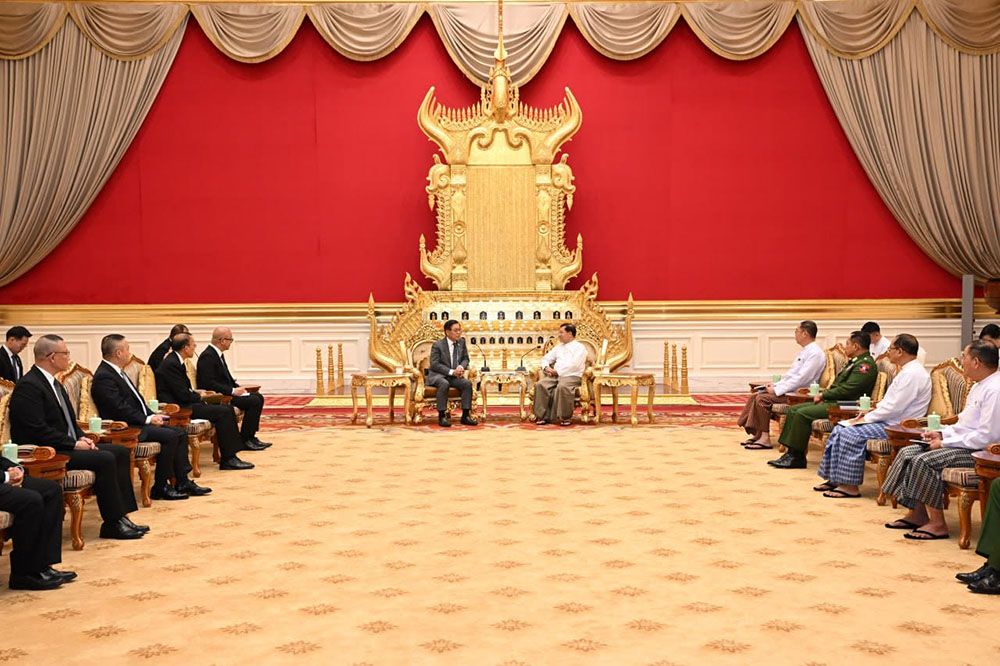
Thailand has offered to facilitate talks between Myanmar’s military regime and ethnic armed groups, including the Karen National Union (KNU) and Karenni National Progressive Party (KNPP), Thai Foreign Minister Sihasak Phuangketkeow announced at a press conference in Bangkok on Thursday.
“Myanmar agreed to the proposal in principle when I conveyed Thailand’s readiness to facilitate talks between the Myanmar government and ethnic organizations along the Thai border, such as the KNU and KNPP,” Sihasak told media, following his one-day visit to Naypyidaw, on Nov. 12.
Sihasak met with regime leader Min Aung Hlaing, Foreign Minister Tin Maung Swe and Defence Minister Yar Pyae, who chairs the regime’s National Solidarity and Peacemaking Negotiation Committee.
During the visit, Sihasak also raised concerns about cross-border river pollution, border trade disruptions, and online scam operations. He also urged the regime to prevent fighting in Myanmar from spilling across the border into Thailand.
The KNU and KNPP are two of Myanmar’s oldest ethnic armed groups based along the Thai border.
Both organizations have decades-long histories of armed resistance to the Myanmar military, with the KNU launching its armed rebellion in 1949 and the KNPP in 1957.
Their armed wings, the Karen National Liberation Army (KNLA) and Karenni Army (KA), signed bilateral ceasefire agreements with the Myanmar government in 2012.
The KNU signed the Nationwide Ceasefire Agreement (NCA) with the military in 2015 while the KNPP did not. Both armed groups returned to fighting the military following the February 2021 coup.
Both the KNU and KNPP are founding members of the Steering Council for the Emergence of a Federal Democratic Union (SCEF)–Myanmar’s premier resistance coalition established on March 30—alongside two other major ethnic armed groups—the Kachin Independence Organization (KIO) and the Chin National Front (CNF)—as well as groups representing those elected in 2020 but ousted in the coup: the National Unity Government (NUG) and the Committee Representing Pyidaungsu Hluttaw (CRPH).
Sihasak said that Thailand was seeking to restore engagement between the Association of Southeast Asian Nations (ASEAN) with the regime in Myanmar, which has been excluded since Min Aung Hlaing agreed to the regional bloc’s peace plan called the Five Point Consensus after the coup in April 2021 but did not implement it upon returning to Naypyidaw.
“I urged further progress on issues of concern to Thailand and the international community, particularly advancing the peace and dialogue processes with opposition ethnic organizations,” added Sihasak.
ASEAN foreign ministers are expected to meet and discuss the crisis in Myanmar as well as the bloc’s next steps ahead of the 49th ASEAN Summit in Manila, Philippines, from Nov. 15–17.