


Guest contributor
Shalini Perumal
The past few years have etched a familiar, powerful image across South and Southeast Asia: Generation Z on the streets. From Colombo to Dhaka and Kathmandu, Bangkok to Yangon and Jakarta, the region’s youth have bravely stood against corruption, economic decay, military repression, authoritarianism and fascism.
They are united by digital tools and global democratic ideals, yet the outcomes of these uprisings have been starkly different. While movements in Sri Lanka, Bangladesh, and Nepal achieved the immediate goal of toppling a leader or forcing significant political concessions, the immensely courageous struggles in Myanmar, Thailand, and Indonesia have, thus far, been checked by the power of the entrenched state.
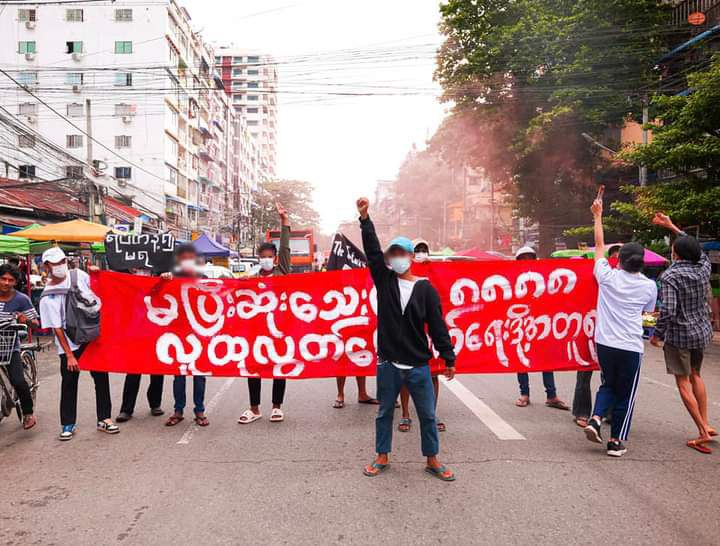
For the Gen Z leaders of the Spring Revolution in Myanmar—who have borne the brunt of a brutal military crackdown—understanding this divergence is not merely an academic exercise; it is a vital, painful process of refining strategy against the world’s most intransigent military machine.
The critical question remains: What allowed success elsewhere, and what factors are blocking change in Myanmar?
The ‘success’ stories in South Asia were not necessarily about achieving deep, long-term democratic reforms, but about the immediate achievement of a core political demand—the resignation of a leader or the end of a specific system.
This was characterized by two critical factors: a universal, non-ideological trigger and a rapid fracture within the elite or security forces.
The Sri Lankan uprising in 2022, known as the Aragalaya, or struggle, provides the clearest regional model of success. It was almost entirely youth-driven, occupying key public spaces and maintaining a cohesive, largely non-violent front.
But the power of the youth lay not just in their organization; it lay in the economic crisis. The country’s unprecedented economic collapse, involving foreign debt default and severe shortages of fuel and food, ran so deep that it became an existential threat to all citizens.
This crisis achieved what years of political opposition could not: it fractured elite cohesion. Key ruling party members abandoned the Rajapaksa family, isolating the regime.
This led to the withdrawal of the security forces’ institutional support. The military simply would not fire on masses supported by a nation on the brink of starvation.
In this case, the state’s mechanism of coercion was rendered impotent by national destitution, allowing the immediate political vacuum to be filled.
However, the change in leadership did not bring the demanded “system change.” Following the election of President Ranil Wickremesinghe by Parliament, the country saw a swift and significant authoritarian rollback.
The state employed emergency regulations and the Prevention of Terrorism Act (PTA) to violently suppress remaining protests and arrest Aragalaya leaders in late 2022 and throughout 2023.
Nevertheless, dissent persisted—civic groups, trade unions, and student federations continued to organize protests against the rising cost of living, new tax hikes imposed to meet IMF conditions, and the government’s attempts to delay local elections.
While these post-Aragalaya actions did not result in another immediate regime change, they demonstrated the enduring anti-establishment sentiment ignited by the youth, helping to consolidate public support for opposition forces.
This growing disillusionment was most effectively channeled by Anura Kumara Dissanayake, the leader of the National People’s Power (NPP) alliance.
Positioning himself as the champion of the “system change” promised during the protests, Dissanayake’s campaign resonated deeply with the public’s desire to dismantle the corrupt political establishment, ultimately leading to his decisive victory in the 2024 presidential elections and the subsequent significant political shifts.
Bangladesh’s recent student uprising in 2024, often called the July Revolution, provides a dynamic counterpoint to the Sri Lankan model, demonstrating how state violence can inadvertently become the accelerant for regime change.
The movement initially focused on a clear, technical, and non-regime-change demand: the abolition of the controversial job quota system in civil service recruitment.
This specific focus unified a large urban, educated population, tapping into widespread youth unemployment and the pervasive perception that the quotas unfairly benefited affiliates of the ruling Awami League party.
This initial phase showcased the power of highly organized, digitally coordinated mass action. Under the banner of the Anti-discrimination Students Movement, students utilized platforms like Facebook, WhatsApp, and Telegram to organize nationwide protests, including the highly disruptive ‘Bangla Blockade’ of major roads and railways.
This swift, decentralized coordination allowed the movement to spread geographically and transcend traditional opposition politics.
However, the nature of the protest shifted dramatically due to the government’s heavy-handed response.
Sheikh Hasina’s Awami League government deployed its own student wing, the Bangladesh Chhatra League (BCL), and security forces, such as the police, the Rapid Action Battalion (RAB), and the Border Guard Bangladesh (BGB), to violently suppress protests.
This violence, which escalated into the July Massacre with hundreds of people killed, including the student Abu Sayed — who was shot while raising his hands — backfired.
The images and stories of these atrocities, amplified relentlessly across social media—despite an unprecedented, prolonged internet shutdown—galvanized the public.
By early August, the movement’s demand had pivoted from quota reform to a single, powerful point: the resignation of Sheikh Hasina. The widespread violence, coupled with her government’s perceived authoritarianism over a 15-year rule, turned a policy protest into a full-fledged ‘Non-Cooperation Movement’.
The final push came with the “Long March to Dhaka” on August 5, where tens of thousands defied curfew. Faced with the unstoppable convergence of mass public outrage and widespread defections or at least, the withdrawal of support within the civil administration and, critically, the military’s refusal to use maximum force to save her, Sheikh Hasina fled to India.
The Bangladesh success was therefore not bloodless, but a direct result of a fundamental strategic miscalculation by the authoritarian state. The state’s security apparatus fractured—not in its ability to be brutal, but in its willingness to be brutal enough to save the leader, a critical distinction when comparing its outcome to Myanmar.
Nepal provides two distinct, successful models of youth-led political change, each illuminating a different path toward regime collapse. The 2006 Loktantra Andolan, or People’s Movement, which ended the King’s direct rule, highlights the paramount importance of political opportunity and elite unity.
While youth and student wings provided the essential mass street power, the movement’s success was guaranteed by the fact that it had a ready-made, legitimate alternative in the form of the Seven-Party Alliance (SPA).
This existing political infrastructure gave the movement clear leadership, a non-negotiable end goal, and a credible body ready to fill the power vacuum.
The Royal Army was divided and unwilling to fire on a population backed by such a major political front, leading to a structured, negotiated transition of power. In contrast, the September 2025 Gen Z Uprising—which led to the resignation of Prime Minister K.P. Sharma Oli and the dramatic burning of the Parliament—offers a modern, spontaneous model rooted in populist fury and digital organization.
The immediate spark was the government’s highly unpopular decision to ban 26 social media platforms, but this ignited a deeper, simmering rage among the youth over rampant corruption, nepotism, authoritarianism, and economic elitism.
Unlike the 2006 movement, the 2025 protest was initially coordinated via decentralized online channels like Discord, bypassing traditional political organizations. The situation escalated violently after security forces fired live ammunition, killing at least 19 protesters in a single day, an atrocity that immediately pivoted the protest’s demand to toppling the entire Oli government.
In the ensuing days, vengeful mobs—fueled by anger over the deaths—torched potent symbols of state power, including the Federal Parliament building and the Supreme Court.
Prime Minister Oli resigned within days under overwhelming pressure. Like Sri Lanka, the military apparatus ultimately did not sustain the political elite.
The state machinery collapsed swiftly under the weight of organized popular fury and widespread destruction of state symbols, confirming that when an elite loses all domestic legitimacy and is unwilling to use sustained, maximum force, even a democratically elected yet authoritarian government can be rapidly toppled.
The common thread: Success was achieved when the movement either co-opted the state’s security forces through popular pressure or had a fully formed political entity ready to inherit the relinquished power.
Shalini Perumal is a creative international development professional who has worked previously in Mae Sot, Thailand at Mae Tao Clinic, consulted for Finnish Refugee Council Myanmar, and served as a Writer/Researcher at Insight Myanmar Podcast. She is currently a freelance journalist working on a novel.
DVB publishes a diversity of opinions that does not reflect DVB editorial policy. We’d like to hear what you think about this or any of our stories: [email protected]