


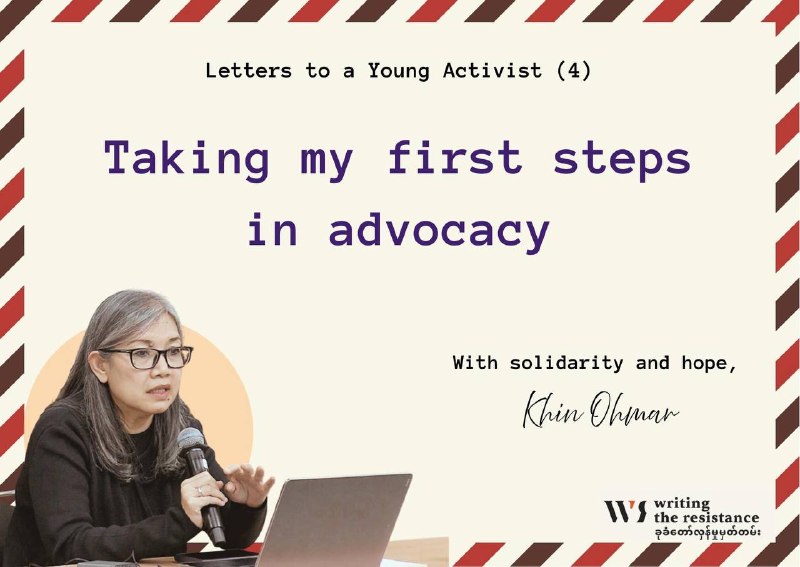
Guest contributor
Khin Ohmar
Dear young activist,
Throughout my decades of activism, I’ve shared what I have learned, experienced, and practiced in the art of effective advocacy with many young people.
I did not start with formal training. I did not know much about strategy, nor did I always have the right words to get my message across.
I began simply because I wanted the world to know what was happening in Burma/Myanmar, and I was determined to tell my story – and how the military dictatorship oppressed us – to draw attention and support to our democracy movement.
When I was accepted to resettle as a political refugee in the U.S. in early 1990s, the interviewers at the U.S. Embassy asked where I wanted to go. I said Washington, D.C., because I knew I wanted to be in the heart of politics.
My instinct told me that I needed to be where people make policies and decisions. That choice has shaped my entire life as an activist and advocate for a Free Burma.
I was sponsored by Calvary Baptist church near Chinatown. On my first Sunday there, I was asked if I wanted to speak to the congregation about Burma.
I immediately said yes! I stood at the podium, and, with my limited English, I introduced myself. I spoke about the 1988 student uprising, my friends still imprisoned in Burma, and those stranded in Thailand, as well as Aung San Suu Kyi.
Without knowing that this was called “advocacy,” I called them to action. I asked if anyone would consider sponsoring my activist friends who were seeking a chance to resettle in the United States.
I found many wonderful allies in the Church community. There was a couple, Carol and Rick, with two young daughters, who later became my English teachers while I became their babysitter.
Carol picked me up from the airport, and continued to help me navigate the complex systems I had to go through as a newly arrived young refugee with no family.
Rick worked on Capitol Hill. It was Rick who gave me my first tour of the U.S. Congress and helped me secure my first meeting with a member of Congress who showed a keen interest in Burma.
I talked about our nationwide pro-democracy uprising, our demand to end one-party military dictatorship, and how the Burma Army brutally crushed our students’ peaceful protests.
I talked about not having a chance to communicate with my mother and about my friends in prison in Burma, in the jungle fighting against the regime, and stranded in neighboring countries.
I was a witness to the military’s violence against the country’s young generation, speaking out, so our story could be heard and understood.
Through the Calvary Church’s networks, I was invited to speak at congregations and universities across several states. Each time, I shared the reality of the life of people in Burma under the military regimes of Ne Win and Than Shwe.
I spoke about the courageous student protests and the ethnic minority nationalities fighting for decades of discrimination and military suppression in their ancestral border homelands.
I highlighted our student activists’ deep desire for democracy and to end the people’s suffering under the military dictatorship and achieve freedom.
I was sure to always share practical ways people in the U.S. could help, such as offering protection and resettlement to fellow student activists and urging the U.S. government to support our democracy movement.
By visiting various congregations on these speaking tours, I helped secure sponsorship for many friends and colleagues, both single activists and those with families.
Later, I connected with Amnesty International. Their local and university chapters opened new doors for expanding my advocacy by meeting new solidarity friends, building networks, and forming coalitions.
Professors offered their class time, and students invited me from campus to campus across the United States and into Canada.
From there, my networks grew to include environmental groups, community organizations, high schools, and even middle and elementary schools.
Many of these supporters later joined the Free Burma Coalition, a large grassroots movement for a Free Burma, and established local chapters of their own to campaign for the Burma democracy movement and for the release of Aung San Suu Kyi and political prisoners.
Everywhere I went, I shared stories, exposed the truth, and urged people to take action.
I brought petitions for them to sign, introduced letter-writing campaigns, and connected them directly with Amnesty and the Free Burma Coalition to join existing campaigns or create new campaigns of their own.
Anything to give people the tools to feel like they could make a change. My American mother and father, Nancy and John, were middle and high school teachers who took me in as their Burmese daughter.
They helped me write advocacy and campaign letters. John even helped me make piles of badges with Aung San Suu Kyi’s photos to distribute during speaking tours.
The badges said, “Free Burma, Free Aung San Suu Kyi!”
I remember visiting an elementary school in Louisiana one April. As I walked into the classroom, I saw the kids sitting on the floor waiting for me.
Before I started, I asked a teacher to bring me a bowl of water and a few leafy branches.
I introduced myself, shared where I am from, and talked about Thingyan, our Burmese Buddhist New Year Water Festival.
Then, I asked the children if I could gently sprinkle water on them. They were utterly delighted, and most burst into happy laughter!
After that fun start, they were completely focused and eager to interact.
I told them about Burma, shared my story, not being able to see my mother or family, talked about the 8888 Uprising, and shared the stories of my friends in prison. I also told them about Aung San Suu Kyi.
When I asked for questions, a small boy raised his hand and asked, very seriously, why the American army didn’t just fight the Burma Army to free Burma. It was an innocent, earnest question that made a complex political struggle seem so simple for a moment.
I wanted them to know and feel that even kids have the power to take action for the betterment of our society, so I explained our boycott campaign against Pepsi, a major U.S. investor in Burma at the time.
Later on, I learned from their teacher that the kids went home and told their parents to stop buying Pepsi.
The teacher also shared that they wrote a letter to the U.N. Secretary-General, demanding that the U.N. support the Burma democracy movement.
The letter included, “Our friend Ohmar cannot go back home because of the Burma Army.”
During those years, I also learned through practice how to use media effectively to spread messages about Burma and expand solidarity.
I learned a great deal from Amnesty International about how they always contacted local newspapers, radio stations, and student publications during my trips with them.
I began asking anyone who invited me to speak, to add a media outreach plan to the program if they had not yet done so, and to see if they knew any media contacts, including university campus news bulletins and magazines, who could cover the event and help me amplify the message for a Free Burma.
Eventually, national and international magazines and publications, such as National Geographic, started to reach out to me and cover the struggle for democracy in Burma.
My time in the U.S. provided me with an abundance of knowledge and opportunities that I could never have gotten from a classroom, and I learned from so many others walking similar paths.
We joined hands in transnational solidarity to support vibrant, powerful people’s movements across different continents for social, environmental, economic, and political justice.
Amnesty activists, church organizers, the exiled Tibetan community, and environmental activists all taught me about persistence, solidarity, strategy, and courage. On every occasion, I spoke truth to power.
In 1996, I was given the Refugees’ Leader of Promise Award by the Women’s Commission for Refugee Women and Children in New York.
I was nominated by a wonderful, well-respected woman leader of the exiled Tibetan community from Utah who hosted me during my advocacy trip there.
Additionally, American University’s Amnesty International Chapter recognized my work with the Capital Area Peacemaker Award.
So many individuals supported my advocacy path across the U.S., Canada, and later Europe and Asia.
My dear director, Mary Pack; big sisters Michele Bohanna and Maureen Aung-Thwin; late Auntie Naw Louisa Benson; and late Don Erikson; another pair of American parents, Arlene and Hank; and many, many more.
I will never forget all these individuals and communities who supported my Free Burma advocacy journey in those years. They were my teachers, my mentors, my friends, and my extended family.
I was alone when I started out on this path, but I was never alone. My American grandma, Ruth, once wrote to my mother in Burma secretly brought in by a sympathetic individual, assuring her that she had taken care of me, making sure I ate well and drank milk regularly.
She told my mother not to worry and that she prayed for our reunion.
All these acts of care and solidarity, coupled with creative public tactics and opportunities, were my sources of power to carry on with my Free Burma activism: sanctions, consumer boycotts, shareholders resolutions at city and state councils (and even States of Massachusetts and Texas), negotiations with company CEOs, testifying before congressional hearings, advocating for bills to sanction military leaders and cronies, public petitions, and protests.
It was such a vibrant movement involving so many determined, great activists with big hearts and creative minds that reassured me that I was not alone and Burma was not forgotten.
Your advocacy journey may not look exactly like mine. It does not need to, of course. But remember you are not alone.
And if you speak your truth with integrity and remember that advocacy means caring for others and for the greater good, and holding responsibility and accountability to others, then you are already doing great work.
With solidarity and hope,
Khin Ohmar is a Myanmar human rights activist who was involved in organizing the ‘8888’ nationwide pro-democracy uprising. She is also the founder and chairperson of Progressive Voice, a Myanmar human rights organization. She developed the Women Peacebuilding Program for Women’s League of Burma and served as program coordinator from 2000 to 2006.
DVB publishes a diversity of opinions that does not reflect DVB editorial policy. We’d like to hear what you think about this or any of our stories: [email protected]