


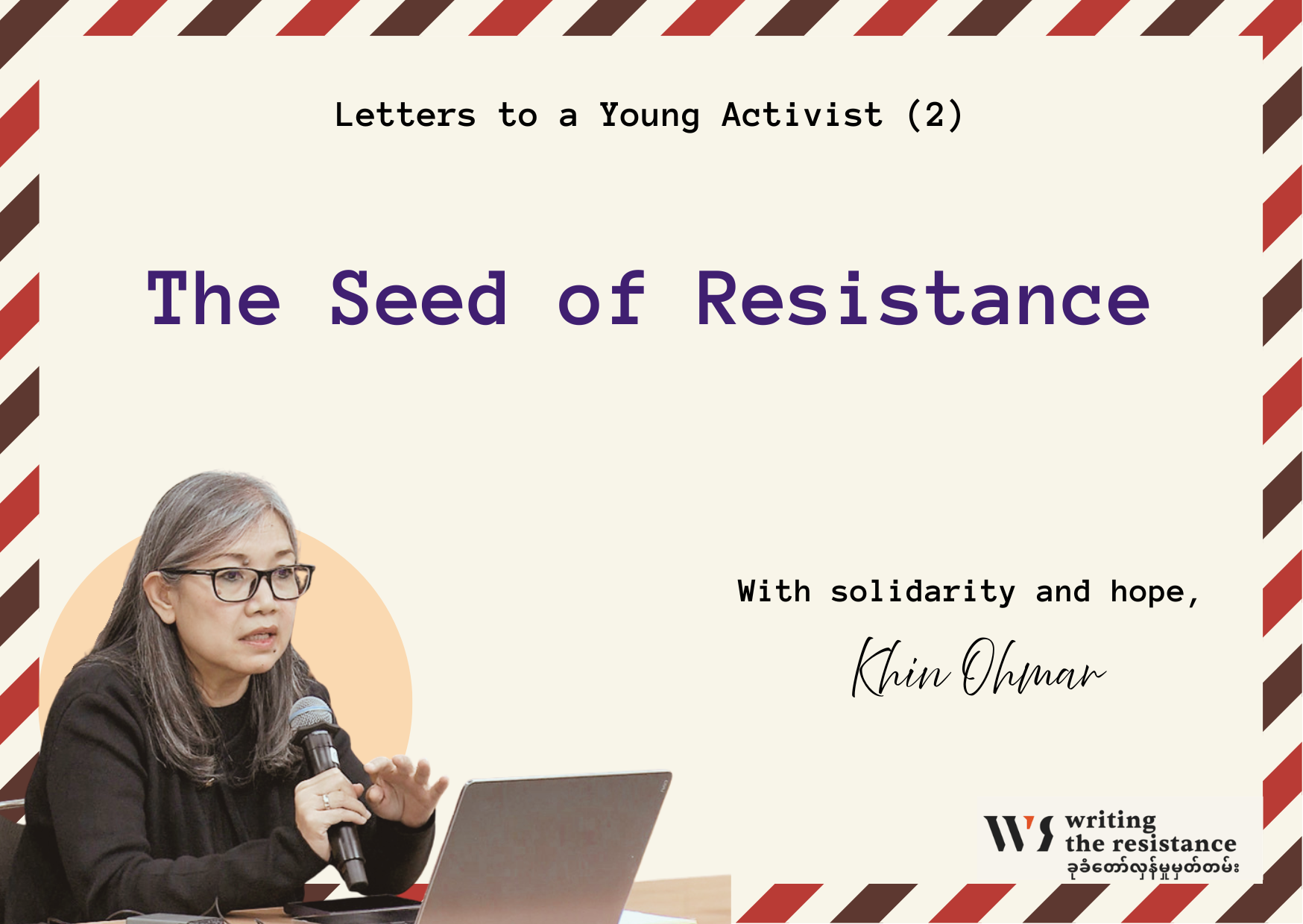
Guest contributor
Khin Ohmar
Dear young activist,
One of the life lessons that has shaped my activism has been the understanding that before we can change anything, we have to ask why it exists in the first place. The courage to ask that question is where every act of justice begins. It is the seed of resistance.
I remember being 14 years old, sitting at the base of the Shwedagon Pagoda, and watching as men ascended a holy site that women were forbidden to enter.
Why? I asked my mother why, and her answer was, “Because we are women.” I asked what makes men more worthy and what makes us, as women and girls, less worthy?
I received such maddening answers that directly and indirectly told me to keep silent. I was told to feel shame about my female body which was looked down upon as dirty because of menstruation, and to regret that my female body lacks “pone,” the spiritual power that we are taught to believe only male bodies possess.
I persisted: But what about an old nun who has stopped monthly periods and is doing religious work, and what about men who are alcoholics and rapists?
The answer remained the same – an old nun still could not enter because she is a woman and those rapists could enter because they are men.
I was told I’d go to hell for asking why and questioning these beliefs. But I couldn’t stop then, and I have never stopped. I think we should encourage ourselves and each other to always question the conditions we find unjust. That is the only way change happens.
Activism is about seeing clearly. It’s about unlearning the lies we were raised with, even when those lies come from people we love, trust and admire.
Among the most radical things we can do is to continually question why things are the way they are, and then to challenge the conditions that have enabled injustice and impunity.
By the time I joined the student movement in 1988, I had started to see the bigger picture of how injustice is woven into the threads of our society – from the violence in our homes, to the rules at sacred sites, to the silence around those in power and silence around ethnic and religious oppression.
I joined the student protests because I felt deeply that silence was complicity.
When I got to the border and met Mon and Karen communities who had been brutalized by the same military we students were fighting against for democracy, I understood a deeper layer in answer to my endless whys.
The injustice of our country wasn’t only political. It was ethnic. It was both systemic and systematic. And for the first time, I realized that despite the discrimination and violence I had faced in my life, I still carried privilege – the privilege of belonging to the majority.
My own lineage is Burman, Shan, and Mon, but my social position as a Burman, Buddhist woman from an urban area with access to education afforded me protections and privileges that women from ethnic minorities and rural areas did not have.
We all lived under the same repressive military dictatorship and I certainly experienced many challenges and discrimination as a woman, but I could not fully know the layered oppression faced daily by Chin, Karen, Ta’ang, Rohingya, and other ethnic communities and the layers of discriminations and violence women from these communities faced.
Only by listening to and standing alongside survivors did I fully understand the Myanmar military’s impunity and how it had shaped our society.
The more I learned, the more committed I became to using my privilege of belonging to the dominant majority to stand in solidarity with and support oppressed and marginalized communities in their struggles for equality, justice, and accountability.
When Myanmar opened up in 2011, I decided not to return home for good for two reasons: I didn’t trust the military, and I knew that my struggle is not complete unless ethnic peoples’ liberation is also achieved.
To me, the essence of a powerful movement is when we come together in our shared struggles and stand firmly in solidarity for and with each other.
We recognize our collective oppression and abuse, and also the different and unequal sources of power and privilege that we’ve gained from the system.
We use our different sources of power to organize and build together for new systems rooted in holistic, inclusive, and lasting peace based on equality, equity, justice, and accountability.
Social justice activism requires us to ask why again and again, about the injustice around us, our own place in the context, and in our own actions.
As we talk about others committing injustice against us, we also need to be aware of injustices we may be committing against others, intentionally or unintentionally, consciously or subconsciously.
Only then can we unlearn and change our own harmful actions and behaviors. With self-awareness, we can effectively share the power we have access to because of dominant identities we may hold, whether ethnicity, gender, economic class, religion, age, or education level.
What Gandhi Gyi said, “Be the change you want to see” is only truly meaningful when we put it into practice.
We can evaluate when to use our sources of power to speak out, and when to step back and make room for others to take the lead and speak out. That is the foundation of solidarity for collective strength and resistance.
The Spring Revolution is unlike any struggle that came before it in our country. Its vision of genuine federal democracy built on inclusivity, justice, and equality, is clear and has reached the hearts and minds of the general public, unlike in our 8888 time.
With more vibrant representation and leadership of youth, women, ethnic nationalities, religious minorities, and LGBTIQA+ communities than ever before, this movement has stood together to declare that the military will never rule us again.
That shared commitment to this vision has pushed the military’s centralized oppressive system to the brink of collapse.
But dismantling the Myanmar military’s repressive system and its machinery will remain a distant dream rather than a reality unless the Spring Revolution’s forces–especially young generation activists–regroup and strategize.
The illegal, criminal military junta has rebranded itself under civilian disguise while escalating violence against the people and using manipulation to crush the resistance and reimpose tyranny.
We must question every move this post-sham-election junta makes. The more we question, the clearer the path forward in our activism for change becomes.
Keep questioning, keep challenging, and keep learning and unlearning until the military’s centralized, oppressive system is dismantled and a new future is built together.
Never underestimate the transformative power of asking why, and of recognizing both your oppression and your privilege in shaping the way you stand in solidarity and fight for justice and freedom.
With solidarity and hope
Khin Ohmar is a Myanmar human rights activist who was involved in organizing the ‘8888’ nationwide pro-democracy uprising. She is also the founder and chairperson of Progressive Voice, a Myanmar human rights organization. She developed the Women Peacebuilding Program for Women’s League of Burma and served as program coordinator from 2000 to 2006.
DVB publishes a diversity of opinions that does not reflect DVB editorial policy. We’d like to hear what you think about this or any of our stories: [email protected]