


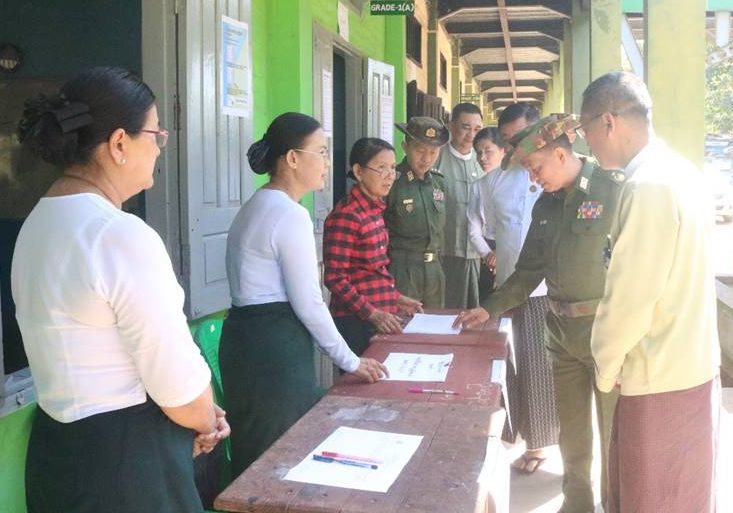
A candidate from a political party contesting the regime’s 2025–26 elections told DVB on Wednesday that the Union Election Commission (UEC) Chairperson Than Soe acknowledged problems during the first phase of voting on Dec. 28 and promised improvements in the upcoming final phases.
“There are difficulties with the voting machines. He said the [UEC] would do their best,” the candidate told DVB on the condition of anonymity. “There were also issues with voter lists and advanced voting.”
The candidate said that Than Soe made the remarks during a meeting with 57 representatives of political parties in Naypyidaw on Jan. 5. Political parties participating in the elections have told DVB that there were errors on voter lists, problems with the electronic voting machines, irregularities during advanced voting, along with intimidation by regime personnel to force voters to the ballot box on Dec. 28.
“We also sent a letter to the commander-in-chief [Senior General Min Aung Hlaing] saying we do not want one-sided victories resulting in single-party dominance in a parliament,” the candidate said, referring to the military-proxy Union Solidarity and Development Party (USDP), which won 88 out of 96 seats in the Pyithu Hluttaw, or lower house of parliament, and 10 out of 18 seats in the Amyotha Hluttaw, or upper house.
Sai Aik Paung, the chairperson of the Shan Nationalities Democratic Party (SNDP), also known as the White Tiger Party, won one parliamentary seat for Shan State’s Langkho Township in the Pyithu Hluttaw after preliminary results were released by the UEC on Jan. 5-6. He told DVB that he filed a complaint about the fairness of the elections to regime leader Min Aung Hlaing directly.
Than Soe also warned candidates at the UEC meeting on Jan. 5 that insults or defamatory comments about rival candidates or political parties during the electoral process could be considered malpractice and may constitute a criminal offense. One candidate told DVB on the condition of anonymity that he viewed this as a threat from the UEC.
Regime media reported that a meeting “on election security” was attended by police, soldiers, and UEC officials in Naypyidaw on Jan. 6 after “terrorist” groups interfered in the first phase of the elections.
It added that as of Jan. 5, legal action had been taken against 335 people—275 men and 60 women—under the Election Protection Law for “incitement and propaganda that could undermine the election.”
The People’s Defense Force (PDF), which is the armed wing of the National Unity Government (NUG), had stated that it would carry out attacks during the regime elections.
Three regime officials were killed and three police officers were injured in an attack by an unknown resistance group on a convoy carrying a UEC official on the road linking Naypyidaw to Magway Region on Jan. 6.
The NUG, which represents lawmakers ousted in the 2021 coup, along with the Women’s League of Burma (WLB), a coalition of women’s organizations working for gender equity, and Progressive Voice (PV), a human rights advocacy group, have all called on citizens to boycott the regime elections.
The ASEAN Parliamentarians for Human Rights (APHR), along with members of the European Parliament and the Special Advisory Council for Myanmar (SAC-M), an independent group of international human rights experts, rejected the regime elections and urged the international community not to recognize the results on Dec. 29.