


Guest contributor
Nathaphob Sungkate
I recently obtained an official document from the Department of Employment at the Ministry of Labour of Thailand, dated October 5, 2026.
The letter requests facilitation of entry visas for 31 Myanmar government officials appointed to operate across Certificate of Identity (CI) centers in Thailand.
This followed a bilateral agreement to open five official CI centers and mobile units nationwide, operating from October 14 to January 14, 2027.
As an independent Thai journalist covering migration issues in Thailand, I have witnessed growing anxiety among more than three million Myanmar migrant workers across the country.
Many strongly oppose the coercive measures imposed by the Myanmar military junta.
These include a 2–3 per cent income tax, a mandatory remittance of 25 per cent of their earnings back home through state-controlled banks at artificially low official exchange rates, and the requirement of tax and remittance receipts as a prerequisite for renewing travel documents, including passports and CI documents.
Failure to comply results in a refusal to extend their documentation. Alarmed by these developments, I set out to report on the situation.
The Thai government’s decision to collaborate with the junta in Naypyidaw—a regime lacking both reliable demographic databases and the trust of Myanmar workers in Thailand—to administer CI issuances is actively pushing an estimated 700,000 to one million Myanmar migrants out of the legal registration system.
This threatens severe repercussions for the Thai economy and local businesses reliant on migrant labor, raising the immediate prospect of acute labor shortages.
According to testimonies from Myanmar migrants, the financial burden of obtaining a single CI booklet is exorbitant.
The official breakdown includes 2,660 THB for the CI booklet, 1,800 THB in taxes remitted to the junta, and 3,000 THB for a Thai visa.
On top of these official fees, workers face unofficial costs: broker fees ranging between 1,300 and 1,500 THB merely to secure a queue spot.
In total, a single migrant worker must fork out no less than 10,000 THB ($300 USD) just to remain documented.
Intimidation inside the CI center
On the morning of October 21, I planned a field visit to the CI center in Samut Prakan outside of Bangkok to observe the atmosphere and interview visitors.
A large sign in Thai, English and Burmese clearly marked the entrance. Turning inside, the site resembled a spacious, open-air old warehouse. I parked my motorcycle in front of an office with constant foot traffic.
Along the pavement, 30 to 40 Myanmar migrant workers sat in rows, flanked by a fleet of vans from various provinces.
Inquiries revealed that these workers had paid broker networks to secure queue slots and transport to one of only five CI centers operating nationwide.
I prepared to carry out my reporting as usual, wearing a blue press armband issued by the Thai Journalists Association on my left arm and a camera around my neck.
My goal for the day was clear: capture the registration process and conduct select interviews with Myanmar workers and Thai employers present.
As I walked around taking photos, a Thai broker shouted and approached me aggressively, asking why I was taking pictures.
When I identified myself as a journalist, his irritation intensified. “If you’re a real journalist, show me your press credentials,” he demanded.
My hands trembled, but I tried to calmly explain my work—that I am a freelance journalist contributing to various Thai news outlets, such as Today and Prachatai.
While he interrogated me, a member of his crew filmed me continuously. Eventually, we reached an uneasy understanding and went our separate ways.
By 8:00 AM, a number of Myanmar workers around 40-50 persons arrived and lined up for documentation.
As I tried to capture the surrounding atmosphere, a heavy-set man wearing a white shirt and a badge bearing the Myanmar national flag shouted at me in accented Thai to stop taking photos.
His first question was, “Are you Thai or Myanmar?”
I walked up to him and stated that I was a Thai journalist. He countered that if I were truly Thai, I had to show my national ID card so he could send my information to his supervisor.
The scene grew chaotic. As I handed my ID to the official claiming to work for the Myanmar government, another Thai man stepped in to intimidate me, demanding that I cease all photography.
The tension temporarily eased when a woman in a black jacket, identifying herself as a center administrator, intervened.
She mediated that I could take photos strictly outside, but requested that I refrain from shooting inside the building.
While this appeared to settle the matter, the man remained visibly displeased and kept his eyes on me.
Moments later, he and three or four associates surrounded me, forcing me to display every photo stored on my camera. He instructed that if any photo captured his face, I had to delete it immediately.
Fearing for my safety, I decided to withdraw from the site. Upon returning home, I posted about the incident on my personal Facebook page.
This subsequently led to individuals reaching out to provide me with insider information regarding the forces operating behind the CI centers.
The Myanmar military network behind the CI centers
An undisclosed source later provided me with information regarding Khin Maung Kyaw, the Managing Director of United K.M.K Co., Ltd.
Having previously been involved in CI operations, he is currently overseeing the management of the Samut Prakan CI center.
A 2023 report by The Irrawaddy revealed that Khin Maung Kyaw’s wife is related to Kyu Kyu Hla, the wife of junta chief Min Aung Hlaing.
Furthermore, Khin Maung Kyaw is himself a former Myanmar military officer, having graduated from the Officer Training School (OTS) Batch 71, The Irrawaddy reported.
This military presence is not confined to Samut Prakan.
In Samut Sakhon—one of the most densely populated migrant hubs in Thailand—I received information that Lt. Col. Thein Zaw, a Myanmar military officer, has been assigned as the head of the operational team at the CI center.
In terms of operations and administration, Lt. Col. Thein Zaw oversees all Myanmar technical and administrative personnel within the center.
His duties cover verifying civil registration databases linked directly to Naypyidaw, approving CI booklet printing, and authorizing document extensions.
Moreover, after news of the intimidation I faced spread across Thai and Myanmar media, journalists from Thai PBS attempted to cover the CI center in Chiang Mai, only to be denied entry as well.
This pattern clearly underscores a troubling reality: the five CI centers across Thailand have become spaces where the Myanmar junta has been granted a free pass by the Thai government.
Under the guise of official procedures, junta-linked figures operate with complete autonomy and zero oversight, facilitating a systematic process of extortion against Myanmar migrant workers on Thai soil.
Voices of workers inside the CI center
A day after my field visit to the Samut Prakan CI center, an unknown number of people tried to call me early in the morning.
My initial instinct was that it might be an angry broker calling to intimidate me over my coverage. So, I recorded a video of the entire conversation.
However, it was a woman who had approached me to ask for my phone number just as I was preparing to leave the CI center on the day of the incident. Her first words to me were:
“Could you please come back and report on the CI center again? Inside, it is full of exploitation and extortion targeting Myanmar workers.”
She explained that she had witnessed the entire confrontation between me and the CI center staff.
She revealed that the first man who aggressively blocked my reporting was an agent from a broker firm handling migrant documentation—later identified through further checks as a manager at Foreign Worker Employment Agency Mahanakhon Labour Company Limited.
Regarding the official claiming to represent the Myanmar government—who demanded my national ID to photograph and send to his supervisor—she identified him as an influential Myanmar national residing in Samut Prakan who works closely with the military junta.
Furthermore, most Myanmar workers traveling from other provinces to the center are brought in by organized broker networks.
Once there, they are forced to consume only the food provided by junta-linked operators, who compel them to use their official payment receipts as meal vouchers.
Tun Soe, a Myanmar migrant worker, told me in an interview that newly arrived Myanmar migrants covered under the Cabinet resolution of November 11, 2025—numbering around 700,000 who still lack passports from their home country—fall into the category required to obtain CI documents in this round.
These individuals typically enter Thailand through broker networks, costing them between 25,000 and 30,000 THB.
Before securing employment, they must also maintain an emergency fund of around 10,000 THB for living expenses and accommodation, bringing their initial cost of starting a working life in Thailand to roughly 40,000 THB.
On top of this heavy debt, they are now forced to pay an additional 10,000 THB for the CI process.
Thailand must stop facilitating the Myanmar junta
Historically, the Thai government’s foreign policy toward the Myanmar junta has been characterized by passive compliance and deference aimed at avoiding confrontation with the regime.
This approach is a double-edged sword that ultimately backfires on Thai society.
A prime example is the official directive from the Department of Employment, Ministry of Labour, granting permission for 31 Myanmar junta officials to operate unchecked across five CI centers nationwide.
By relinquishing regulatory oversight, Thai state agencies risk severely damaging the country’s international reputation, exposing Thailand to heightened scrutiny from international oversight bodies.
This situation echoes the harsh lessons of Thailand’s maritime sector crisis.
In April 2015, the European Union issued a “yellow card” warning Thailand over Illegal, Unreported, and Unregulated (IUU) fishing, alongside a downgrade by the United States to Tier 3 in its Trafficking in Persons (TIP) Report due to rampant human trafficking and forced labor on fishing vessels.
By facilitating the junta’s exploitation of Myanmar workers within Thai borders, the Thai government is needlessly incurring massive economic and geopolitical risks.
The only beneficiaries of this policy are corrupt broker networks, concessionaire companies with close ties to Naypyidaw, and the junta itself, which gains access to census and tracking data of its citizens—exacerbating panic among workers, particularly those eligible for mandatory military conscription back home.
In reality, Thailand has viable policy alternatives. Bangkok could choose for a temporary, unilateral registration and permit extension system, as it has done successfully in the past, allowing workers to maintain legal status for 1–2 years.
Thailand already possesses comprehensive data on these workers through biometric identification by the Immigration Bureau, non-Thai identification cards (known as “pink cards”) issued by the Ministry of Interior, and health screening records held by the Ministry of Public Health.
This demonstrates that Thailand’s internal database system is far more robust, reliable, and equipped to manage worker registration than the Myanmar junta’s infrastructure.
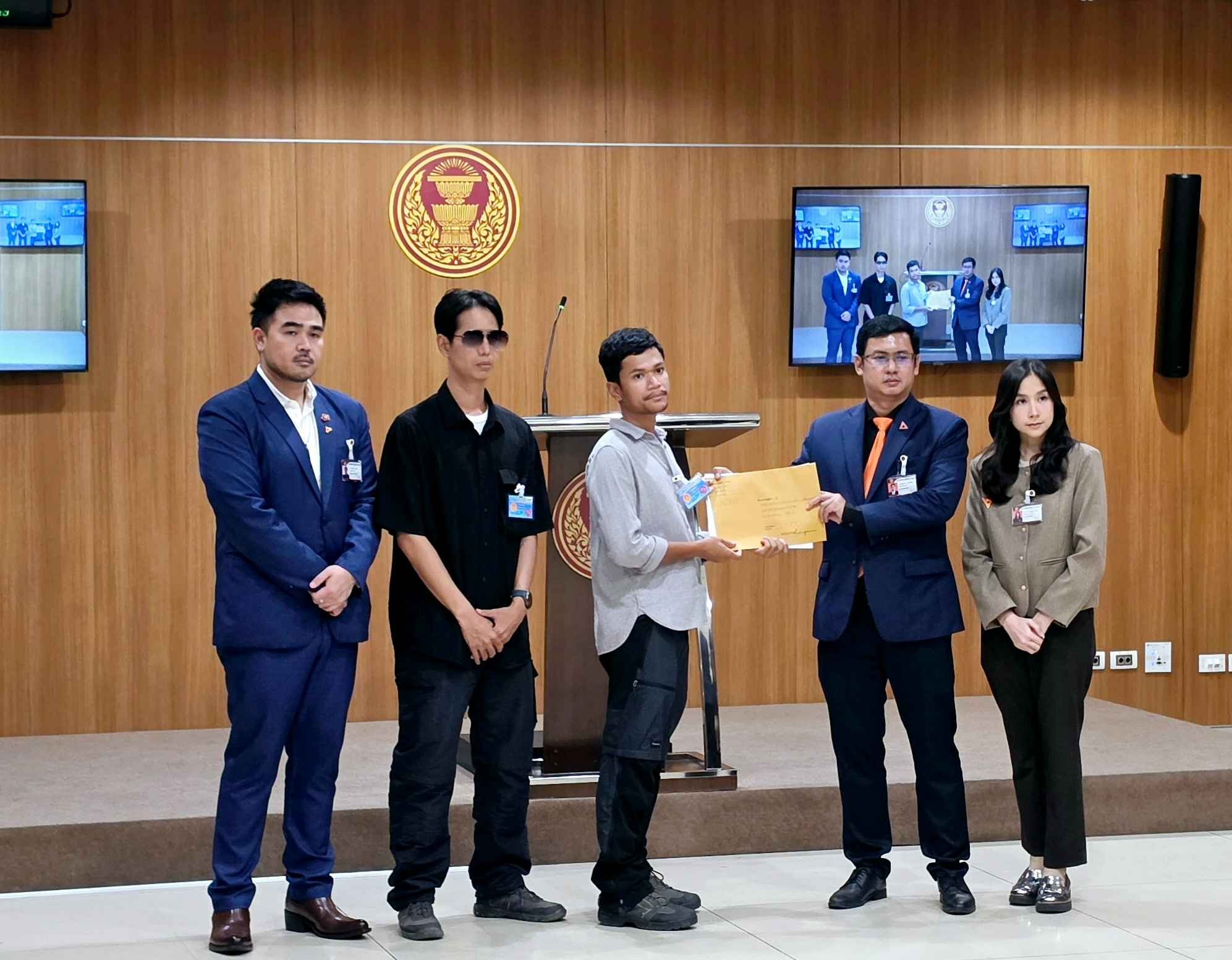
As a journalist who has closely reported this issue and personally faced intimidation on-site at a CI center, I submitted an official petition to The Committee on Political Development, Mass Communications, and Public Participation on October 28.
My demand is clear: all processes related to work permits and document renewals for migrant workers—now and in the future—must be transparent, accountable, and free from intimidation.
No one should face extortion simply because their migrant status renders them vulnerable.
Given that migrant labor is a vital engine driving Thailand’s foundation-level economy, it is the fundamental duty of Thai society to safeguard their basic human rights, ensuring they can live and work with safety, dignity, and peace of mind.
Nathaphob Sungkate is an independent journalist focusing on migration issues in Thailand and across Southeast Asia.
DVB publishes a diversity of opinions that does not reflect DVB editorial policy. We’d like to hear what you think about this or any of our stories: [email protected]