


Guest contributor
Shalini Perumal
In stark contrast, movements in Myanmar, Thailand, and Indonesia faced states armed with a singular, unwavering focus: the preservation of power at any cost, regardless of civilian casualties or economic stability.
In Thailand, the youth-led pro-democracy movement, which peaked in the massive street rallies of 2020-2021, known as the Ratsadon Movement, directly challenged the most sacred and protected institution—the Monarchy—and by extension,the military that guarantees its power.
The state’s strategy of containment has been a sophisticated, cyclical one, where the military acts as the ultimate ‘veto player’ ready to annul democratic gains not through a direct coup, but through the judicial and constitutional apparatus.
This dynamic was most recently illustrated following the May 2023 General Election. The youth-backed, progressive Move Forward Party won the most seats on a platform promising constitutional and institutional reform, including an amendment to the strict Lèse-majesté royal defamation law known as Article 112.
However, this victory was immediately blocked by the conservative establishment: the military-appointed Senate refused to endorse the Move Forward Party leader, Pita Limjaroenrat, as Prime Minister, citing the party’s desire to touch the monarchy.
This refusal, though operating within the constitution written by the former junta, effectively denied the democratic mandate.
The final blow came in August 2024, when the Thai Constitutional Court dissolved the Move Forward Party and banned its executives from politics for ten years, explicitly ruling that their campaign to amend Article 112 was an attempt to overthrow the constitutional monarchy.
This move demonstrated the failure of the youth movement to achieve political change: they won the election, but they could not win the system.
The repression extends beyond party politics. The struggle has been consistently choked by the intensified use of the Lèse-majesté law.
Since the start of the 2020 protests, hundreds of youth activists have been charged, with prominent leaders like Arnon Nampa receiving lengthy, cumulative sentences well into 2025.
This use of draconian legalism effectively fractures the movement’s leadership and chills public dissent, preventing the critical, unifying mass action required for regime paralysis.
Unlike the rapid collapse in Sri Lanka or Bangladesh, the Thai struggle is against a sophisticated, cyclical system designed to neutralize dissent by weaponizing the law in defense of a deeply entrenched, non-elected elite.
Indonesia’s experience demonstrates that a stable, resilient post-1998 democratic framework can effectively neutralize even massive youth uprisings.
The key difference here is the nature of the state’s security forces: the military (TNI) is largely depoliticized compared to Myanmar’s military or the Thai Royal Army, and the system is designed to absorb pressure through established, if often flawed, constitutional channels rather than collapsing under it.
This dynamic has played out repeatedly in recent years, beginning with the September 2019 “Reform Corrupted” Protests, the largest student actions since the fall of Suharto, which opposed revisions to the KPK law and a proposed new Criminal Code.
Despite the scale of these protests, the government only delayed some bills and refused to reverse the enacted KPK law, demonstrating its capacity to resist fundamental policy reversal.
This was followed by the October 2020 Omnibus Law Protests, where tens of thousands of students and labor unions mobilized against a law that eroded labor and environmental rights; yet, despite the disruptions and occasional riots, the government pushed the law through Parliament.
Though the Constitutional Court later deemed the law procedurally flawed in 2021, the government simply issued a replacement regulation which Parliament ratified in March 2023, effectively circumventing the court and crushing the movement’s policy goal.
Most recently, the August 2025 Anti-Corruption Protests—triggered by a proposed raise in parliamentary allowances and escalating after a police tactical vehicle killed a protester—resulted in seven deaths and thousands of arrests.
In response, the government narrowly tailored its concessions by canceling the parliamentary perks but leaving the systemic democratic backsliding unaddressed.
In each case, the student movement successfully exposed corruption and rallied public opinion, but the system remained impervious to their core demand for policy reversal or systemic change.
The Indonesian state relies on the institutional space such as courts and parliament that allows the system to bend without breaking, ensuring that the youth struggle remains a process of political pressure rather than revolutionary overthrow.
Myanmar’s Spring Revolution is the most sustained and morally compelling youth-led struggle in the region, defined by the brave Gen Z who grew up tasting a decade of quasi-democracy that began in 2011.
Immediately following the coup on February 1, 2021, they organized the monumental Civil Disobedience Movement (CDM), which saw civil servants, doctors, and students stage mass walkouts to cripple the junta’s administration.
When the military responded with escalating, indiscriminate massacres—such as the over 100 killed on March 27, 2021—Armed Forces Day–the movement quickly evolved from street protests to armed resistance, forming the People’s Defence Force (PDF) and aligning with key ethnic armed organizations (EAOs).
Their primary adversary, the Myanmar military, is unique in its resilience. It’s not just a national army; it is a highly cohesive, self-contained economic and political entity whose very institutional survival is predicated on maintaining a chokehold on the state.
This leads to two critical differences from the ‘success’ cases.
Firstly, there has been near-zero significant elite defection from the top military leadership. Where Sri Lanka’s Rajapaksas faced betrayal from within, Min Aung Hlaing commands an institution whose senior ranks are financially and politically tied to his survival.
However, the period of 2024-25 saw unprecedented pressure: in February 2024, the junta was forced to implement a Military conscription law to address its severe manpower shortages, prompting an exodus of young men from cities.
More significantly, the resistance has generated over 15,000 defections of soldiers, police, and militia members, since the 2021 coup, a number unprecedented in Myanmar’s history, demonstrating the cohesion is weakening, though not yet at the command level.
Secondly, the junta has demonstrated an unwillingness to compromise its power for any cost, using maximum, indiscriminate force, including the continued use of airstrikes on civilian areas throughout 2024-25.
This willingness to murder its own people indefinitely, seen in over 5,350 civilian deaths by late 2024, is the critical discriminator that prevented a non-violent political overturn.
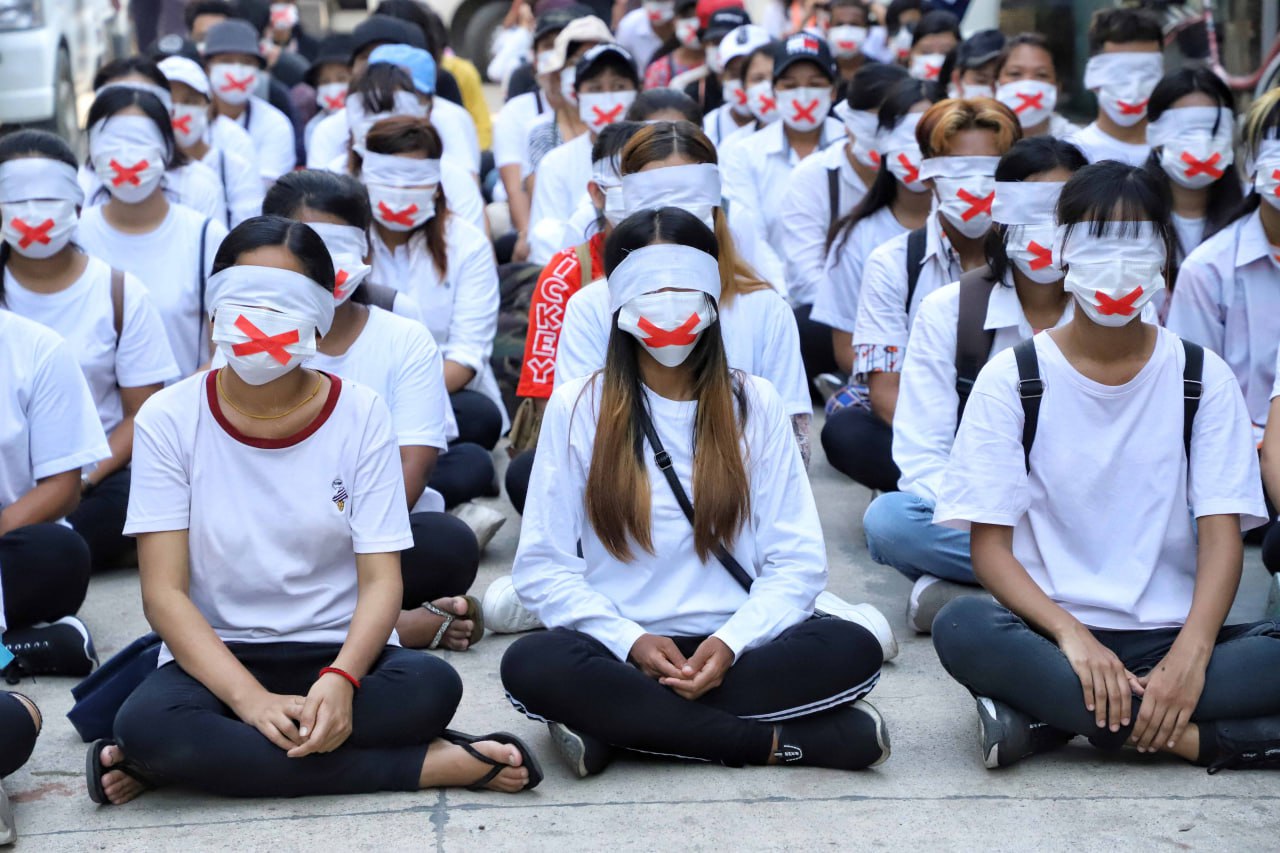
Despite the brutality, the non-violent resistance has continued its multi-faceted strategy. Non-violent action adapted to the environment with innovative tactics allowed the public to demonstrate massive, coordinated dissent and non-cooperation with the junta without risking the mass arrests and violence associated with large physical gatherings.
By utilizing silent strikes and flash mob protests, activists kept the anti-2021 coup movement alive.
To mark the one year anniversary of the coup on 1 February 2022, citizens stayed home, closing down shops and halting all outdoor activities, resulting in deserted streets in towns and cities nationwide.
Flash mob protests are also a key tactic used by anti-coup activists to evade the military’s violent crackdowns. These are brief, spontaneous gatherings in urban areas that disperse quickly to minimize the risk of confrontation with security forces.
Such tactics maintain pressure on the junta and showcasing the populace’s enduring refusal to accept military rule.
The fight for Myanmar remains the region’s toughest, but it has transitioned from street protests to a nationwide uprising against a state that relies solely on coercion.
The fundamental reason the youth-led revolutions in Sri Lanka, Bangladesh, and Nepal achieved rapid success while Myanmar’s has not lies in the structural role of the military and the nature of the political vacuum created by the protests.
In the successful trio, the military apparatus is essentially subordinate and integrated into the civilian state, depending on government budgets and professional mandates.
Consequently, military cohesion fractured quickly when the leadership perceived the political and economic cost of defending the current regime—such as the national destitution in Sri Lanka in 2022 or the mass public outrage in Bangladesh in 2024—to be catastrophically high.
The regional Gen Z movements, therefore, needed only to isolate the political leader, compelling the security forces to withdraw support and create a power vacuum.
In stark contrast, the junta in Myanmar operates as a monopoly and autonomous entity, a self-sufficient, state-within-a-state.
Its survival is not primarily dependent on a specific political budget but on its vast, opaque corporate empires like Myanmar Economic Holdings Limited (MEHL) and Myanmar Economic Corporation (MEC), making its power financial and ideological.
High cohesion at the top is secured by shared financial interests and the institutional belief in their historical role as the sole guardian of the state.
Because of this, the Gen Z movement must dismantle not just a government, but a corporate-military fortress, necessitating the swift and necessary shift from non-violent protest in 2021 to an armed and economic revolutionary war executed by the CDM, the People’s Defense Force (PDF), and the National Unity Government (NUG).
Furthermore, the political opportunity structure differs significantly. The regional successes largely involved a political substitution within existing democratic norms.
For instance, in Nepal in 2006, the Seven-Party Alliance (SPA) was a ready-made, legitimate alternative poised to step in; and in Bangladesh in 2024, the interim transition to Chief Advisor Muhammad Yunus was quickly brokered.
These transitions provided a stable, non-revolutionary path. By contrast, the Myanmar youth’s demand is truly revolutionary: a total systemic overhaul leading to a Federal Democratic Union, fundamentally different from the pre-2021 status quo.
Consequently, the NUG and its allies were formed after the 2021 coup and have had to build legitimacy, control territory, and govern simultaneously, engaging in the costlier, longer process of creating a parallel state rather than filling a political vacuum.
Finally, the international response has sealed the divergent outcomes. When Sri Lanka and Bangladesh faced collapse, regional powers and international financial institutions often applied pressure for an orderly transition to prevent economic fallout.
Myanmar, however, faces regional indifference and support for the junta from key neighbors like China and India, which prioritize stability and border security.
The Association of Southeast Asian Nations (ASEAN), the regional bloc, has remained ineffective and divided. Lacking external pressure, the burden of resistance falls almost entirely on the youth and the NUG.
This absence of external mediation or decisive pressure has compelled the resistance to adopt armed force as the primary means of generating political change, proving that against a security apparatus as ruthless as the junta, internal civilian sacrifice alone is insufficient without a change in the military’s top-level financial or physical security.
The youth of Myanmar are not simply fighting for a return to the past; they are fighting for a future that no other youth movement in the region has yet secured: a true federal democracy free from military control.
Their fight is the region’s toughest, but their resilience, now channeled into structural political and armed resistance, ensures that the flame of the Spring Revolution will endure.
Shalini Perumal is a creative international development professional who has worked previously in Mae Sot, Thailand at Mae Tao Clinic, consulted for Finnish Refugee Council Myanmar, and served as a Writer/Researcher at Insight Myanmar Podcast. She is currently a freelance journalist working on a novel.
DVB publishes a diversity of opinions that does not reflect DVB editorial policy. We’d like to hear what you think about this or any of our stories: [email protected]