


Guest contributor
Fergus Harlow
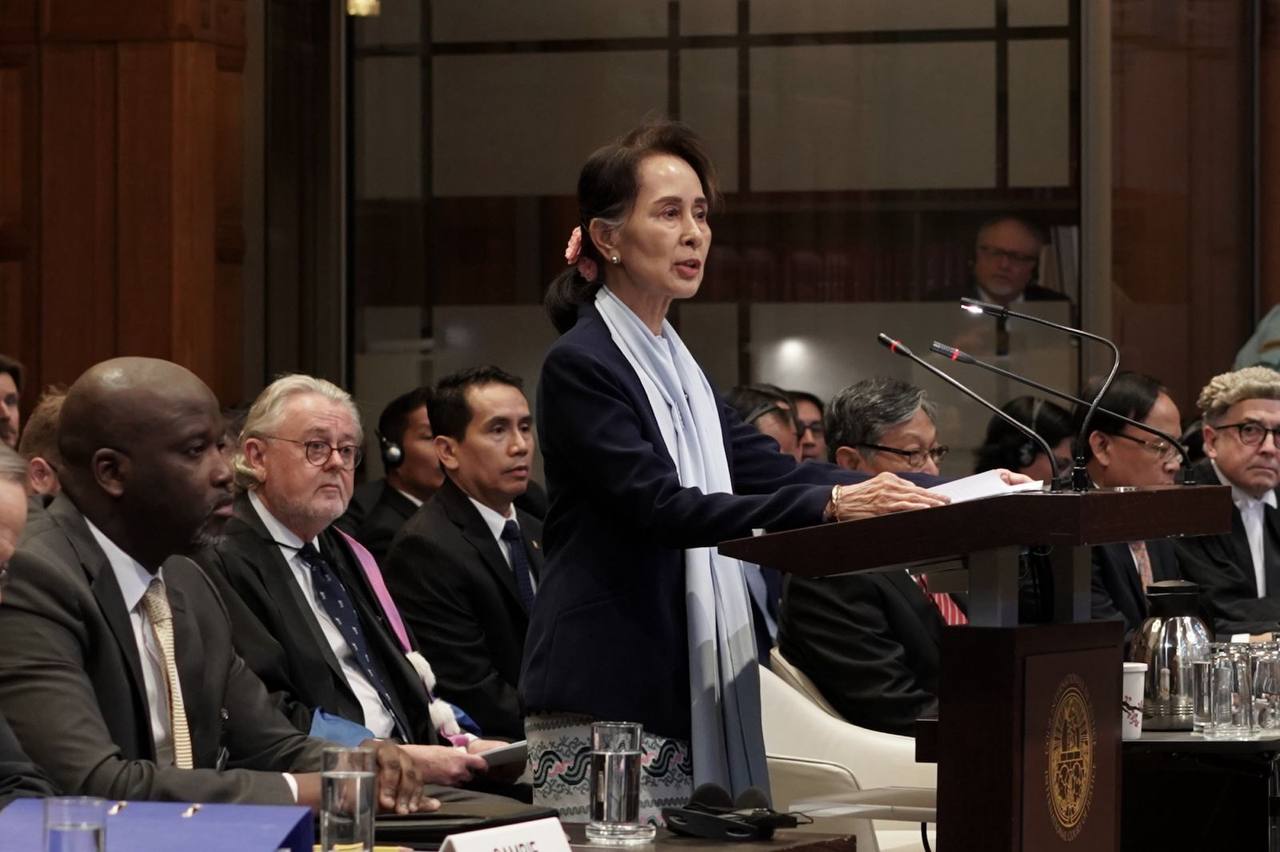
The International Court of Justice has scheduled its judgment in The Gambia v. Myanmar for November 19
The language around Aung San Suu Kyi’s complicity in genocide has softened considerably since her imprisonment in 2021.
Although it is the state of Myanmar on trial at the ICJ, news about the upcoming verdict in the Gambia vs. Myanmar genocide case more often places responsibility firmly with the military.
In March 2022, then-U.S. Secretary of State Antony Blinken announced that “members of the Burmese military committed genocide and crimes against humanity.”
John Sifton, Asia advocacy director at Human Rights Watch, said the U.S. “should couple its condemnations of Myanmar’s military with action.”
Tin Khun, president of the Burmese Rohingya Organisation UK, likewise called for “concrete action to hold the Burmese military accountable for their crimes.”
In January this year, in a Guardian article headlined ‘A Big Step Forward’, Tin Khun commented that the U.N. case is “the first time the Burmese military are in court having to defend themselves.”
The absence of the National League for Democracy (NLD) government remains conspicuous.
It seems unlikely that, whatever ruling the U.N. makes, Aung San Suu Kyi’s role will be given as much significance as it was in the headlines of the international press.
That leaves an uncomfortable possibility: a judgment may establish responsibility for atrocities without resolving the allegations surrounding a civilian leader who had no command over the forces that committed them.
There is a serious argument that, as well as committing atrocities against the Rohingya, the military used the chaos of 2017 to destroy the NLD: to place international condemnation at its feet and put it in an untenable position at home and abroad.
Theirs was a trial by media, their sentence already passed.
For international observers, not having to contend with Myanmar’s domestic problems, the situation always appeared clear cut – the facts spoke for themselves.
Yet, in hindsight, it seems the military did not need to persuade the world of the legitimacy of its actions. It merely needed to appeal to a sense of moral superiority.
While Myanmar’s domestic context in 2015–2021 was defined by inter-communal violence, armed militancy in Arakan (Rakhine) State, contested borders, and unresolved disputes over citizenship rooted partly in British colonial history, the public record views this complexity as simply an excuse for hatred.
Moral vocabulary makes disagreement difficult. Structural limitations are interpreted as planned persecution. Intent is superimposed on chaos.
Questions about capacity become judgments about character. Explanations of political constraints become proof of indifference to suffering.
Genocide, ethnic cleansing, and war crimes have at times become interchangeable in reporting, as have the roles of the NLD government and the military.
Today, that ambiguity means the accusation that the Myanmar government supported religious extremist movements tarnishes Suu Kyi’s civilian government instead of the military proxy party responsible.
Win Htein, Aung San Suu Kyi’s most senior NLD MP, offered a complex perspective on the political forces shaping this environment during the many meetings from 2013-2020 that became our work, “Burma’s Voices of Freedom.”
Speaking about the relationship between the military-aligned political establishment and the Buddhist nationalist movement, he explained:
“The NLD cannot support U Wirathu because he’s preaching racism. It was U Htay Oo and U Aung Thaung who went to U Wirathu. Powerful USDP men. Now, he and Ma Ba Tha have the full support of the military party.”
Win Htein also described how religious nationalism was being mobilised as an electoral weapon against the NLD:
“Now, the 969 monks are making people believe that if Daw Suu wins the elections, the country will be overrun by Muslims. Preaching such things is harmful — people will believe it whether its true or not.”
These observations identify a political contradiction that deserves greater attention: Suu Kyi could be attacked domestically as a threat to Buddhist nationalism while being condemned internationally as its defender.
The intractability of moral framing can displace the work of establishing responsibility. Public sentiment becomes “historical record.” Popularity becomes evidence. Abstractions replace actions.
When we say ‘Aung San Suu Kyi denied ethnic cleansing,’ or ‘Aung San Suu Kyi defended the military,’ or ‘Aung San Suu Kyi defended the imprisonment of the Reuters journalists’ these news-worthy soundbites remove Myanmar’s political, legal and social context and attribute events to the machinations of an individual.
The suggestion that Suu Kyi was colluding with the generals was challenged repeatedly by Win Htein, who emphasised the difficulty of interpreting her political position from outside Myanmar:
“Some say she is colluding with the generals, but there’s no way. It’s very difficult for other people to see her nuances. Being friendly is a very fine line she choosing.”
His comments point to a distinction often overlooked in international assessments of the NLD government: the difference between political accommodation and political allegiance.
Suu Kyi’s relationship with the military was shaped by the institutional and constitutional constraints under which her government operated.
Win Htein also described the practical difficulties facing Suu Kyi in addressing the Rohingya question, including the limitations of international diplomatic pressure:
“Daw Suu is advocating for a census, seeking the help of the Bangladesh government. The difficult is that they won’t recognise the problem.
And if she speaks up more for the Rohingya, it will make the situation worse. It might help the international community, but it won’t help Burma.”
This was the dilemma confronting the NLD: the demands of international opinion did not necessarily correspond with what was politically possible within Myanmar.
The position was not simply one of defending the military or denying the suffering of the Rohingya.
A statement applauded abroad could be weaponised at home. A diplomatic initiative might require an accommodation that looked, from a distance, like surrender.
These dilemmas deserve examination on their actual terms, including their consequences for the people whose lives were at stake.
A serious reckoning requires the willingness to return to the record: to distinguish what she said from what was said about her; the authority she held from the power she lacked; and the decisions she made from the actions of institutions beyond her command.
If there is to be accountability for the crimes committed in Myanmar, these distinctions matter.
The Rohingya deserve justice grounded in the fullest possible account of what happened. Establishing that account requires precision about responsibility at every level.
Fergus Harlow is a writer, scholar, and human rights advocate. Together with Alan Clements, he co-authored the four-volume “Burma’s Voices of Freedom” as well as “Aung San Suu Kyi From Prison and a Letter to a Dictator”, providing an in-depth exploration of Myanmar’s political crises and the resilience of its people. Harlow’s work centers on the intersections of democracy, spirituality, and global human rights.
DVB publishes a diversity of opinions that does not reflect DVB editorial policy. We’d like to hear what you think about this or any of our stories: [email protected]