


Guest contributor
Seán Donal Barry
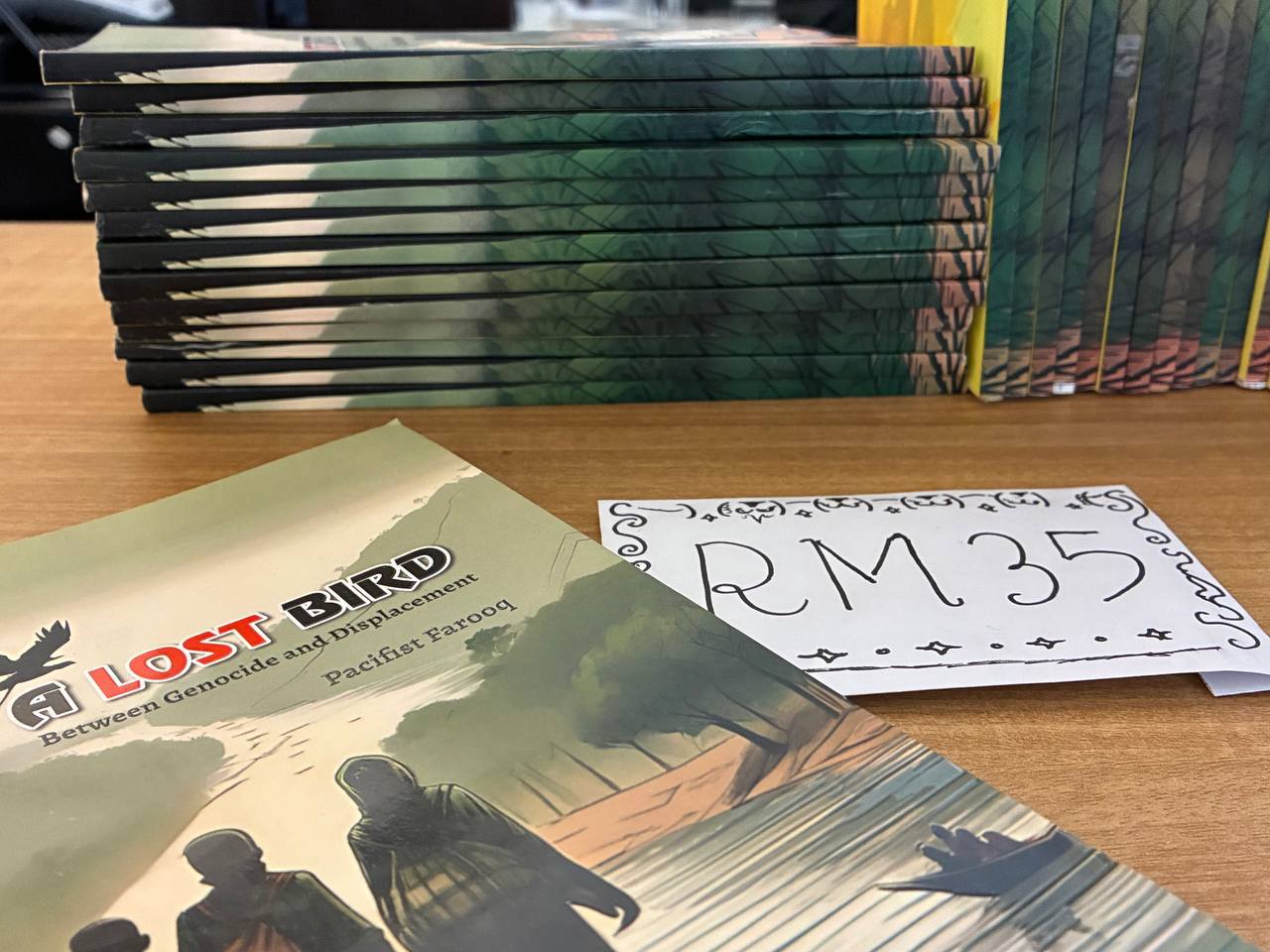
Love, exile and dreams. In A Lost Bird, Rohingya poet Pacifist Farooq responds to the dehumanisation of his people with remarkable humanity and poetic restraint.
Pacifist Farooq dedicates A Lost Bird: Between Genocide and Displacement to his mother and six sisters and begins by establishing faith, family, prayer, and love.
Much like its individual poems, the book warms the reader with familiar images before making them sit in the frankness and discomfort of experiences so extreme many would scarcely have the framework to connect with without real craft.
A Rohingya from Myanmar’s Rakhine State, Farooq fled the 2017 clearance operations by Myanmar’s military and wrote much of this 2024 collection in Cox’s Bazar’s refugee camps.
Death threats forced him on to Malaysia in October 2024.
Min Aung Hlaing, who commanded the 2017 operations, is now president, recently welcomed by Malaysia and engaged in renewed U.S. talks, despite Washington’s 2022 determination that the military committed genocide.
And so Farooq’s poetry feels as relevant as ever.
Considering the real Kafka-esque journey of its author, there is a sense that A Lost Bird has much more bubbling under its pages; disbelief, yearning, anger; ready to burst out.
Although sometimes pointed, Farooq for the most part delivers his experiences in keeping with a greater message: the commitment to grace in the face of malevolence.
“Someone; God gifted”, is underpinned by grief and loss, yet it is a poem which feels far more concerned with the sheer power of love.
Elsewhere that love is expressed in ordinary moments, made extraordinary by the conditions imposed on him and his people.
“Bullet, kill no more of my friends
(I cannot play football alone).”
Farooq conveys that feeling of looking over at the other side, noticing unequal treatment, blocked paths, and wondering: why? What’s different about me and them?
It’s this hazy influence of unseen forces, hard to understand, that forms perhaps the most poetic theme connecting Farooq’s work.
A sense, both metaphorical and physical, of being trapped in a waking state.
Disbelief, confusion, tiredness, unrealised dreams, the uncanniness of seeing contemporaries experience an easier reality.
Like labouring to run waist-deep in thick liquid, neither asleep nor awake, neither here nor there.
“Am I not tortured more than Tantalus?” Farooq asks in “Airport”, recounting his blocked attempt to travel abroad despite holding a passport, visa and ticket.
Home, education, and freedom remain tantalisingly close, yet somehow out of reach.
The lost bird wanders from place to place, sometimes here, sometimes there, without a permanent nest.
And the nest he remembers may no longer be there.
The U.N. has recently documented the Arakan Army’s continued seizure of Rohingya homes and land, the destruction of villages and the renewed displacement of those who remained in Rakhine.
In “History”, addressing rejection, he writes: “I claim you as mine / But you retort with / Differences in skin.”
Poems ostensibly about romantic love, yearning, or betrayal acquire another possible meaning; the lover turning away in “Worst Betrayal of the History” may well be Myanmar.
But there is something more than bitterness in “History”. Farooq pointedly reminds his country that history bears witness, that everyone is shaping it.
Perhaps he believes justice will come in time, or at least that history will remember, and seems content with his own part in the story.
Like old war poems, A Lost Bird in this world is the purity of feeling in that moment of chaos, the innocence of observation, the rarity of vulnerability, the relief of slowing down while everything speeds up around you, the beauty of considered prose in the heat of panic, and how special love is amid hatred.
The book may not win justice for the Rohingya, but it is a win for craft and dignity against hate and apathy.
When cut, Farooq’s response is often not to cut back, but simply to say: you cut me, and the world will judge you.
“I open my chest. Come and stab it.”
Seán Donal Barry is a Scottish-Irish freelance journalist based in Southeast Asia.